No legitimate migration ever needs your seed phrase. Moving crypto off a platform requires a destination address — a public string you paste in. The recovery phrase is not a login; it is the wallet, and whoever holds it owns the funds instantly and irreversibly. MiCA also does not do what these messages claim: it restricts what licensed platforms may offer, not what you may hold. Holding, sending and receiving USDT remain legal.
Here is what makes this one difficult, and worth your attention even if you have heard every scam warning there is.
Most frauds fall apart when you check them. You look up the number, you read the address bar, you ask a question the script does not cover, and it collapses. This one does not collapse, because the person checking finds that nearly everything they were told is accurate. The regulation is real. The delisting is real. Their own exchange really did email them about it. The deadline really is weeks away.
So the useful exercise is not spot the lie. It is audit the message line by line and notice how few lines are actually doing any work.
The truth audit
Below is a recreated version of the message, in the shape people are receiving it. Each line gets one of three verdicts.
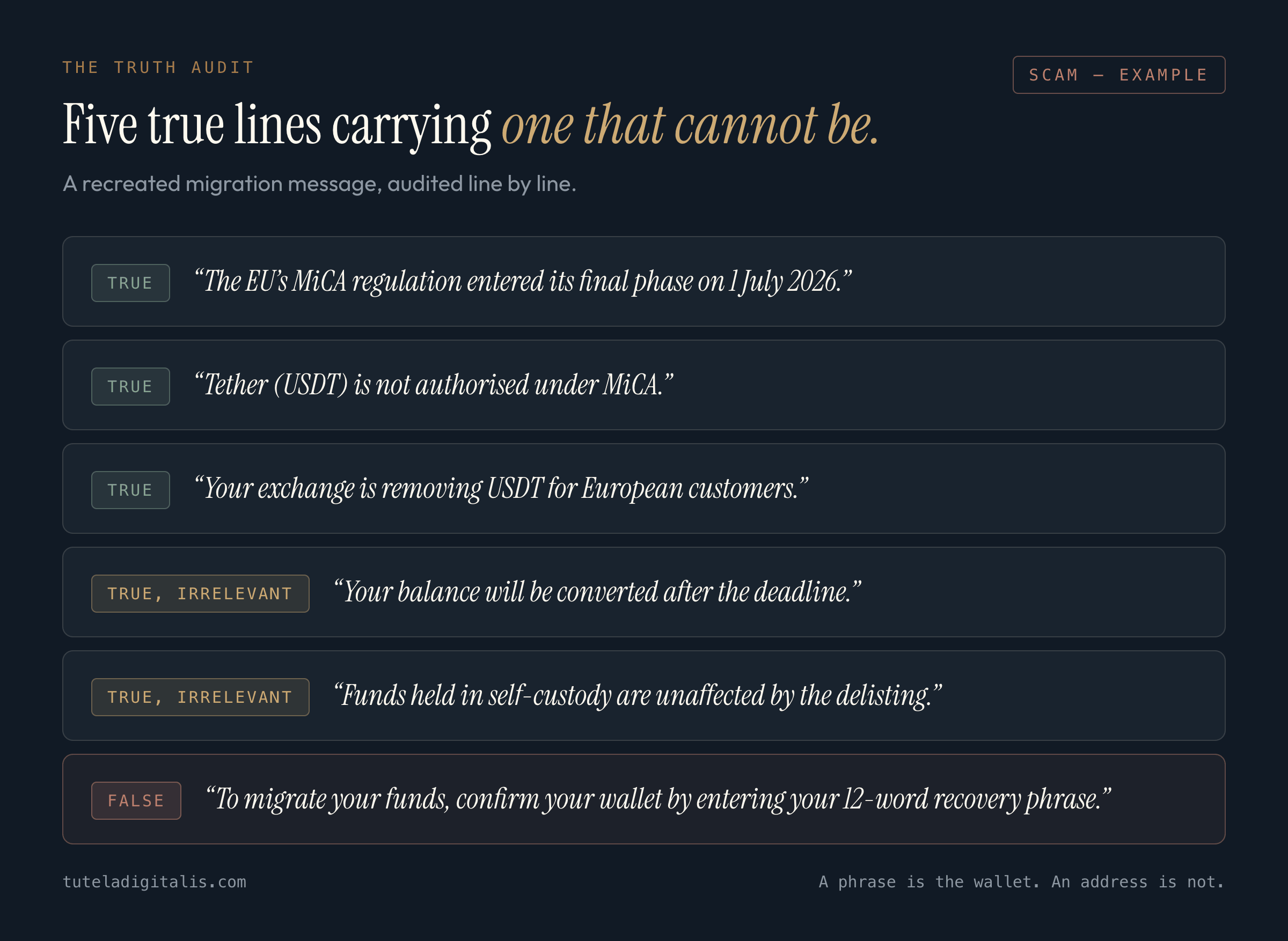
Count the verdicts. Five of the six lines survive scrutiny. A person who checks the first three — the sensible, sceptical thing to do — finds them all correct, and that verification becomes the reason they trust the sixth.
The one line that cannot be true
Everything rests on a distinction most people have never had explained, because nobody explains it until after it has cost them.
To receive crypto, you give out an address. It is a long public string, it is safe to share, and it works like an account number: people can send things to it and can do nothing else with it. Withdrawing from an exchange means pasting that address into a withdraw field.
A recovery phrase is not an address, and not a password. Those twelve or twenty-four words mathematically are the wallet. Type them anywhere and you have not proved ownership — you have transferred it. There is no reversal, no chargeback, no fraud department. The funds move in seconds, usually to a chain of addresses and then into a privacy coin.
What MiCA actually says
The premise collapses the moment you read the regulation rather than the message about it.
MiCA governs what regulated platforms may offer, not what individuals may own. A licensed exchange may no longer list USDT for EU customers because the issuer is unauthorised. That is a rule aimed at the venue. Holding USDT is legal. Sending it is legal. Receiving it is legal. Self-custody is untouched, and decentralised exchanges are outside the perimeter entirely.
Which means the sentence “we must move your funds because we are not MiCA approved” is not a lie about the deadline. It is a lie about what the deadline requires — a real deadline wrapped around a fake premise. Nothing about the regulation obliges you to prove ownership of a wallet to anyone.
The real dates
Note what is not on that list: any platform freezing withdrawals, and any platform requiring a recovery phrase. The pattern across all of them is the same — trading stops, a window stays open to sell or withdraw, and remaining balances convert. Circle’s USDC and EURC are authorised under MiCA and keep their European listings, which is why several venues offer a one-to-one swap.
What to do instead
Go to the platform yourself
Type the exchange address into your browser or use your own saved bookmark. Never use a link from an email, SMS, DM or pop-up, however official the wording looks.
Copy your wallet's receiving address
Open or create your own wallet and copy its public receiving address. This is the only thing the exchange needs in order to send your funds out.
Paste the address into the withdraw field
Use the exchange's own withdraw screen. At no point does a legitimate withdrawal ask for a recovery phrase, private key or wallet password.
Send a small test amount first
Withdraw a small amount, confirm it arrives in your wallet, and only then move the rest. If anything asks for your seed phrase at any stage, stop.
If you would rather not self-custody at all, swapping to a MiCA-compliant stablecoin inside the platform you already use is a legitimate option and involves no wallet, no address and no phrase.
Why this is not a small-holder problem
It is tempting to read seed-phrase theft as something that happens to careless beginners for small sums. The largest single social-engineering theft on record says otherwise.
In January 2026, an attacker impersonating customer support for the hardware-wallet maker Trezor walked a victim through what sounded like a verification process and had them read out their recovery seed. The loss was about $282 million in bitcoin and litecoin — roughly three-quarters of all crypto theft losses recorded that month, from one conversation. The funds were moved through chains of addresses and swapped into a privacy coin. The finding is blockchain investigator ZachXBT’s, and it was reported across the crypto press.
No software was broken. No exchange was hacked. Somebody with enough wealth to buy a hardware wallet, and enough sense to use one, said twelve words out loud to a stranger who sounded official and had a plausible reason to ask.
The wider pattern is documented too. Security researchers at Blockaid tracked five separate campaigns in April 2026 in which operators registered fake “migration” and “revoke” sites within hours of major incidents and mirrored the official guidance on social media — so that users following security advice arrived at the draining site. Those particular campaigns followed hacks rather than the MiCA deadline. The conditions are what matter, and a regulatory deadline supplies every one of them: a genuine event, official-sounding instructions to move assets, a countdown, and a large population unsure how custody works.
The rule that outlives the deadline
Every date on this page will expire. Revolut’s window closes, the delistings finish, the news moves on, and the next real event arrives to be borrowed by the next set of operators.
What does not expire is the distinction. An address is what you give out. A phrase is what you never give out — to anyone, for any reason, ever. A message can be right about the law, right about your exchange, right about the date, and still be the most expensive thing you ever read. Being correct about the context is not the same as being entitled to your wallet.
If a deadline is real, it will still be real in ten minutes, after you have closed the message and gone to the platform yourself.
If you have already entered a recovery phrase, treat it as compromised permanently and move anything remaining to a brand-new wallet with a new phrase. Then work through the emergency steps — speed is the whole game in the first hour. And be ready for the second approach: people offering to trace or recover the stolen crypto for a fee. That is its own industry, and a trace is not a recovery.
Sources & further reading
Every factual claim above links to its source. Click any to verify.