CANADA · THE FALSE RETURN
By Peter · 9 October 2026 · 10 min read
Rogers phone scam: a real phone can still be bait.
A Rogers phone scam can start with a caller offering a cheaper plan or upgrade, then end with a request to return a real phone to the wrong address. The order and delivery can be genuine; they do not authenticate the caller. Stop before sharing a login code or shipping anything. Contact Rogers or Fido through a route you find independently and ask them to verify the offer, order and return.
The unnerving part is that several things can be real at once: your account, the order confirmation, the courier and the expensive phone in your hands. The missing check is the person directing the next step. A real transaction can be recruited into a false story.
The Canadian Anti-Fraud Centre describes cellphone-provider impersonation involving promotions, account access and a false wrong-device return. An Airdrie RCMP warning dated 24 March 2026 documents both genuine orders placed by the customer and account-takeover variants. This article is about that pattern. It is not an allegation that Rogers or Fido is operating the scam.
What should you do at the stage you reached?
Work from the action you actually took. Merely answering a call is different from sharing an account code, creating a financed order or handing a parcel to a courier. More than one of these situations can apply.
You only received the offer
An order was placed, but the phone has not arrived
The phone arrived, or you have a return label
You already shipped the phone
These are protective requests, not promises of cancellation or recovery. Rogers' account-risk guidance also advises changing exposed account credentials and contacting the bank where financial information is at risk. Follow the provider's instructions for your account rather than the caller's proposed fix.
What did a reported fake-return email look like?
In a firsthand account published on 10 July 2026, Chibuikem Ndubuisi describes a caller claiming to represent Rogers who guided him to order through his Fido account. After delivery, the caller claimed the wrong phone had arrived and supplied a return label. The published email added a gift-card and accessory promise to the supposed correction.
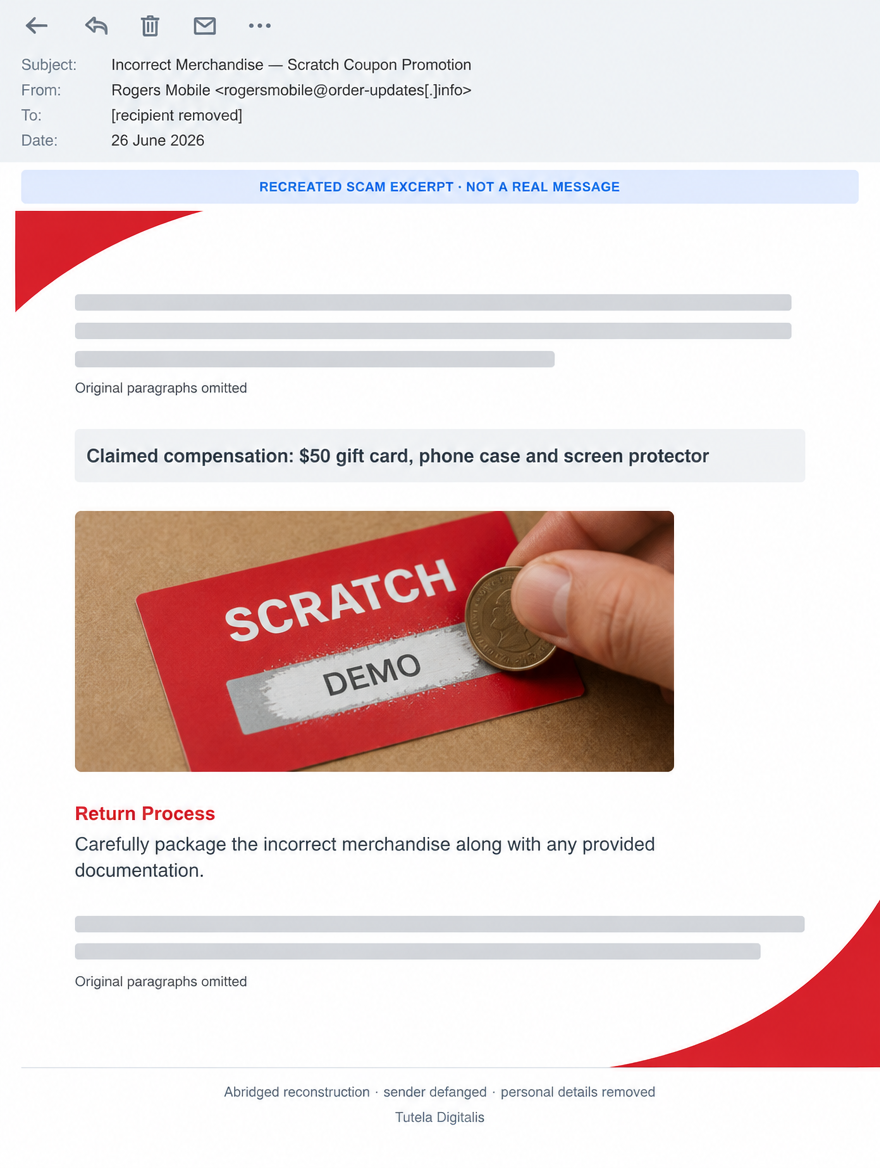
Read the image and its warning signs
The displayed sender uses the defanged address rogersmobile@order-updates[.]info. A familiar display name and copied visual style are not verification. The gift-card promise is part of the purported remedy, not evidence that the return is authorized.
The return excerpt asks the recipient to pack the supposedly incorrect phone and its documentation. That ordinary instruction is dangerous when the return destination has not been independently verified.
The example shows recognition cues from one reported email. Different wording or a different sender does not make another return request safe.
This is one person's published account, corroborating the documented pattern rather than proving every detail of every similar call. The screenshot cannot establish who was behind the operation. There is no need to speculate about an insider to explain the risk.
How does a real order become a false return?
The practical deception is a change in what counts as proof. Your account proves the order exists. The phone proves a delivery occurred. Neither proves that the stranger should decide where it goes next. The following is Tutela's analysis of the documented sequence; each point ends with a check you can make.
STEP 1
The offer gives you a reason to stay
An unexpected caller offers a plan discount or phone upgrade and presents themselves as your provider.
Why it can persuade: Borrowed authority: the familiar company name makes an unfamiliar person seem accountable.
Your check: End the incoming conversation. Ask the provider to verify the specific offer through its independently opened app, official support page or known number.
STEP 2
The real account makes the story feel checked
In one variant, you are guided to place the order through your own provider account. In another, the caller tries to obtain account access or a verification code.
Why it can persuade: The proof shifts: a legitimate website or order becomes supposed evidence that the caller is legitimate too. Those are different questions.
Your check: Do not read out a login or verification code to an unsolicited caller. Read the purpose of any code. Verify the offer before authorizing an order or account change.
STEP 3
The delivery becomes the strongest prop
A genuine new phone arrives. The caller's earlier story appears to have produced a real result.
Why it can persuade: Confirmation: holding the phone can make the whole conversation feel validated, including instructions that have not yet been checked.
Your check: Confirm the device, financing and order with the provider. A delivered phone proves a shipment occurred; it does not prove the caller controls the return process.
STEP 4
The wrong-phone story changes the task
The caller says there was a shipping mistake and asks you to return the device using supplied instructions or a prepaid label.
Why it can persuade: A repair pretext: you are invited to fix an ordinary customer-service problem rather than recognize a new decision about who gets the phone.
Your check: Keep the device while you independently verify the return. Have the provider confirm the authorization and exact destination before using any label.
STEP 5
Compensation makes cooperation feel reasonable
An apology, gift or replacement promise can accompany the return request. The published example shown here contains compensation bait.
Why it can persuade: Reciprocity and continuity: helpful treatment makes finishing the apparent transaction feel natural. It does not authenticate the recipient of the parcel.
Your check: Treat the compensation promise and the return authorization as separate claims. Neither a gift card nor a supervisor on the same call replaces independent verification.
How do you verify the return without trusting the caller?
Open your provider's app or official support page yourself, then start a fresh contact. Ask them to confirm the offer, the device order, whether a return is authorized and the exact destination or label. Keep the reference number for that conversation.
“We'll never contact you about device returns.”
The same official Mobile section explains how customers initiate an approved return and obtain a shipping label. Its page also covers internet and TV equipment, which have different procedures. Use the section for your actual product; do not borrow modem-return instructions for a phone.
| What you see | What it actually establishes |
|---|---|
| A genuine order in your account | An order exists. The caller and their promised promotion still need verification. |
| A real phone and courier delivery | A phone was shipped. A later return request is a separate claim. |
| A prepaid label or tracking number | A shipment can be created. The provider must confirm the return authorization and destination. |
| A gift card, apology or supervisor | More of the same story. Verification must come from contact you initiate independently. |
Do not test a suspicious label by shipping an inexpensive item, and do not treat a residential-looking address as the only possible warning sign. The safer test is the provider's independently confirmed authorization. Genuine third-party logistics arrangements exist; appearance alone cannot authenticate or disprove one.
Where should you report a Rogers phone scam?
Rogers' reporting guidance lists Customer Care for account or fraud concerns: 1-888-764-3771 for Rogers and 1-888-481-3436 for Fido. Suspected Rogers/Fido phishing emails can be forwarded to abuse@rogers.com with the original full email headers and a brief description. If you are a Rogers or Fido mobile customer, suspicious texts can be forwarded to 7726. Those message-reporting routes do not replace contacting support when an order or account is at risk.
For suspected fraud, also use the CAFC's current reporting instructions, and report to local police if you are a victim. Save the timeline, email, caller numbers, order and shipping records. Keep credentials and identity documents out of public posts. The Canadian reporting guide explains the different roles of the national report, local police and complaint routes.
If you are still evaluating a suspicious message, the Canadian scam-text checker can help you organize the warning signs. It cannot verify an account or approve a return. For the wider issue of a caller using information about you, read what a scammer can do with your phone number.
The decisive moment may arrive after everything has looked legitimate. Keep the boundary simple: a stranger's explanation does not authorize the next shipment.
Questions about Rogers phone scams
Is the Rogers phone upgrade scam real?
Canadian authorities have documented cellphone-provider impersonation involving genuine phone orders followed by false return instructions. Rogers is a legitimate provider; the fraud is someone pretending to represent it. A real phone, shipping confirmation or account order can be part of the deception. Verify an unsolicited offer and any return through Rogers or Fido using contact details you find independently.
Can the scam work if I ordered through the official Rogers or Fido website?
Yes. Using the real website authenticates the website, not the caller guiding you. A firsthand published account describes a person placing a genuine Fido order before receiving a false return request. Do not infer that every genuine order came from an authorized offer. Tell the provider accurately who placed the order and what the caller asked you to do.
How can I check whether a Rogers call is legitimate?
End the incoming conversation and start a separate contact through your provider's official app, website, bill or verified support number. Ask them to check the precise offer or order. Caller ID, an account detail, a case number and a transferred supervisor are not independent verification. A promise that the offer disappears when you hang up is a reason to pause, not to bypass the check.
Someone says the wrong phone was sent. Should I use their prepaid return label?
Pause and verify the return with the actual provider before shipping. A carrier logo, tracking number or prepaid label does not establish who authorized the return or controls its destination. Rogers' Mobile return guidance specifically warns about unsolicited device-return contact. Genuine returns still exist, but they must follow the provider's confirmed process for your purchase and device.
What should I do if I gave the caller a verification code?
Contact your provider promptly through a trusted route and explain which code you shared and when. Ask them to check account access, orders, contact changes and any SIM or number-transfer activity. Change compromised credentials through the real service and follow its security instructions. If the code belonged to email, banking or another service, protect that account too; not every code is a telecom login code.
Can I get the phone back after shipping it to the scammer?
Contact the carrier immediately through its official channels and ask whether the shipment can be stopped, held or returned. Eligibility and control over a label vary; interception is not guaranteed. Notify your provider and local police, save the tracking and order records, and file a CAFC report. Do not pay someone who contacts you claiming they can recover the parcel for a fee.
Will Rogers cancel the device charges after I report the scam?
Do not assume a fraud report automatically cancels an order, financing agreement or bill. Ask the provider to investigate and give you a written case reference and decision. Explain accurately whether you placed the order yourself or someone accessed your account without permission. Keep the order, correspondence and shipping records. If the decision remains disputed, use the provider's formal complaint process and the relevant Canadian escalation route.
Sources and review
Reviewed 9 October 2026 against current official guidance. The reconstruction illustrates a publicly reported email; Tutela has not independently authenticated the full personal account. Protective actions depend on your provider, purchase and shipping carrier. No recovery or billing outcome is promised.