IN THE NEWS · INVESTMENT SCAMSUpdated June 17, 20268 min read

SpaceX is finally public. Which is exactly why the "SpaceX stock" offer in your inbox just got more dangerous.

On 12 June 2026, SpaceX completed the largest IPO in history — listing as SPCX at a valuation around $1.75 trillion (CNN, CNBC). For the first time, an ordinary person can actually buy a piece of it. And that is the problem: for years the scam was selling "pre-IPO access" to shares you couldn't buy. Now the pitch — "get SpaceX stock, fast" — finally sounds true, because the stock is real. So when a message offers you guaranteed SPCX returns, which part is the tell?

$1.75tn
SpaceX IPO valuation, 12 Jun 2026 (SPCX) — the largest in history (CNN/CNBC)
247
Elon Musk impersonation scam reports to the FTC in 9 months (AARP)
$220k–$700k
Reported individual losses to Musk-impersonation investment scams (FTC)
0
Legitimate investments that can 'guarantee' your returns
The short answer

Now that SpaceX trades publicly as SPCX (it listed on 12 June 2026), the scam has shifted. For years it sold "pre-IPO access" to shares the public couldn't buy; today it sells fake ways to buy the real stock — bogus "SPCX brokers", cloned trading apps, a "SpaceX Capital" desk that contacted you, and "guaranteed" SPCX returns, often wrapped in a fake Elon Musk endorsement. You deposit into a slick app where the balance climbs, then can't withdraw it. The one rule that defeats every version: you buy a real stock like SPCX only through a regulated broker you went to yourself — never through an app, link, or "desk" that messaged you — and no real investment can promise guaranteed returns. If an offer breaks either, it's a scam. Stop there.

If you have already deposited money and want the emergency steps, skip to if you already paid. With investment fraud, the speed of your first phone call to the bank matters.

Every big, hyped financial event drags a shadow behind it, and scammers read the news faster than regulators can warn about it. The SpaceX listing is the perfect lure precisely because of what's true about it: it is real enough to be believable, enormous enough to be exciting, and closed enough that "exclusive early access" sounds plausible instead of absurd. The scammer isn't selling you a lie about a company that doesn't exist. They're selling you a lie about your access to a company everyone wants.

What's actually true about the SpaceX IPO

Start with the facts, because the scam is built on top of them. On 12 June 2026, SpaceX completed its initial public offering and began trading under the ticker SPCX, at a valuation reported around $1.75 trillion — the largest IPO in history, according to CNN and CNBC. That headline is the engine of every scam message right now.

Two things changed the day it listed. First, the good news the scammers exploit: an ordinary investor can now buy SpaceX — but only one way, through a regulated broker you went to yourself (the same place you'd buy any other share). Second, the catch: the lie that used to be obviously impossible — "buy SpaceX before the public can" — has been replaced by one that sounds completely reasonable: "we'll help you get SPCX." There is still no insider who picked you out of a group chat, no special desk, no app that messaged you first. The stock became real; the shortcut never did.

How the scam uses all of that against you

The fraud is a near-perfect mirror of the real story. Where reality says "buy it the slow, regulated way", the scam says "we'll fast-track you." Where reality says "any investment can lose", the scam says "guaranteed." It typically runs like this:
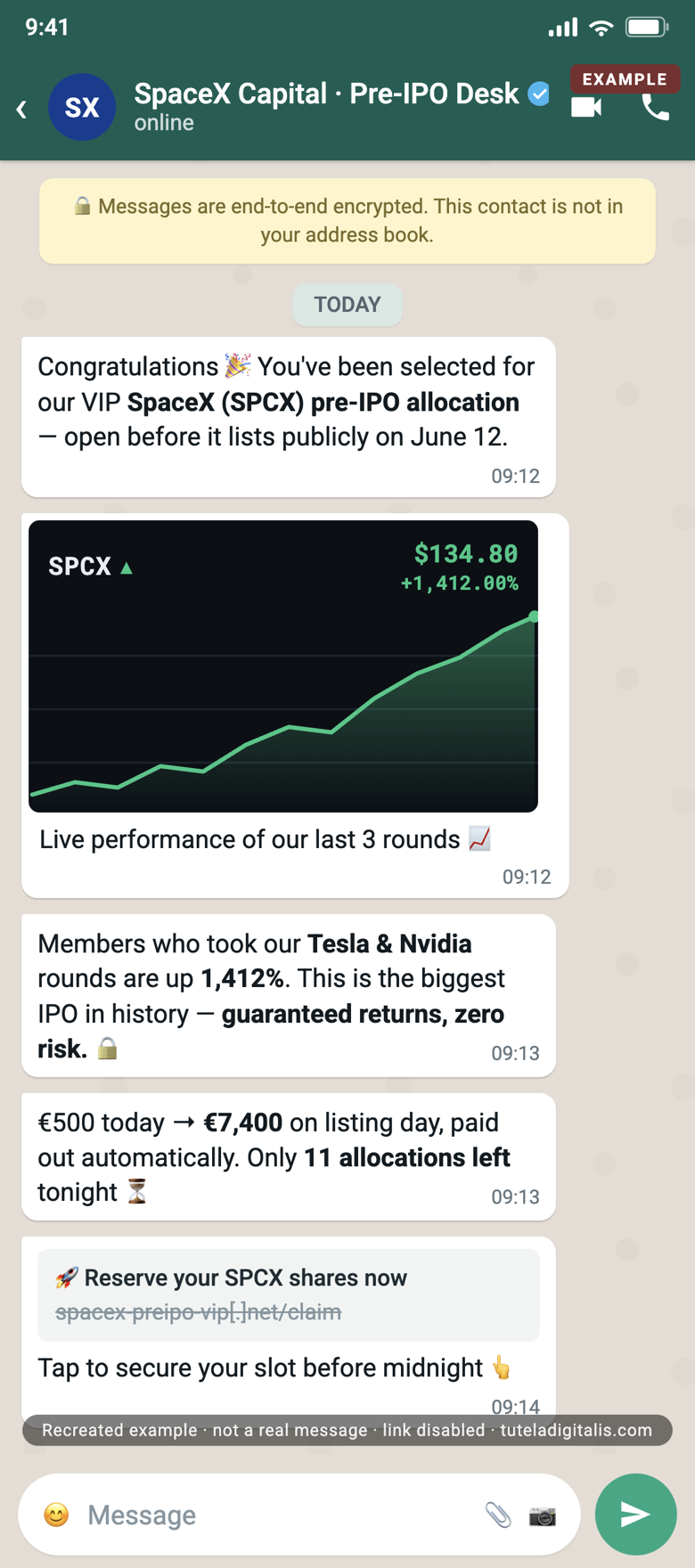
The exclusive invitation. A WhatsApp or Telegram message, an ad, or a 'VIP investors' group tells you you've been selected for early or discounted SPCX — a 'pre-IPO allocation' that supposedly carried over, a 'private placement', or just a faster, cheaper way to buy in than your bank offers. Being chosen is flattering, and flattery lowers your guard.
The borrowed authority. It's branded as a 'SpaceX Capital' or 'pre-IPO desk', often with a fake Elon Musk endorsement, a 'verified' badge, a deepfake clip, or a fabricated news article. None of it is real; all of it is designed to borrow trust SpaceX and Musk have earned.
The proof that proves nothing. A chart rocketing upward, a record of past 'rounds up 1,400%', a dashboard showing your balance climbing. Every pixel of it is free to fabricate.
The impossible promise. Guaranteed returns, zero risk, a fixed payout by listing day — '€500 today becomes €7,400.' No lawful investment talks this way, because no lawful investment can.
The deadline. 'Only a few allocations left tonight.' Manufactured scarcity exists to stop you doing the one thing that kills the scam: pausing to check.
Look at the shape of it. The scam doesn't ask you to believe SpaceX is fake — you'd never fall for that. It asks you to believe that you, specifically, have been handed a door past the rules that apply to everyone else. The flattery is the weapon. The moment an offer's appeal depends on you being special enough to skip the normal, regulated, slow way in, you are not being let in early — you are being set up.
Recreated WhatsApp chat from a fake 'SpaceX Capital SPCX desk' claiming SpaceX is now public and offering a managed SPCX program with guaranteed returns, a fabricated soaring SPCX chart up 1,412%, a 'deposit €500, withdraw €7,400' promise, false urgency about spots left, and a disabled link — an example of the SPCX stock investment scam.
What the pitch looks like now that SPCX is public, recreated. A fake 'SPCX desk' contact, a fabricated chart 'up 1,412%', a guaranteed deposit-to-payout offer and a midnight deadline. Example only — not a real message, the link is disabled. A real stock you buy yourself through a regulated broker, never through a desk that messaged you.

The two rules that defeat every version of it

You do not need to evaluate the chart, research "SpaceX Capital", or work out whether the verified badge is genuine. Two rules settle it before any of that:

You buy a real stock through a broker you went to yourself — never through a 'desk' that contacted you. SPCX trades on a public exchange now, so you buy it the same boring way as any share: through a regulated brokerage you opened yourself (check it against the SEC/FINRA BrokerCheck in the US, the FCA register in the UK, your national authority elsewhere). An unsolicited offer to 'get you SPCX' — however official the app or badge looks — is the one channel a real share purchase never uses. The delivery method alone is the verdict.
No real investment can guarantee returns. 'Guaranteed', 'risk-free', and a fixed sum by a fixed date are not features of a good opportunity. In legitimate finance they are illegal to promise — which is why only scammers say them.

If an offer breaks either rule — and the "we'll get you SPCX" pitch breaks both — you have all the information you need. Don't engage, don't deposit "just a little to test it", don't click the link. Walk away.

How to protect yourself

1Remember a real stock is bought through a broker you went to yourself. SPCX trades publicly now, so you buy it the same boring way as any share — through a regulated brokerage you opened and walked into yourself. Nobody legitimate sells it to you through a DM, an ad, a group chat, or an app that messaged you first. If someone contacted you offering to 'get you SpaceX', you already know enough to stop.
2Treat 'guaranteed returns' and 'zero risk' as the alarm, not the attraction. Every real investment can lose money, and it is illegal in most countries to promise otherwise. 'Guaranteed', 'risk-free', and a fixed payout by a fixed date are not signs of a great opportunity — they are the single clearest signature of an investment scam. The bigger and more certain the promise, the faster you should leave.
3Distrust the chart and the track record. A green chart rocketing upward and a list of past 'rounds up 1,400%' cost the scammer nothing to fabricate. Screenshots, dashboards, and 'live performance' figures are props. Never let a picture of profit stand in for a regulated, verifiable record.
4Verify any IPO only through a regulated broker. If you want exposure to a company when it genuinely lists, you buy it through a licensed brokerage you went to yourself. Check the firm against your national regulator's register (the SEC/FINRA BrokerCheck in the US, the FCA register in the UK, your national authority elsewhere). Never follow a link supplied inside the pitch.
5A celebrity endorsement or verified badge is not verification. Elon Musk is the most impersonated figure in this category of fraud — fake ads, deepfake videos, cloned 'verified' accounts and invented news stories. Seeing his name or face attached to an offer should raise your suspicion, not lower it.
6If you already deposited: stop, refuse the 'withdrawal fee', report fast. Do not send another cent — especially not the fee they claim will unlock your balance. Screenshot everything, tell your bank immediately, and report to IC3.gov and reportfraud.ftc.gov (or your national equivalent). Speed gives you the only real chance of a recall.

If you already paid — the emergency steps

If you deposited money, treat it as urgent and move in this order:

1Stop paying immediately — and refuse any "withdrawal fee", "tax", or "release fee" they say will unlock your balance. That fee is a second scam; paying it never frees the money.
2Call your bank or card provider now, report it as fraud, and ask them to attempt a recall or chargeback. With a card or recent transfer, speed is everything.
3Screenshot everything before it disappears — the chat, the platform, the profile, and any crypto wallet addresses or bank details you sent to.
4Report to the FBI's IC3 and the FTC — or use our international reporting directory if you are outside the US.
5If you paid in cryptocurrency, give the wallet addresses to investigators — the blockchain trail is sometimes traceable, and exchanges can occasionally freeze funds.
6Change any passwords you reused, and watch for the follow-up: a "recovery" contact promising to get your money back for a fee.
Then expect the second approach. People who have just lost money to an investment scam are sold on to other criminals as a known, vulnerable target. Within days, someone may contact you claiming to be a lawyer, a regulator, a "blockchain investigator", or a fund-recovery service that can claw your money back — for an upfront fee. No legitimate body ever charges you in advance to recover stolen funds. The recovery offer is the same trap, a second time.
From the field. The people who fall for this are not greedy or gullible — they're optimistic about something real. SpaceX is extraordinary; the listing is historic; wanting a piece of it is completely rational. The scammer's only trick is to convince you that the rules everyone else plays by don't apply to you tonight. That's why "be smarter" is the wrong defence. The right one is a single fixed habit: you buy investments by going to a regulated broker yourself — never by accepting an offer that came to you first. Hold that line and there is nothing for the pitch to grab.

The one rule

If you take one habit from this piece, take this: nobody can "get you" SpaceX stock through a message, and no real investment can guarantee your return. SPCX is real now, and it's buyable the ordinary, regulated way — through a broker you walked into yourself. Anyone messaging you a faster, surer door is selling the door, not the stock.

Been offered SpaceX (SPCX) shares — and not sure if it's real? Ask before you deposit.

Describe the offer and what you've been told. A real expert reviews every case and replies within 24 hours — free, confidential, nothing to sell.

Submit a free case review →Already lost money? Avoid the second scam →

Common questions about the SpaceX pre-IPO scam

Can I buy SpaceX stock now, and is it safe?

Yes — SpaceX completed its IPO on 12 June 2026 and now trades publicly under the ticker SPCX, at a valuation around $1.75 trillion, the largest listing in history (CNN, CNBC). So buying it is genuinely possible — but only one way is safe: through a regulated brokerage you open and go to yourself (the same place you'd buy any share), where you can check the firm against the SEC/FINRA BrokerCheck in the US, the FCA register in the UK, or your national authority. You never buy a real stock through a private message, an ad, a Telegram 'investors' group, an app that found you, or a 'SpaceX desk' that contacted you. The fact that SPCX is now real is exactly what scammers are using — the offer finally sounds plausible.

What does the SpaceX stock scam look like now?

Two versions run side by side. The older one still sells 'pre-IPO' or 'discounted allocation' SpaceX shares to people who don't realise it has already listed. The newer one sells fake ways to buy the real SPCX stock: a cloned 'SpaceX Capital' or broker app, a 'private placement' at a special price, or a 'guaranteed' SPCX return — usually via a WhatsApp or Telegram message, a social ad, or a 'VIP' group, often with a fake Elon Musk endorsement or verified badge. Both show you a soaring chart and a climbing balance in a slick app, both add a deadline, and both end the same way: when you try to withdraw, the money was never there.

Now that SpaceX is public, is the scam over?

No — it got easier to fall for. When SpaceX was private, the pitch 'buy SpaceX before everyone else' was impossible on its face, which protected a lot of people. Now that SPCX trades publicly, 'we'll help you get SpaceX stock' sounds completely reasonable, so the same crews simply pivoted to impersonating brokers, trading apps and 'allocation desks'. The defence didn't change: a real share purchase only ever happens through a regulated broker you went to yourself, and no legitimate investment guarantees a return. If either is missing, it's a scam.

They showed me Elon Musk endorsing it, or a 'verified' account — isn't that proof?

No. Elon Musk is one of the most impersonated people in investment fraud. AARP, citing FTC data, reported that the FTC received 247 Musk-related scam reports in just a nine-month span, with criminals using his image to pitch fake investments — and individual victims losing between $220,000 and $700,000. Scammers fake his face, his voice (deepfakes), 'verified' social accounts, and fake news articles. An endorsement, a blue check, or a screenshot of Musk is not verification — it is the bait.

I already sent money to a pre-IPO 'platform' — what do I do now?

Move quickly. Stop all further payments, and do not pay any 'withdrawal fee', 'tax', or 'release fee' they demand to free your balance — that is a second scam layered on the first, and the money never comes out. Screenshot everything — the chat, the platform, the wallet addresses. Call your bank or card provider to report fraud and try to recall the payment, report to the FBI's Internet Crime Complaint Center at IC3.gov and the FTC at reportfraud.ftc.gov, and if you paid in crypto, give the wallet addresses to investigators. Then ignore anyone who later offers to 'recover' your funds for a fee — that is the predators coming back.

Sources & further reading

Claims in this piece are attributed to these sources. Click any of them to verify.

CNBC — SpaceX's historic IPO plans (~$1.75tn valuation)CNBC — skeptics concerned as Musk comments diverge from IPO filingAARP — bogus ads use Elon Musk's image to steal savings (FTC data)FTC — report fraudFBI — Internet Crime Complaint Center (IC3)

Keep reading