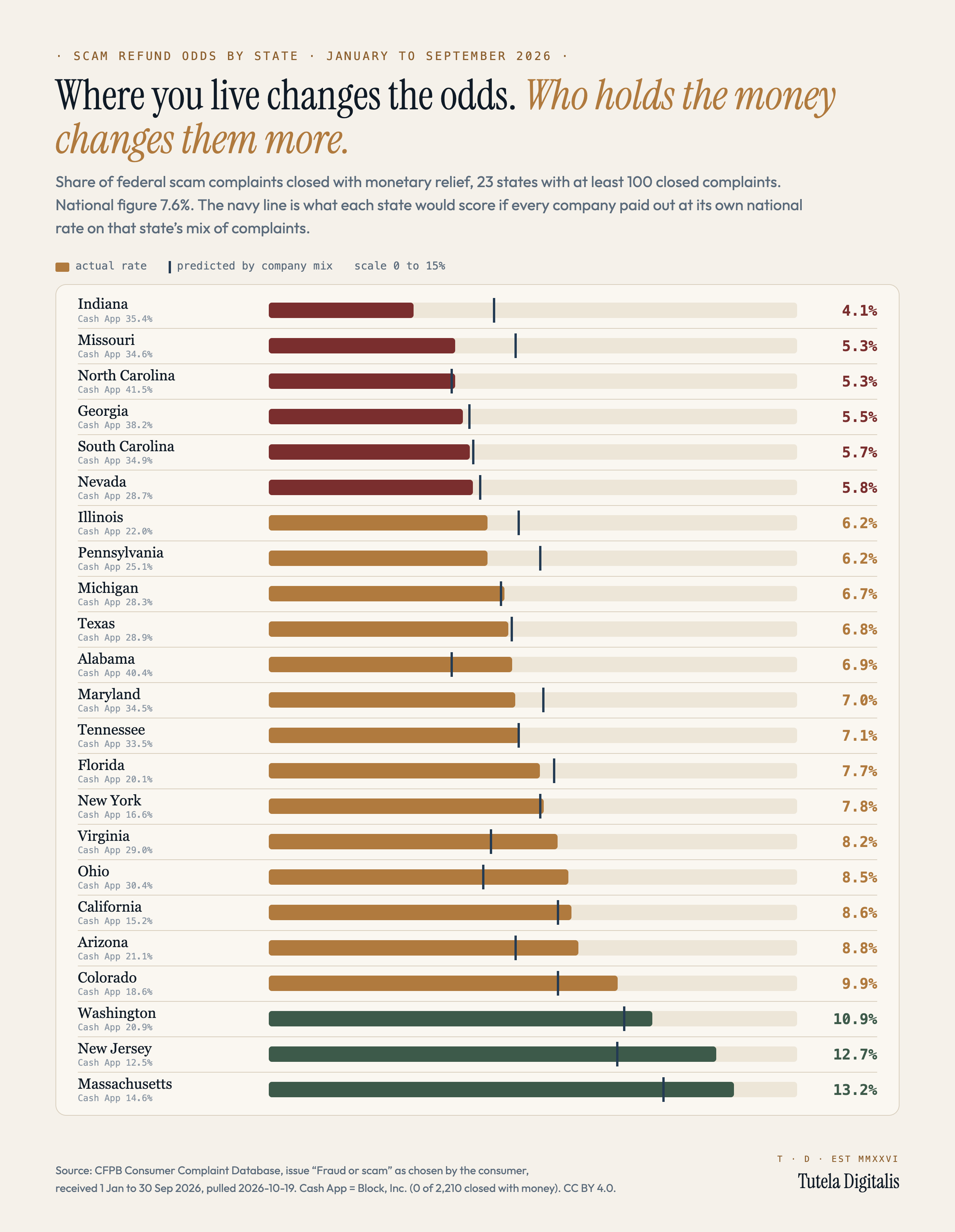
In the federal record for 2026, 7.6% of scam complaints closed with money. Massachusetts came out highest at 13.2% and Indiana lowest at 4.1%. The biggest single factor is the company, not the state: Block (Cash App) closed none of its 2,210 scam complaints with money, PayPal 27.1%. Apply each company’s national rate to a state’s own mix of complaints and you predict most states to within a point or two.
23 states, ranked by how often a scam complaint ended with money
Each bar is the share of a state’s closed scam complaints that ended with monetary relief. The thin navy line is what the state would have scored if every company had paid out at its own national rate on that state’s actual mix of complaints. Only states with at least 100 closed complaints are ranked; every state is listed further down.
The same complaint, sent to different companies, ends differently
The companies with at least 100 closed scam complaints in this period sit far apart. 3 closed none with money: Block (Cash App) (2,210 closed), Early Warning Services, which operates the Zelle network (232), and Western Union (124). At the other end, PayPal closed 27.1% with money and Bank of America 18.1%. Each company picks its own closing label: Block closed all 2,210 of its scam complaints here as “Closed with explanation”, the label it uses for almost every complaint it receives. Some refunds may be recorded under “explanation”, and the public record cannot show that, so a zero means none recorded as monetary relief.
Read every line as what happened to people who escalated to a federal regulator, not as a company’s refund rate. Anyone refunded at first contact never appears here. And a zero can mean a company that holds no account, like a network operator, is structurally unable to pay rather than unwilling; this data cannot tell those apart.
We tested the obvious explanation. Half of it was wrong.
The tempting story is that states with lots of Cash App complaints simply score lower. The correlation is real (r = -0.75 across the 23 states), but it is partly arithmetic: a company that closes every complaint without money pulls any state’s average down. So we removed Cash App complaints and ranked the states again.
Every state moves up, but the gap between them barely shrinks. It is not just Cash App. What does predict a state’s rate is its whole mix of companies. Give every company its own national payout rate, apply it to each state’s actual complaints, and the prediction tracks reality closely (r = 0.82); the mix accounts for roughly 65% of the differences between states. The rest is unexplained here, and we are not going to guess at it.
North Carolina: 5.3%, and almost exactly what its mix predicts
18 of North Carolina’s 342 closed scam complaints ended with money, 5.3%, tied with Missouri for second lowest of the 23 ranked states. 41.5% of the state’s scam complaints named Block, the company behind Cash App, one of the highest shares in the country. The company-mix prediction for North Carolina is 5.2%. In other words, the state’s low rate is what you would expect from who its residents were dealing with, not from anything about North Carolina itself.
For context, and without drawing a connection the data cannot support: on 8 July 2026 North Carolina’s attorney general announced a settlement with Block resolving allegations that it misrepresented Cash App’s safety (NC Department of Justice). The complaints counted here run from January to September 2026.
What these numbers mean for you
- Call your bank or the app the same day. The first contact is where most refunds happen, and none of those appear in this data.
- Escalate to the institution that holds your money, not the network your payment travelled on. Complaints aimed at the Zelle network operator produced no relief at all, in this data and in our Complaint Outcome Index.
- How you paid matters more than where you live. Card payments carry chargeback rights that a transfer you authorised yourself usually does not; our refund checker walks through your options by payment type.
- A federal complaint is free at consumerfinance.gov/complaint. It is a second step, after the company has had its chance.
- Never pay anyone to recover the money. Fee-first recovery offers are the second scam that follows the first.
Every state, in one line each
- Alabama
- 9 of 131 closed scam complaints ended with money (6.9%), below the 7.6% national figure. Cash App was named in 40.4%; the company-mix prediction is 5.2%.
- Alaska
- 19 scam complaints, 19 closed, 0 with money. Too few to rank reliably.
- Arizona
- 14 of 159 closed scam complaints ended with money (8.8%), above the 7.6% national figure. Cash App was named in 21.1%; the company-mix prediction is 7.0%.
- Arkansas
- 82 scam complaints, 78 closed, 3 with money. Too few to rank reliably.
- Armed Forces Americas
- 1 scam complaint, 1 closed, 0 with money. Too few to rank reliably.
- Armed Forces Europe
- 3 scam complaints, 3 closed, 0 with money. Too few to rank reliably.
- Armed Forces Pacific
- 2 scam complaints, 2 closed, 0 with money. Too few to rank reliably.
- California
- 96 of 1118 closed scam complaints ended with money (8.6%), above the 7.6% national figure. Cash App was named in 15.2%; the company-mix prediction is 8.2%.
- Colorado
- 14 of 142 closed scam complaints ended with money (9.9%), above the 7.6% national figure. Cash App was named in 18.6%; the company-mix prediction is 8.2%.
- Connecticut
- 92 scam complaints, 89 closed, 14 with money. Too few to rank reliably.
- Delaware
- 29 scam complaints, 29 closed, 3 with money. Too few to rank reliably.
- District of Columbia
- 28 scam complaints, 27 closed, 3 with money. Too few to rank reliably.
- Florida
- 65 of 844 closed scam complaints ended with money (7.7%), above the 7.6% national figure. Cash App was named in 20.1%; the company-mix prediction is 8.1%.
- Georgia
- 21 of 382 closed scam complaints ended with money (5.5%), below the 7.6% national figure. Cash App was named in 38.2%; the company-mix prediction is 5.7%.
- Guam
- 1 scam complaint, 1 closed, 0 with money. Too few to rank reliably.
- Hawaii
- 28 scam complaints, 27 closed, 3 with money. Too few to rank reliably.
- Idaho
- 45 scam complaints, 42 closed, 1 with money. Too few to rank reliably.
- Illinois
- 19 of 305 closed scam complaints ended with money (6.2%), below the 7.6% national figure. Cash App was named in 22.0%; the company-mix prediction is 7.1%.
- Indiana
- 5 of 121 closed scam complaints ended with money (4.1%), below the 7.6% national figure. Cash App was named in 35.4%; the company-mix prediction is 6.4%.
- Iowa
- 38 scam complaints, 37 closed, 4 with money. Too few to rank reliably.
- Kansas
- 62 scam complaints, 60 closed, 2 with money. Too few to rank reliably.
- Kentucky
- 67 scam complaints, 64 closed, 5 with money. Too few to rank reliably.
- Louisiana
- 100 scam complaints, 99 closed, 8 with money. Too few to rank reliably.
- Maine
- 17 scam complaints, 15 closed, 1 with money. Too few to rank reliably.
- Maryland
- 15 of 215 closed scam complaints ended with money (7.0%), below the 7.6% national figure. Cash App was named in 34.5%; the company-mix prediction is 7.8%.
- Massachusetts
- 20 of 151 closed scam complaints ended with money (13.2%), above the 7.6% national figure. Cash App was named in 14.6%; the company-mix prediction is 11.2%.
- Michigan
- 12 of 178 closed scam complaints ended with money (6.7%), below the 7.6% national figure. Cash App was named in 28.3%; the company-mix prediction is 6.6%.
- Minnesota
- 101 scam complaints, 96 closed, 7 with money. Too few to rank reliably.
- Mississippi
- 61 scam complaints, 59 closed, 1 with money. Too few to rank reliably.
- Missouri
- 8 of 152 closed scam complaints ended with money (5.3%), below the 7.6% national figure. Cash App was named in 34.6%; the company-mix prediction is 7.0%.
- Montana
- 18 scam complaints, 18 closed, 2 with money. Too few to rank reliably.
- Nebraska
- 30 scam complaints, 29 closed, 3 with money. Too few to rank reliably.
- Nevada
- 6 of 103 closed scam complaints ended with money (5.8%), below the 7.6% national figure. Cash App was named in 28.7%; the company-mix prediction is 6.0%.
- New Hampshire
- 15 scam complaints, 14 closed, 4 with money. Too few to rank reliably.
- New Jersey
- 32 of 252 closed scam complaints ended with money (12.7%), above the 7.6% national figure. Cash App was named in 12.5%; the company-mix prediction is 9.9%.
- New Mexico
- 29 scam complaints, 28 closed, 2 with money. Too few to rank reliably.
- New York
- 47 of 602 closed scam complaints ended with money (7.8%), above the 7.6% national figure. Cash App was named in 16.6%; the company-mix prediction is 7.7%.
- North Carolina
- 18 of 342 closed scam complaints ended with money (5.3%), below the 7.6% national figure. Cash App was named in 41.5%; the company-mix prediction is 5.2%.
- North Dakota
- 7 scam complaints, 7 closed, 0 with money. Too few to rank reliably.
- Ohio
- 17 of 200 closed scam complaints ended with money (8.5%), above the 7.6% national figure. Cash App was named in 30.4%; the company-mix prediction is 6.1%.
- Oklahoma
- 81 scam complaints, 78 closed, 6 with money. Too few to rank reliably.
- Oregon
- 83 scam complaints, 80 closed, 9 with money. Too few to rank reliably.
- Pennsylvania
- 18 of 288 closed scam complaints ended with money (6.2%), below the 7.6% national figure. Cash App was named in 25.1%; the company-mix prediction is 7.7%.
- Puerto Rico
- 16 scam complaints, 16 closed, 4 with money. Too few to rank reliably.
- Rhode Island
- 21 scam complaints, 20 closed, 2 with money. Too few to rank reliably.
- South Carolina
- 8 of 141 closed scam complaints ended with money (5.7%), below the 7.6% national figure. Cash App was named in 34.9%; the company-mix prediction is 5.8%.
- South Dakota
- 5 scam complaints, 5 closed, 2 with money. Too few to rank reliably.
- Tennessee
- 12 of 170 closed scam complaints ended with money (7.1%), below the 7.6% national figure. Cash App was named in 33.5%; the company-mix prediction is 7.1%.
- Texas
- 54 of 791 closed scam complaints ended with money (6.8%), below the 7.6% national figure. Cash App was named in 28.9%; the company-mix prediction is 6.9%.
- U.S. Virgin Islands
- 1 scam complaint, 1 closed, 0 with money. Too few to rank reliably.
- Utah
- 53 scam complaints, 52 closed, 3 with money. Too few to rank reliably.
- Vermont
- 8 scam complaints, 7 closed, 1 with money. Too few to rank reliably.
- Virginia
- 19 of 231 closed scam complaints ended with money (8.2%), above the 7.6% national figure. Cash App was named in 29.0%; the company-mix prediction is 6.3%.
- Washington
- 20 of 184 closed scam complaints ended with money (10.9%), above the 7.6% national figure. Cash App was named in 20.9%; the company-mix prediction is 10.1%.
- West Virginia
- 28 scam complaints, 27 closed, 0 with money. Too few to rank reliably.
- Wisconsin
- 82 scam complaints, 80 closed, 7 with money. Too few to rank reliably.
- Wyoming
- 12 scam complaints, 12 closed, 1 with money. Too few to rank reliably.
What this data can and cannot tell you
- The label is the consumer’s. “Fraud or scam” is the issue the person chose when filing; the CFPB does not assign or verify it.
- These are escalated cases. People complain to a federal regulator after the company has had its chance, so first-contact refunds are invisible here.
- The outcome is coded by the company in its response to the complaint, and the CFPB publishes it as reported.
- Volume follows customers. A company with more users gets more complaints; counts are not a measure of how often fraud happens.
- Some complaints are templated. Waves of near-identical payment-app complaints have been reported in earlier years, so treat any single company’s count with care.
- Small states are noisy, which is why only states with at least 100 closed complaints are ranked.
Since 14 August 2026 the CFPB no longer publishes complaint narratives. The Bureau said they were one-sided and could mislead; consumer advocates and reporters, including ProPublica, have described the change as a loss for accountability. The structured fields used here are still published, which is why this count can be repeated by anyone.
We offered Block, Early Warning Services and Western Union the chance to comment on these figures on 19 October 2026. Early Warning replied the same day with a statement attributed to a Zelle spokesperson, which did not dispute any figure. “We don’t hold a user’s money or manage their bank or credit union accounts,” the spokesperson said, adding that consumers who suspect fraud or a scam “should immediately contact their financial institution, as they are required by law to investigate all fraud claims.” We then asked how a complaint that names Early Warning is handled, and whether Zelle’s network rules require banks to reimburse any kind of scam. Early Warning referred us to Zelle’s published Fast Facts page and fact sheets. Those say participating banks must fully reimburse confirmed fraud and must reimburse “certain qualifying imposter scams where the customer authorized the transaction,” without saying which scams qualify, and they do not say how a complaint naming Early Warning is recorded. Zelle’s fact sheet also tells consumers that once they approve a payment, the money “is often unrecoverable.” Block replied before the deadline but asked that its comments not be quoted. Western Union had not replied by the 21 October deadline.
Method, data and how to cite
Source: the CFPB Consumer Complaint Database public API, issue “Fraud or scam”, received 2026-01-01 to 2026-09-30, pulled 19 October 2026. 8,930 complaints, 8,629 closed, 653 closed with monetary relief. The relief rate is closed with monetary relief divided by all closed complaints. “Cash App” means complaints naming Block, Inc. The company-mix prediction applies each company’s national rate to the state’s own complaints; companies outside the 25 largest share one residual rate. This is a different population from our Complaint Outcome Index, which counted complaints whose narrative used the word scam, so its numbers differ.
Free to cite and reuse under CC BY 4.0. Download the full table: scam-refund-odds-by-state CSV.
Suggested citation: Tutela Digitalis (2026). Scam Refund Odds by State, January to September 2026 [Data set]. https://www.tuteladigitalis.com/scam-refund-odds-by-state
Need a state’s figures, a correction, or a quote? Email press@tuteladigitalis.com. We publish corrections.
Common questions
Which state gets scam money back most often?
Among the 23 states with at least 100 closed complaints, Massachusetts had the highest share of scam complaints closed with monetary relief in the Consumer Financial Protection Bureau’s record, 13.2%, and Indiana the lowest, 4.1%. The national figure was 7.6%. These are complaints that reached a federal regulator after the company had been contacted, January to September 2026, so the figures describe escalated cases, not every scam.
Why is North Carolina’s scam refund rate so low?
In North Carolina, 18 of 342 closed scam complaints ended with money (5.3%). 41.5% of the state’s scam complaints named Block, the company behind Cash App, which closed none of its 2,210 with monetary relief nationally. If every company had paid out at its national rate on North Carolina’s actual mix of complaints, the state would have come out at 5.2%. Its low rate is almost exactly what its mix of companies predicts.
Does Cash App refund scam victims?
In the CFPB’s record for January to September 2026, Block, Inc., which operates Cash App, received 2,229 complaints where the consumer chose “Fraud or scam”. It closed 2,210 with an explanation, 19 were still in progress, and none was closed with monetary relief. That is the regulator’s record of escalated complaints, not a statement about every Cash App dispute.
Is it Cash App that makes some states worse?
Only in part. Removing Cash App complaints lifts every ranked state by a few points, but the gap between states survives: without them the range is 6.6% to 15.6%. What predicts a state’s rate is its whole mix of companies, from PayPal at 27.1% to 3 companies at zero. That mix explains roughly 65% of the differences between states.
How can I check these numbers myself?
Every figure comes from the CFPB Consumer Complaint Database public API. Filter to the issue “Fraud or scam”, received 1 January to 30 September 2026, then group by state and by company response. Our pull ran on 19 October 2026. Late complaints keep publishing, so a later pull will differ slightly. The full table is free to download as a CSV.