On 4 August 2026 a federal judge in Arizona granted the FTC a temporary restraining order against Credit Glory and a network of related companies, froze their assets and appointed a temporary receiver. The FTC alleges the operation took nearly $200 million since at least 2016 through upfront and recurring charges that federal law prohibits, that its telemarketers presented themselves as consumers’ own creditors, and that it filed identity theft reports on IdentityTheft.gov for people who were not identity theft victims. The allegations have not been tested at trial and the FTC states that the case will be decided by the court. Meanwhile the company holds 4.4 stars from 10,009 Trustpilot reviews and its site is still taking calls. The one test that settles it in a single step: under the Credit Repair Organizations Act, no credit repair company may charge you before the work is finished.
There is a version of this article that is just the news. A court shut down a big credit repair operation, the number is two hundred million dollars, here are the names. That version is already written in several places and it is accurate.
The more useful article is about a smaller thing. For years, anyone who typed the obvious question about this company into a search box got a reassuring answer. They still do. The reassurance came from the places we are all told to check, and it did not move when a federal judge froze the company’s bank accounts. Understanding why is worth more than the headline, because the headline is about one company and the reassurance problem is about all of them.
The six steps, as the FTC describes them
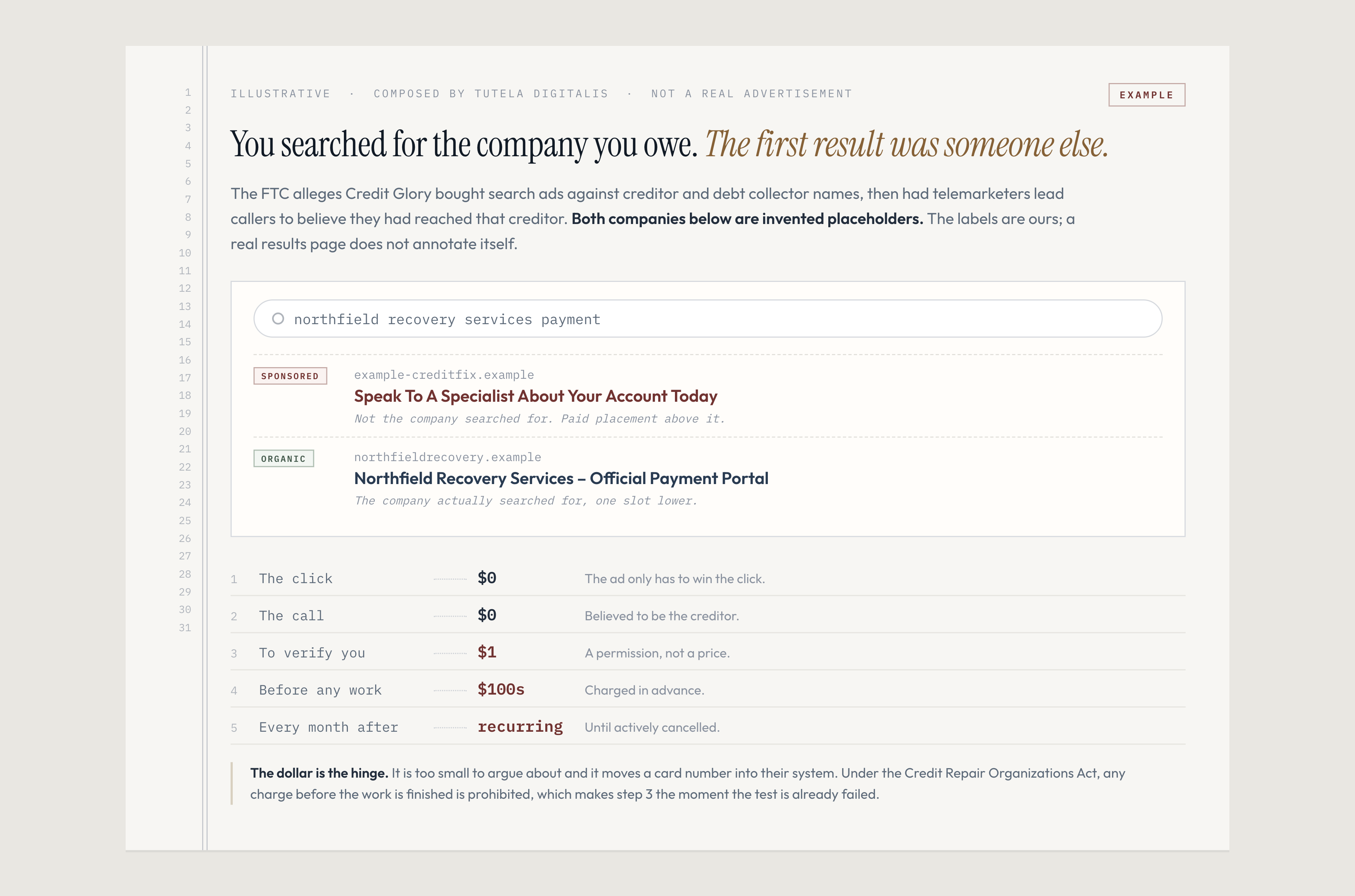
The complaint lays out an acquisition funnel. Read it as one, because that is what it is. Each step has a job, and only the last three cost money.
They bought the ad on your creditor's name
You search for a company you owe money to. The first result is a paid ad. The ad is not your creditor. According to the FTC's complaint, the defendants ran Google search ads to catch people looking up debt collectors and creditors, and in some instances aimed them specifically at servicemembers owing money to military related creditors including the Army & Air Force Exchange Service and USAA.
The person who answered was not who you were calling
The FTC alleges the telemarketers tricked consumers into believing they were speaking with the actual debt collection company or creditor. The person on the phone was helpful. That is the point of the step. You had a question about a specific debt, and someone answered it in a voice that sounded like the institution you were trying to reach.
One dollar, to verify you
The complaint says telemarketers typically asked for a dollar, sometimes describing it as needed to confirm identity or to pull the credit report. A dollar is not a price. It is a permission. It moves a card number from your wallet into their system and it converts a conversation into an account.
Then the real fee, before any work
After the dollar came a second charge, the FTC says typically hundreds of dollars, taken before services were provided. This is the step that is not a judgement call. Charging in advance of performing the service is what the Credit Repair Organizations Act prohibits outright.
And then it did not stop
The FTC alleges recurring charges continued on a negative option basis, often without express informed consent and without clearly disclosing that billing would continue unless cancelled. Telemarketers are said to have promised a few months. Consumers reported being billed indefinitely until they actively cancelled, and the complaint says refund requests were routinely denied.
Some of the disputes were false, and filed as you
This is the allegation that goes furthest. The FTC says that in some instances the defendants disputed legitimate debts and filed identity theft reports on IdentityTheft.gov without the consumer's knowledge, for people who had not been victims of identity theft. IdentityTheft.gov is the federal government's own recovery service for fraud victims. The allegation is that it was used as a tool against the people it exists for.
The Bureau of Consumer Protection’s director, Christopher Mufarrige, described it in the announcement as using paid Google search ads to target and deceive vulnerable consumers, including military servicemembers, through falsely promising to improve their credit.
The one test that does not need a lawyer
Almost everything above is an allegation waiting on a court. One part is not, and it is the part you can use tomorrow on a company nobody has ever written about.
That is the whole test. It is binary, it is free, and it takes one question. The FTC’s complaint alleges Credit Glory failed it twice in the same call, first with the dollar and then with the several hundred that followed.
What the trust signals said, the day after
Here is the part that should change how you check things. Everything in this table was true on 16 August 2026, twelve days after the asset freeze, and every line is a place a careful person would reasonably look.
4.4 out of 5, from 10,009 reviews. Profile claimed since February 2022, badged “Paid Trustpilot subscription”. An AI written summary at the top reports that reviewers overwhelmingly had a great experience.
No mention of the FTC, the complaint, the asset freeze or the receiver.
Rating of B. Not BBB accredited. The stated reason for the rating is 266 complaints filed against the business. Listed CEO is Marko Petkovic, one of the five individuals named as defendants.
No mention of the FTC action. The registered address is a private mailbox in Henderson, Nevada.
A page titled “Credit Glory Review 2025”.
It is a review from last year. Someone asking today whether the company is legitimate is being handed a verdict formed before any of this was filed.
Still live. Still headed “Top Rated Credit Repair Service”. Still lists a phone number to call.
No notice of the court order. This is permitted: the order leaves that decision to the receiver. See below.
The obvious conclusion is that the reviews must be fake. Resist it, because it is the weaker explanation and it lets the real one escape.
A star rating measures how an interaction felt. The FTC’s complaint is not about rudeness. It alleges illegal fees, telemarketers presenting themselves as your creditor, and billing that outlasted what people were told. A representative can be patient and genuinely helpful on the phone while the charge that follows is unlawful. Those two facts do not contradict each other, which is exactly why ten thousand satisfied reviews can sit on top of a federal complaint without anybody lying. Trustpilot says on that same page that it does not fact check reviews. It is telling the truth about what it is. We are the ones who read a rating as a verdict on legality when it was only ever a verdict on service.
The BBB entry is the same lesson from the other direction. A rating of B, sitting directly on top of the sentence explaining that 266 complaints have been filed. The complaints were visible the whole time. The letter grade was doing the talking.
Why the website is still up
As of publication, creditglory.com loads normally, still describes itself as a top rated credit repair service, and still lists a phone number. It would be easy, and wrong, to read that as somebody ignoring a judge.
The order directs that the domains be handed to the receiver, naming creditglory.com, creditsage.com, creditjoy.com, creditclerk.com and standardscores.com. What happens next is left to the receiver’s judgment: if the business cannot be continued legally and profitably, the receiver is to take steps so the sites cannot be reached by the public, or are modified for consumer education purposes, and the same for the phone numbers. A live site twelve days in is consistent with that. It is a decision that has not been made yet, not an order being broken.
It does mean something for you, though. Until that decision is made, somebody searching this company today lands on marketing rather than a notice, and nothing on the page tells them a court has frozen the company’s assets.
If you are being charged right now
What is not settled
A temporary restraining order is an emergency measure, not a verdict. The court found good cause to believe the defendants violated the FTC Act, the Credit Repair Organizations Act, the Telemarketing Sales Rule and several other statutes, and that the FTC is likely to prevail. That is a real finding and it is not a final one. The FTC’s own notice says the case will be decided by the court, and the defendants have not had their answer heard. Nothing here should be read as a finding that any named individual committed a crime.
One small thing, since precision is the point of this site. The FTC’s announcement calls the network 17 related companies in one sentence and 16 related entities in the next. The defendant list carries 15 distinct company names, one of which is separately incorporated in three states. All three numbers can be defended depending on what you are counting, which is a fair description of why these structures are built this way in the first place.
Federal Trade Commission — Credit Glory case page, complaint and order ↑Federal Trade Commission — Credit Repair Organizations Act, including the advance-fee prohibition at 15 U.S.C. § 1679b(b) ↑Questions people are actually asking
If you are trying to check a company that nobody has written about yet, the reviews will not tell you and the rating will not either. Ask when the money is due. On credit repair, the law already answered that one for you. Our glossary covers the terms these calls tend to use, and recovery scams is worth reading before anyone offers to get this money back for you.