The UAE's routes in 2026: in Dubai, report online fraud through the Dubai Police eCrime portal (ecrime.ae — a verified UAE Pass account is required); in Abu Dhabi, use the Abu Dhabi Police Aman service on 800 2626 (or SMS 2828, or the ADPolice app); federally, the UAE Government portal u.ae has a "Report cybercrimes online" page. Call 999 in an emergency. Report scam calls and spam SMS to the regulator, TDRA. Check that any investment or crypto firm is licensed by the Central Bank, the SCA, the DFSA, the FSRA or VARA before paying. Escalate a bank's refusal — free — to Sanadak, the Central Bank's independent ombudsman unit. On refunds: if a payment was unauthorised the Central Bank's consumer-protection framework backs you (and from July 2025 banks must fully refund 3D-Secure SMS-OTP card fraud), but money you were deceived into authorising yourself is generally not refundable, because the UAE has no UK-style mandatory-reimbursement rule.
Read the image explanation
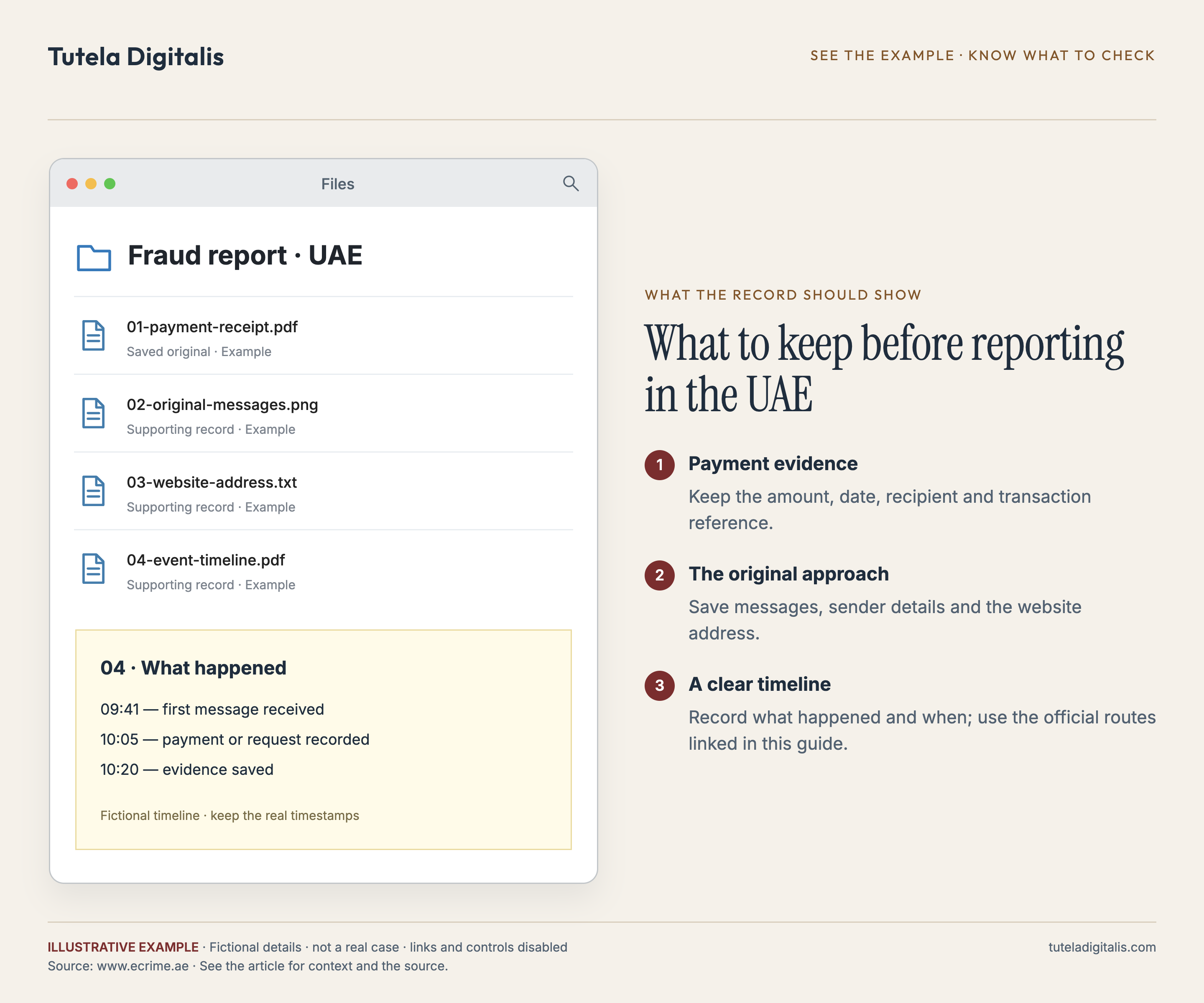
Illustrative example: Fraud report · UAE 01-payment-receipt.pdf 02-original-messages.png 03-website-address.txt 04-event-timeline.pdf
- Payment evidence. Keep the amount, date, recipient and transaction reference.
- The original approach. Save messages, sender details and the website address.
- A clear timeline. Record what happened and when; use the official routes linked in this guide.
If you have been scammed in the UAE, two things matter most in the first 24 hours: stopping any further loss and creating a record while the evidence still exists. Everything downstream — which portal, which emirate, which refund argument — depends on getting those two right. The complication is that the UAE has no single place to report and no automatic refund for a transfer you authorised, so the order below is built to be the fastest path through a system with several separate doors.
If you are reading this with a transaction you already regret, skip to if money has already moved. A same-day bank recall is sometimes the only thing that works.
The hard truth first: the UAE increasingly refunds the hack, not the con
This matters most, because it sets your expectations correctly before you spend a week chasing the wrong outcome.
UAE rules draw a sharp line between two kinds of loss. If a payment was unauthorised — someone used your card or got into your account without permission — the Central Bank of the UAE's Consumer Protection framework is on your side, and UAE courts have ordered banks to refund unauthorised transfers. The Central Bank went notably further in 2025: from July 2025, banks must fully reimburse customers for 3D-Secure card fraud that was authenticated by an SMS one-time password — part of a wider regulatory shift away from SMS OTPs as a security method.
But if you authorised the payment yourself because you were deceived — you logged in and sent the transfer because a convincing "bank officer" or "investment adviser" told you to — that is legally a valid instruction, and the mandatory-refund logic does not apply. There is no UAE equivalent of the UK rule that forces banks to reimburse this kind of authorised-push-payment fraud.
There is no single front door, it is split by emirate
This is the detail that catches people out. The UAE has no single national fraud-reporting portal of the kind the US (IC3) or the UK (Report Fraud) run. The criminal report goes to the police force of the emirate you are in, with a federal layer on top.
The full UAE reporting directory, by scam type
Different scams route to different specialists. Using the right one matters more than reporting to all of them.
If money has already moved: the first 24 hours
Speed is the whole game, especially in the UAE where there is no automatic refund to fall back on for a transfer you authorised. This is the maximum-recovery order:
The UAE numbers, and why losses per victim are the world's highest
The UAE is not an average fraud market. A few figures, all from named sources, explain why:
The habits that keep you out of the reporting machinery entirely
Reporting is downstream. Prevention is upstream, and three habits stop most UAE scams cold:
If you are unsure whether something is a scam before any money moves, the fastest second opinion is the Scam Checker on this site, or our free case review. Both are read by a human and answered within 24 hours.
One rule, end to end
If you take one habit from this piece, take this: any unsolicited call, text, or message that pressures you to move money or share a one-time password is a scam until you have hung up and verified it by contacting the institution on a number you already trust. In a market where the average crypto victim loses tens of thousands and a transfer you authorised has no automatic refund, that one pause is worth more than the entire reporting machinery downstream of it.
In the UAE and not sure where to start? Let's look at it together.
Describe the message, the call, the transaction. A real expert reviews every case and replies within 24 hours. Free, confidential, no pressure.
Common questions about reporting a scam in the UAE
Is there one place to report all scams in the UAE?
No — the UAE's reporting map is split by emirate plus a federal layer. In Dubai, report online fraud, hacking and identity theft through the Dubai Police eCrime portal at ecrime.ae (a verified UAE Pass account is required, and you get a case number to track it). In Abu Dhabi, use the Abu Dhabi Police Aman service on 800 2626 (or SMS 2828, or the ADPolice app), which has a dedicated scam-and-fraud category and keeps your identity confidential. Federally, the UAE Government portal u.ae has a 'Report cybercrimes online' page that routes you to the right channel. In an emergency, or while money is still moving, call 999. Tell your bank in the same hour. The practical order: bank first, then the police channel for your emirate, then the specialist body that matches the scam.
Will my UAE bank refund money I lost to a scam?
It depends on one distinction. If the payment was unauthorised — someone used your card or got into your account without your permission — the Central Bank of the UAE's Consumer Protection framework is on your side, and UAE courts have ordered banks to refund unauthorised transfers. The Central Bank went further in 2025: from July 2025, banks must fully reimburse customers for 3D-Secure card fraud that was authenticated by an SMS one-time password, part of a wider move away from SMS OTPs. But if you authorised the payment yourself because you were deceived — you sent the transfer because a convincing 'bank officer' or 'investment adviser' told you to — that counts as a valid instruction, and the UAE has no rule forcing banks to reimburse this kind of authorised-push-payment fraud. So UAE banks increasingly refund the hack, but not the con. Report it fast anyway: speed is what gives a same-day recall any chance.
How do I report a fake online shop, phishing message, or scam call in the UAE?
If money or your card details were involved, tell your bank immediately so it can watch the account and attempt a recall, then file the crime through your emirate's police channel — the Dubai Police eCrime portal (ecrime.ae) in Dubai, or the Abu Dhabi Police Aman service (800 2626) in Abu Dhabi. Scam calls and spam SMS can also be flagged to the Telecommunications and Digital Government Regulatory Authority (TDRA), the federal regulator that works with operators to block fraudulent numbers, and most UAE telecoms let you forward a spam SMS to a short reporting code. If you only spotted a scam without losing anything, reporting it still helps the authorities map the campaign.
How do I check whether an investment or crypto platform is legitimate in the UAE?
Confirm the firm is licensed before you send a dirham. Financial firms are regulated by the Central Bank of the UAE, the Securities and Commodities Authority (SCA), and — inside the financial free zones — the DFSA in the Dubai International Financial Centre and the FSRA in Abu Dhabi Global Market; virtual-asset providers in Dubai are licensed by VARA. If a 'broker' or crypto platform is not authorised by the relevant regulator, that is your answer. This matters acutely in the UAE: Chainalysis found UAE crypto-scam victims lost almost US$80,000 each on average in the first half of 2025 — the highest per-victim loss of any country it measured. The dominant pattern is a polished investment ad or a stranger on a messaging app promising guaranteed returns.
Where can a scam victim escalate or get help in the UAE?
If your bank or an insurer mishandles your case, you can escalate free of charge to Sanadak — the UAE's first independent Financial and Insurance Ombudsman Unit, launched in March 2024 under the Central Bank, which took over the complaint-handling the Central Bank's Consumer Protection Department used to do. Complain to your bank first with evidence; if it is unresolved or the answer is unsatisfactory, take it to Sanadak. None of these channels — your bank, the police, the Central Bank, or Sanadak — will ever charge an upfront fee to 'recover' your money. Anyone who does is running the second scam.
Sources & further reading
Every figure in this piece is drawn from these authorities. Click any of them to verify.