A ready-to-post scam alert for your members, every Monday.
Each week we pick a scam that is hitting members now, check every fact against a government or primary source, and write it up in the formats your team already posts: social, newsletter, website and branch. You add your logo and member service number, run it past compliance, and publish.
What arrives each Monday
- A 60-second brief for marketing and front-line staff: what the scam is, how it works and why members fall for it.
- A social post for Facebook, Instagram and LinkedIn.
- A newsletter or email blurb with a headline.
- A website alert a one-line banner and a short alert page.
- Talking points for tellers and the call center.
- A feed graphic in your colors, with your logo and member service number.
- Sources for every claim linked, so your compliance review is quick.
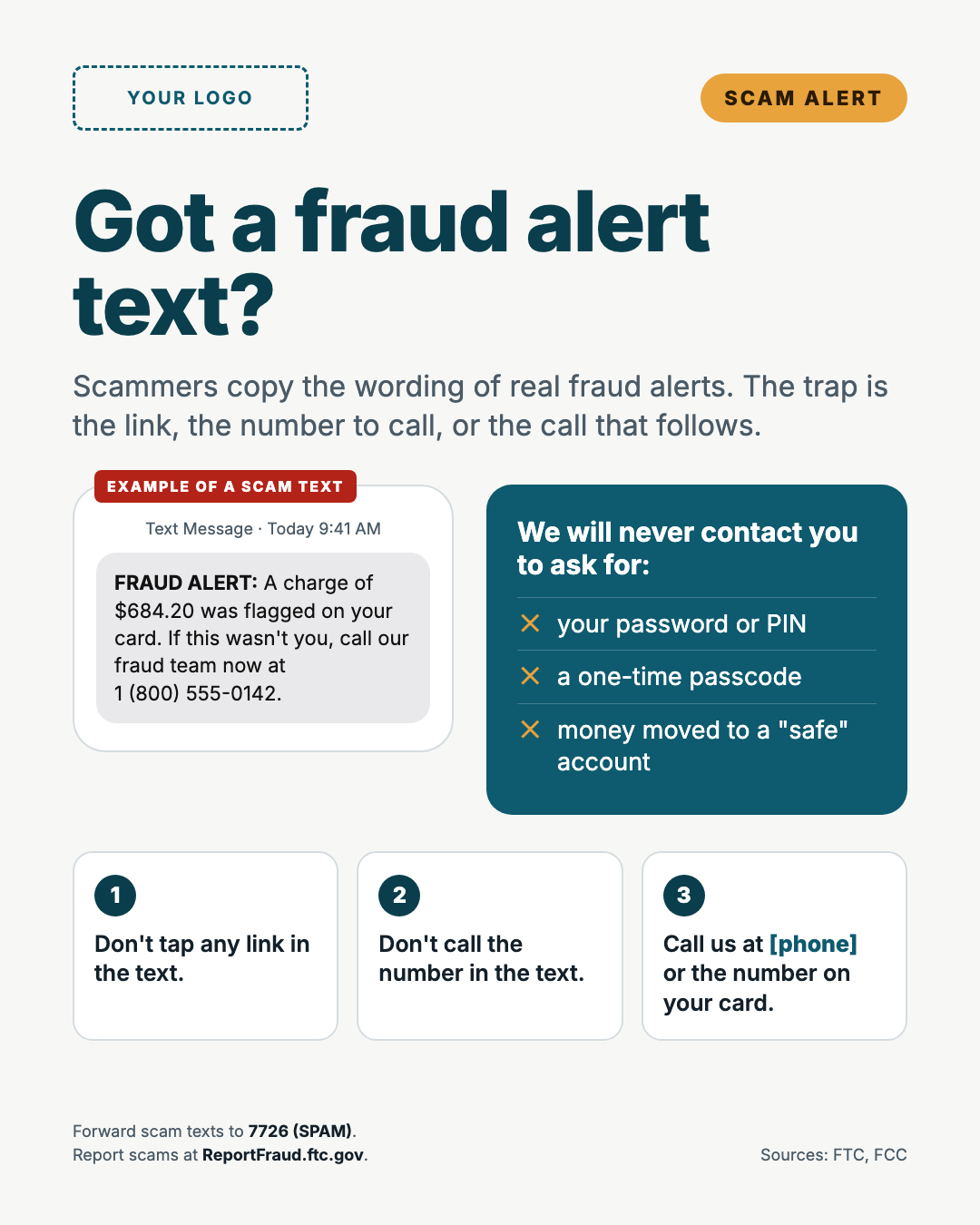
What a kit says, in one line
"We will never contact you to ask for your password, PIN or a one-time code, and we will never ask you to move money to keep it safe. Not sure about a text? Close it and call us at [your number], or use the number on the back of your card."
Kit #1 is built on the FTC's 2024 text-scam data, the FCC's guidance on bank impersonation scams and the FTC's advice to forward scam texts to 7726 (SPAM).
This week's alert, free to post
Kit #1, week of 9 November 2026. Copy it, put in your credit union's name and member service number, and post it, with or without a subscription. A credit to Tutela Digitalis is welcome and never required. The full kit adds the staff brief, a website alert, teller talking points and a graphic with your logo.
Sources: FTC, 16 April 2025; FCC, bank impersonation scams; FTC, reporting spam texts to 7726.
Pricing
Two Monday kits with your logo. No card, no contract. If they don't earn a place in your posting schedule, you owe nothing.
Every weekly kit, branded graphic included. Month to month, cancel any time. Annual plan: two months free.
Everything in Standard, plus two 30 to 45 second vertical videos a month with your logo, for Reels, TikTok, Shorts and lobby screens.
How the pilot works
- Email us your credit union's name, your logo file and your member service number.
- We send this week's kit with your branding, then next Monday's.
- Your team reviews, edits if needed, and posts. If you want to continue, we invoice monthly; if not, that's the end of it.
What we never do
- See or handle member data.
- Put ads, affiliate links or product pitches inside a kit.
- Use fear tactics. Kits are calm and specific, with steps members can act on.
- Let a subscriber pay for coverage or review what we publish on this site.
Who writes it
Tutela Digitalis is an independent scam-education publisher. We have published more than 120 source-checked guides, keep a public corrections log, and publish our research indexes with DOIs under CC BY 4.0. Bing Webmaster Tools counted 31,092 citations of our pages in Microsoft Copilot and partner AI answers between 21 May and 3 November 2026. Since September we have also published 18 short scam-awareness videos on Instagram and TikTok.
Questions
We already use our league's toolkits. Why add this?
Can our compliance team edit the copy?
Do you need any member data?
Which scams do the kits cover?
Who owns the content?
How do we pay?
Does paying you buy coverage on your site?
Start with two free kits
Email Peter at hello@tuteladigitalis.com with your credit union's name, logo and member service number. You'll have this week's kit with your branding on it, and next Monday's after that.
Email us to start