The AT&T settlement has not paid. The silence is doing the damage.
About 4.38 million people filed a claim, then heard nothing for seven months. That is not a gap in the news. That is the most valuable audience a scammer can be handed, and somebody was always going to fill it.
Nobody has been paid because the court has not approved the settlement. The final approval hearing was held on 15 January 2026 and, as of 9 August 2026, no ruling has been issued and no payment date exists. The claim window closed on 18 December 2025 and claim forms are gone. Those two facts settle almost every message you are likely to receive about this: a real administrator is trying to give money away and needs nothing from you, and any offer to file a claim today is fake.
I read scams the way I read a sales pipeline, because that is what they are. The hardest part of any pipeline is not the pitch. It is finding someone who is already expecting the call, has already handed over their details, and is anxious enough to move quickly. That is the expensive part, and it is the part a scammer normally has to guess at.
This settlement built that list for them and then published it. Close to 100 million people were told they might be owed money. About 4.38 million of them raised a hand, filled in a form, and gave a stranger their details in good faith. And then, for seven months, nothing. No ruling, no date, no letter. When the legitimate channel goes quiet for that long, a fake message does not have to be convincing. It only has to arrive first.
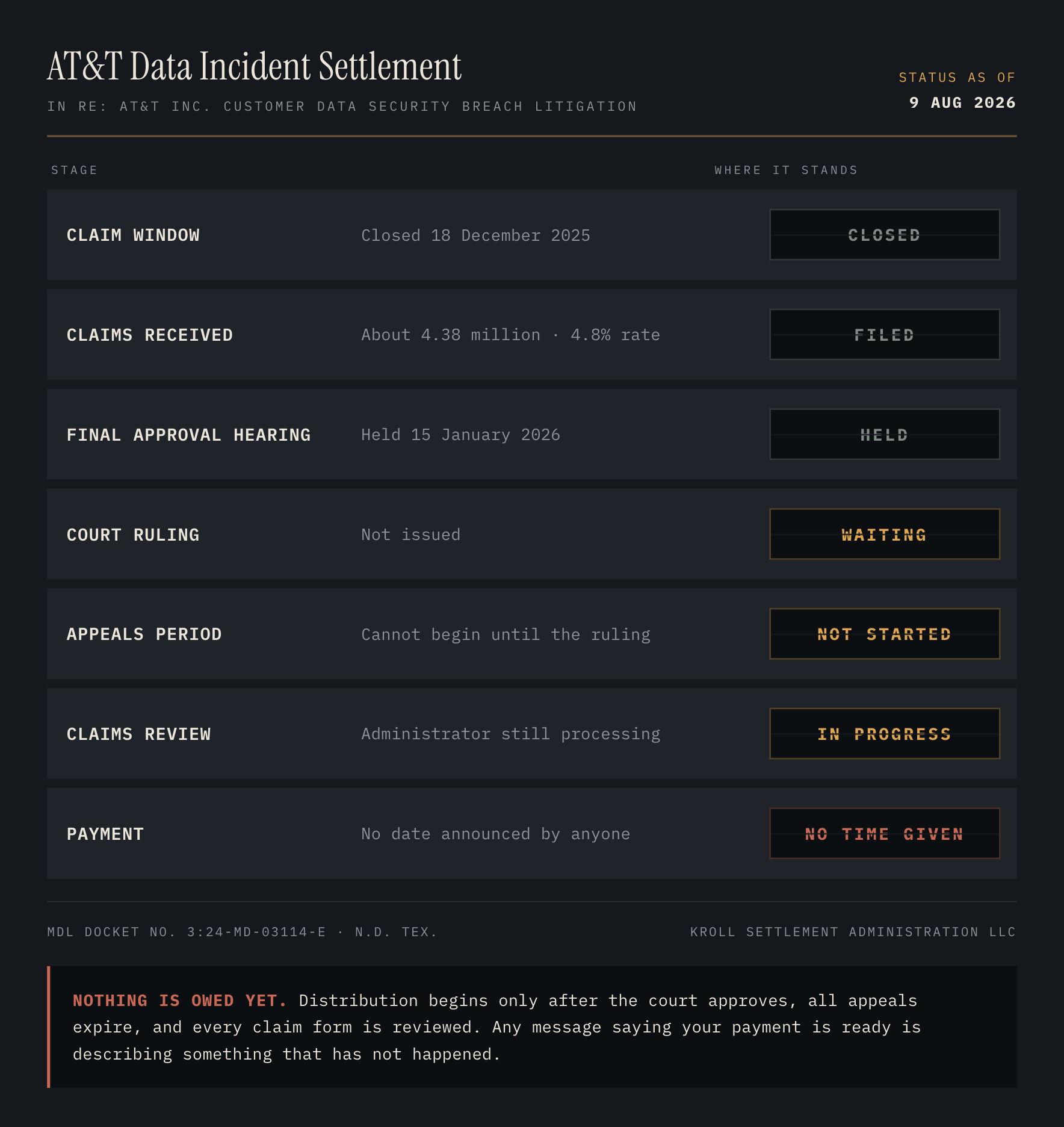
Where this actually stands
The case is In re: AT&T Inc. Customer Data Security Breach Litigation, MDL Docket No. 3:24-md-03114-E, in the United States District Court for the Northern District of Texas, before Judge Ada E. Brown. It resolves two separate 2024 disclosures, one affecting about 73 million people and one about 36.4 million. The fund is $177 million, split into $149 million for the AT&T 1 incident and $28 million for the AT&T 2 incident.
The final approval hearing took place on 15 January 2026. As of 9 August 2026 the official settlement website states that the administrator is reviewing and processing claims “while the Court continues to consider whether it will approve the Settlement.” The site’s own most recent posted update is dated 23 April 2026. Distribution begins only after the settlement obtains court approval, the time for all appeals expires, and all claim forms have been reviewed.
On the money itself: documented losses can be claimed up to $5,000 for the AT&T 1 incident and up to $2,500 for AT&T 2. The widely repeated “up to $7,500” is those two maximums added together, which reaches only someone in both classes with documented losses in both. Where a Social Security number was exposed in the AT&T 1 incident, the settlement sets a Tier 1 payment at five times a Tier 2 payment. What any individual actually receives depends on the claims review, because most of it is a pro rata share.
Official settlement website, AT&T Data Incident Settlement ↑Court-approved settlement notice, $177 million fund ↑Two tests that do not expire
Everything above changes the day the judge rules. These do not. They are the reason this page is worth keeping rather than refreshing.
The four things that are real
There is one of each. Not a main one and some alternatives. If something claims to be the AT&T settlement and is not on this list, it is not a different route to the same place.
What is arriving in the silence
Two different groups are being worked, and they are being told opposite stories. Roughly 4.38 million people filed and are waiting. Something close to 95 million more were eligible and never filed at all. The first group is told their payment is ready and needs confirming. The second is told they still have time.
The second story is the easier sell and the easier catch, because it is the one that fails Test one instantly. While researching this piece I found a post ranking on the first page of Google advertising a “NEW deadline to claim $7,500” for a claim window that has been closed since December. Nothing about that post needed examining. The date did all the work.
There is a second layer of confusion that has nothing to do with fraud, and it makes all of this harder. AT&T has been involved in more than one consumer settlement, and searching for this one surfaces the others, including an unrelated FTC data throttling refund programme. A headline from June 2025 announcing that a judge approved the settlement is also still circulating: that was preliminary approval, more than a year ago, and not the decision anyone is waiting for. Read it today and you would reasonably conclude that money is about to arrive, which is precisely the belief a fake payment notice needs you to hold.
If you filed, and if you did not
If you filed a claim, there is nothing you need to do and nothing you can do to speed it up. No service can move you up a queue that has not started. Keep the confirmation you received when you submitted, watch for post at the address you gave, and treat every unsolicited message about the settlement as something to verify by your own route rather than something to act on.
If you did not file, the honest answer is that the deadline has passed and there is no route back in. That is disappointing, and it is also the most useful thing you can know, because it means every offer you now receive to claim is one you can dismiss without deliberating. If you want to see what a genuine unclaimed money process looks like by comparison, our guide to unclaimed money scams covers the state programmes that really do hold money for people, and how they contact you.
Why this keeps happening
The uncomfortable part is that none of this required a leak. The class was public. The claims rate was filed with the court and reported. The delay is a matter of record. A scammer running this does not need to buy a list of AT&T customers, because the settlement announced who they were, how many of them were waiting, and roughly what they were expecting to receive.
That is the same machinery we describe in the sucker list, which is how people who have already been through something get targeted a second time. The difference here is that the list was not stolen or sold. It was assembled by a legitimate legal process doing exactly what it was supposed to do, and then left unattended.
The official settlement website, serving several million people who have been waiting since December, carries no warning about any of this. Not a line about what the administrator will never ask for, not a note about the fake claim offers already circulating. That absence is the gap this page exists to fill, and it is worth saying plainly that it should not have to.
Official settlement FAQ, status and contact details ↑Yahoo Finance, claims figures from the 2 January 2026 court filing ↑Snopes, AT&T data breach settlement fact check ↑Got a message about a settlement and not sure? Send it to me.
Tell me what arrived and how it reached you. I read every message myself and reply within 24 hours. Free, confidential, no pressure.
Get help with a scam