A bank you have never heard of says it is holding your money, and wants your Social Security number to give it back
Everything about the Pathward unclaimed property letter looks like a scam. It arrives unsolicited, about a card you do not remember, from a bank whose name means nothing to you. It asks for your full Social Security number and copies of two government IDs, and it wants them back by email or fax. Apply the usual advice and you would shred it.
The usual advice would be wrong. This is a real legal process, and refusing it is still an option that gets you paid.
The short answer
Pathward, N.A. is a genuine FDIC-insured national bank (certificate 30776), and unclaimed property letters like this one are required by state law before a dormant balance is handed to your state. But you have two legitimate routes, not one. You can complete Pathward's process and be paid directly, or you can decline, let the money pass to your state, and claim it from the state instead — an option Pathward states in its own FAQ. Both are free. Anyone asking you to pay a fee is not part of either one.
Why it looks exactly like a scam
The reason this letter unsettles people is not that they are careless readers. It is that the genuine version trips almost every rule we teach. Each of those alarming features has a mundane legal explanation, and knowing them is what lets you judge the letter instead of just fearing it.
—It arrived without you asking. This is the part that contradicts the standard rule, and it is the most important thing on this page. State unclaimed property law does not let a company quietly keep your dormant balance and it does not let it hand the money over in silence either. The holder has to write to you first. North Carolina's guidance for holders, citing General Statute 116B-59, says the law requires a holder to send a written notice to an owner at the owner's last known address, telling them that if they do not acknowledge the property by the deadline it will be turned over to the state. Thresholds and timing vary by state, but the duty to write to you is ordinary, not suspicious.
—It is about a card you do not remember. Pathward issues prepaid, gift, payroll, reward and refund cards on behalf of other companies, which is why its name is unfamiliar even to its own cardholders. Its FAQ says most of these letters concern prepaid debit cards that have been idle for more than a year, or several years. The brand on the card you were given was somebody else's. The bank behind it was this one.
—It wants your Social Security number. Because it is about to hand money to whoever answers, and it absorbs the loss if that person is not you. Pathward's FAQ asks for the claim form plus copies of two forms of government-issued identification, and says these requirements are for the protection of our accountholders. The reasoning is sound. It is also, word for word, what someone stealing identities would say.
—It routes you to email or a fax number. Unglamorous, dated, and exactly what a back-office escheatment desk runs on. It is weak evidence in either direction — which is precisely why it should not be what you decide on.
—Then it makes you wait months. Pathward's FAQ says to allow up to 90 days for an official check, and up to 90 days from approval for a replacement card. Slowness is a mark of the real process, not the fake one. Pressure to act this week is the anomaly worth noticing.
The uncomfortable summary. A genuine unclaimed property letter is an unsolicited request for your Social Security number and identity documents, sent by a company you do not recognise, about money you did not know you had. There is no wording that could make that look safe. That is why the answer is never to judge the letter by how it feels — it is to verify it through a channel the letter did not give you, or to take the route that requires you to send nothing at all.
The three checks that actually settle it
None of these require you to trust the letter. That is the point of them: each one is something you can confirm from a source the sender does not control.
—Confirm the bank exists, independently. Search the FDIC's BankFind directory yourself for Pathward, N.A. The record shows certificate 30776, an active national bank regulated by the Office of the Comptroller of the Currency, based in Sioux Falls, South Dakota, and FDIC-insured since 1989. If you search that directory for MetaBank instead you will find no active institution under that name, which is correct and is not a warning sign: Pathward's own company history records “MetaBank rebrands as Pathward” in 2022, so an older account or an older document may carry the previous name for the same business. This tells you the institution is real. It does not tell you this particular letter came from it.
—Reach Pathward through Pathward, never through the letter. Type pathward.com into your browser and work from there. Its published unclaimed property FAQ gives an escheat administrator line of 1-877-497-7479, the address unclaimedproperty@pathward.com, a fax on 605-977-0202, and a postal address at 5501 S Broadband Lane, Sioux Falls, SD 57108. If a letter directs you somewhere that does not match what Pathward publishes, that mismatch is the answer. Never dial a number that only exists on the document you are trying to verify.
—Apply the fee test, which never fails. Pathward's FAQ states there is not a charge to claim funds directly from Pathward before they are turned over to the state, and that most states do not charge a fee or percentage once they have been. So any fee, at any stage, from any party, means you are not dealing with a legitimate holder or a state program. This test does not care whether you correctly identified the sender. It works regardless.
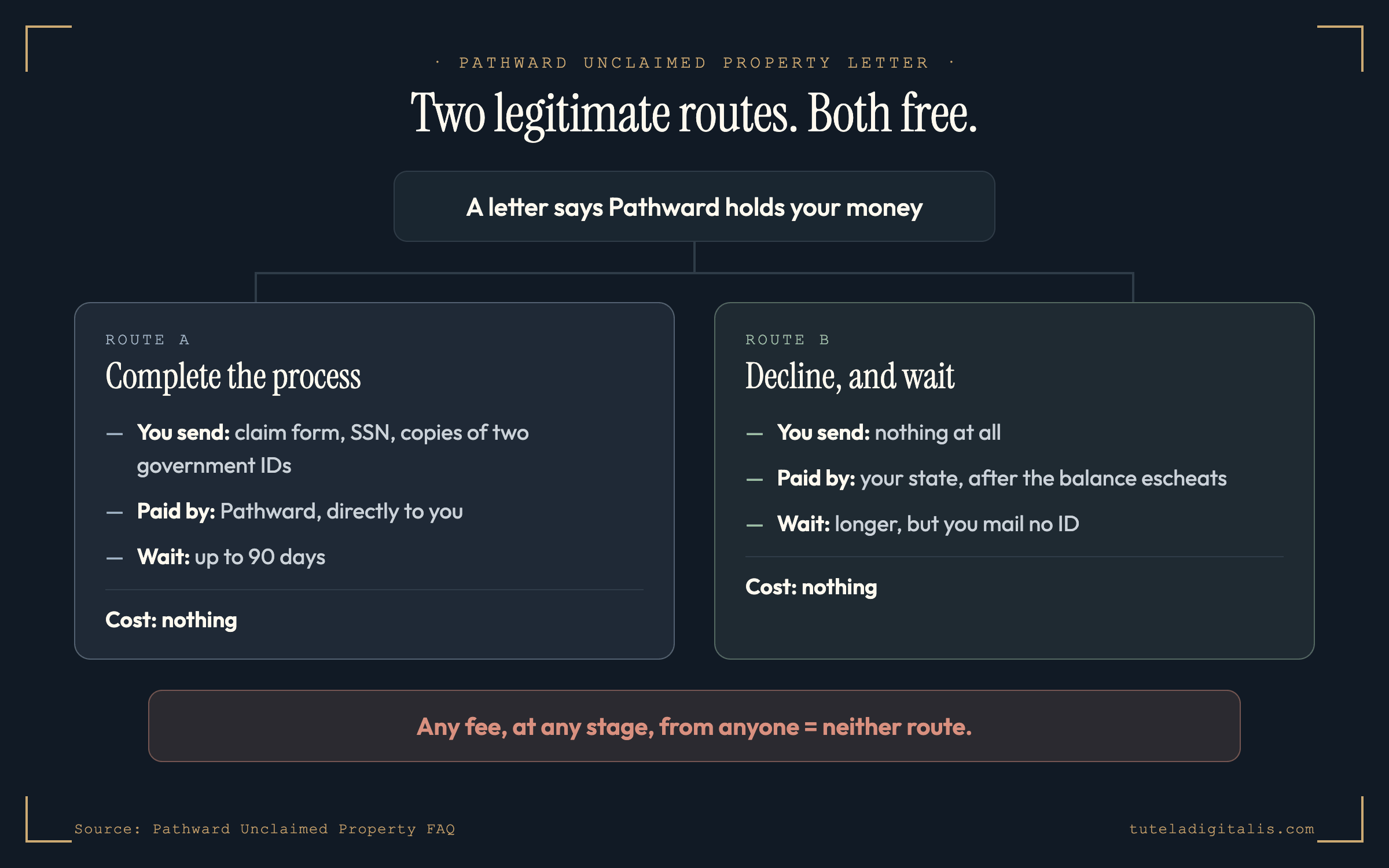
Both branches are legitimate and both are free. The route on the right is the one the letter does not lead with.
If the letter has a different bank on it
Nothing about this is specific to one bank. Unclaimed property is a matter of state escheatment law, which applies to every institution holding a balance that has gone quiet, so the same letter arrives with different names on the envelope. If yours says a bank you have never heard of, that alone tells you nothing, in either direction.
Pathward describes the mechanism plainly on its own site, and the description is worth reading closely because it corrects the thing most people assume.
Pathward, on its own unclaimed property page. “You have received a letter from your state indicating you have unclaimed property with Pathward, you possibly had a prepaid debit card in the form of a gift card or reloadable card issued by Pathward that has been dormant or not used for one year or more. State laws require Pathward to return these monies to the state as unclaimed property.”
Two things follow from that. The letter originates with your state, not with the bank, which is why the name on it is often one you have no memory of dealing with. And the money underneath it is usually something small and long forgotten, most often a prepaid or gift card that stopped being used. That is why the amounts are frequently trivial, and why a letter about a few dollars asking for a Social Security number feels so wrong.
A lot of people arrive here having typed the return address from the envelope into a search box, a PO box in Overland Park, Kansas being a common one. That instinct is right and the answer is disappointing: a return address proves nothing either way. Anyone can print one, and legitimate mailers are routinely sent by third-party administrators from addresses that have no obvious connection to the bank named inside. Do not try to authenticate the envelope. Authenticate the claim, using the three checks above, none of which depend on what the letter says about itself. The same reasoning settles the version that arrives by text rather than post: see whether an EnFact fraud notification is real, where the service doing the alerting is genuine and the impersonation rides on that.
The safest habit works regardless of which name is on the paper: go to your own state's unclaimed property database yourself, through unclaimed.org or MissingMoney, and search your own name. If the property is real it will be listed there, and you can claim it through the state without using a single contact detail from the letter. If it is not listed, you have lost nothing by checking.
The fork: two legitimate ways to get paid
Almost every article about an unexpected financial letter ends with a single instruction: comply, or delete. This one genuinely has two correct answers, and the second one is buried on page three of a PDF that most people never open.
Route A — complete Pathward's processYou return the claim form with copies of two forms of government-issued ID and the information requested, and Pathward pays you directly. Its FAQ says to allow up to 90 days for the check or the replacement card. It costs nothing. The trade is that you have to send identity documents to an address you learned about from an unsolicited letter, so this route is only reasonable once you have verified the contact details against what Pathward itself publishes.
Route B — decline, and claim from your stateYou do nothing. The dormancy clock runs out, and the balance escheats to your state's unclaimed property program, which then holds it for you. Pathward's own FAQ describes this as an available choice, saying that if you are simply uncomfortable providing Pathward with that information through our process, you may wait until the funds are turned over to your state and claim from them directly. You then claim through your state's official program, under its own identity checks. It takes longer. You never mail your Social Security number to anyone who wrote to you first.
Route B is the one worth knowing about, because it dissolves the dilemma rather than answering it. The reason the letter is frightening is that you cannot be certain who is really asking. Route B means you do not have to be certain. You are no longer deciding whether to trust an envelope — you are choosing to deal only with a state program you approached yourself. The money is not at risk in the meantime; escheatment is a transfer of custody, not a forfeiture, and states hold unclaimed property indefinitely for the owner.
From the field. I read a lot of documents written by people trying to get something from a stranger, and the tell is rarely a single word. It is what the document does with your options. A con narrows them: one route, one deadline, one channel, and any hesitation is treated as a problem to be handled. What struck me about Pathward's FAQ is that it does the opposite — it volunteers, unprompted, that you can refuse its process entirely and still get your money from somebody else. Nobody running a con tells you that the exit exists. The irony is that this genuinely helpful sentence is sitting inside a PDF, on a page that offers no phone number and no reassurance at all, which is why so many people conclude the whole thing is fake.
What we could not find, and why we are saying so
We looked for documented cases of criminals impersonating Pathward with counterfeit unclaimed property notices, and we did not find any — no regulator alert, no state attorney general warning, no consumer-protection bulletin naming that specific scam. That is an absence of evidence, not proof of absence. Fraudsters imitate whatever is currently landing in mailboxes, and a letter that legitimately asks for a Social Security number is an obvious template to copy.
What is well documented is the wider unclaimed property scam, and it behaves differently from the letter described here. It arrives by text, call or email rather than post, it impersonates a government body rather than a named holder, and it asks for an upfront fee or a payment to release the funds. Our breakdown of unclaimed money scams covers that version and the rule that governs it. The distinction to carry away is not who sent it but how it arrived. A letter can legitimately come from the company still holding your money, which the law obliges it to send, and it can legitimately come from a state office too — Pathward's FAQ has an entry for people who receive letters from the California State Controller's Office, because California requires the notice a year ahead of the transfer. A call, a text or an email announcing a windfall is a different animal. And whichever it is, the fee test still settles it: the real process never costs anything.
If a version of this ever asks you for money, it is not the real process. No legitimate holder and no state program charges you to return property that is already yours — Pathward says so in its own FAQ, and the states say so in theirs. A fee is not a variation on the process. It is proof you are outside it.
What to do this week
—Do not act on the letter's contact details. Not the phone number, not the email address, not the return envelope. Open a browser and go to pathward.com yourself, then compare what it publishes with what you were sent.
—Search your own name in the state system. Use MissingMoney.com or unclaimed.org, both operated by the National Association of Unclaimed Property Administrators, and check every state you have lived or worked in. It is free, it is independent of the letter, and it may show you property the letter never mentioned.
—Decide which route you want before you fill anything in. If you are not fully satisfied the letter is genuine, take Route B. Waiting is a legitimate strategy here, not a failure to act.
—Never pay a fee, and never accept help that charges a percentage. Finder companies are unnecessary for property you can claim yourself for nothing.
—Keep the letter. If it does turn out to be counterfeit, it is evidence. Report it to the FTC at ReportFraud.ftc.gov and to your state attorney general, and it will help the next person.
The instinct that made you suspicious of this letter is a good instinct, and it is worth keeping. It just needs one adjustment: an unexpected letter is a reason to verify, not a verdict on its own. Here, verification is cheap, the fee test settles almost everything, and there is a second route that lets you get your money without ever trusting the envelope.