CREDIT CARDS · THE CHARGEBACKJune 26, 202611 min read

Paid a scammer with a credit card? It's the one rail with a legal way back — which is exactly why scammers fight to keep you off it.

Every "how to get your money back" guide treats payment methods the same. They are not the same. Your odds of recovery were largely decided the moment you chose how to pay — and the credit card is the single rail that comes with a federal reversal right built in. That is why a scammer's push toward gift cards, crypto, a wire, or Zelle isn't a detail. It's a confession.

$50
Federal cap on your liability for unauthorized charges (FTC)
$0
Typical cost to you under Visa/Mastercard zero-liability
60 days
To dispute a billing error in writing (FCBA)
$12.5B
Reported US fraud losses in 2024 (FTC)
The short answer

If you paid a scammer with a credit card, you hold the strongest recovery tool in consumer payments: the chargeback. The Fair Credit Billing Act lets you dispute a charge in writing within 60 days, and federal law caps your liability for unauthorized charges at $50 — usually $0 under Visa and Mastercard zero-liability rules. The key split: a card used without your permission is the easy case; a charge you were tricked into making yourself is harder, but still disputable as goods or services "not delivered as agreed." Call your issuer, name the dispute type correctly, and put it in writing.

"Federal law (the Fair Credit Billing Act, or FCBA) sets out a dispute process to help you get those mistakes fixed on credit cards … [you can dispute charges that] are things you didn't accept or weren't delivered as agreed. … Federal law limits your responsibility for unauthorized charges to $50."

— Federal Trade Commission, "Using Credit Cards and Disputing Charges." This dispute right is the one consumer-protection mechanism no other scam-payment rail has — which is why being pushed off a card is itself a warning.

Here is the thing almost nobody tells you when you have just been scammed: the question "can I get my money back?" has already been half-answered by how you paid. A bank wire is hard to recall. Zelle is treated like cash. A gift card has only a freeze window measured in hours. Cryptocurrency is gone. The credit card is the exception — it is the only everyday payment method with a legal reversal right standing behind it. If your money left on a card, you are in the best position a scam victim can be in.

This is the credit-card version of the same recovery question that runs under every scam where money has already moved. The difference is the mechanism. With a gift card the lever is a freeze; with a credit card the lever is the dispute — and unlike the freeze, it does not expire in hours. But it is not automatic, and the words you use decide whether it works.

If you just paid, move now. Before the dispute details below, run our free emergency triage tool — it lays out the exact first moves for the next hour, sorted by how you paid. And to see your odds by payment method, the refund checker walks you through it in under a minute.

Why the credit card is the one rail with an undo button

Different payment methods carry completely different rights, and a scammer knows the ladder better than most victims do. Here is where the credit card sits, and why.
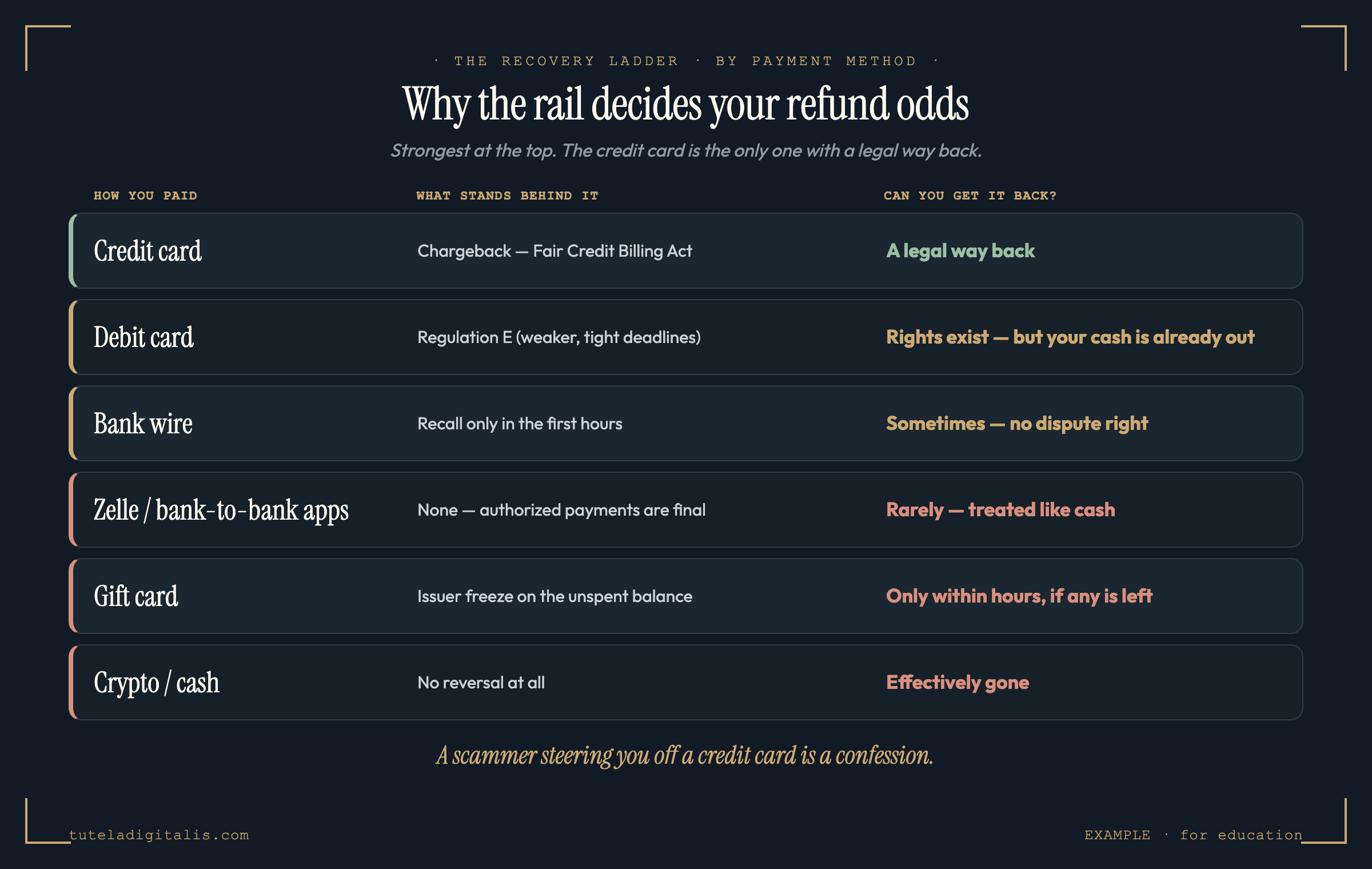
Credit card — a legal dispute right. The Fair Credit Billing Act gives you a federal right to dispute charges, and the card networks give your issuer a chargeback process to reverse them. It covers both charges you never made and charges for goods or services that never arrived or weren't as agreed. No other everyday rail has this.
Debit card — weaker, and your real money is already gone. Debit fraud falls under Regulation E, which has error-resolution rights but tighter deadlines and rising liability the longer you wait — and because debit pulls cash straight from your account, you are out the money while it's investigated. The gap is covered in the do-banks-refund breakdown.
Bank wire — sometimes recallable, but only in the first hours. A wire can occasionally be recalled if you catch it almost immediately, but there is no consumer dispute right behind it. Once it settles, it's gone.
Zelle and bank-to-bank apps — treated like cash. An authorized payment you were deceived into sending rarely comes back, because you pressed Send. That is the whole trap behind every P2P-app scam.
Gift cards and crypto — a freeze window, or nothing. A gift card can sometimes be frozen if you call within hours (the gift-card playbook covers it); cryptocurrency has no reversal at all. These are the rails scammers love most.
A recoverability ladder of payment rails after a scam, strongest to weakest. Credit card sits at the top with a legal chargeback right under the Fair Credit Billing Act. Below it, a debit card with weaker Regulation E error-resolution rights. Then a bank wire, sometimes recallable only in the first hours. Then Zelle and other bank-to-bank apps, treated like cash and rarely returned. Then gift cards, with only an issuer freeze on the unspent balance. At the bottom, cryptocurrency and cash, effectively unrecoverable. The credit card is highest because it is the only rail with a federal dispute and reversal right.
Why the rail decides your odds. The credit card is the only everyday payment method with a legal chargeback right — which is exactly why a scammer steers you toward the bottom of this ladder. Built from US consumer-protection law; for education.
The payment method a scammer demands is a confession. If someone insists you pay by gift card, crypto, wire, or Zelle — or tells you a credit card "won't work" — the reason is almost always that those rails cannot take the money back. The request itself is the red flag.

The two kinds of dispute — and which one you have

Everything about a credit-card scam recovery turns on one distinction, and using the wrong word can sink a winnable claim. There are two situations, and they are routed differently.

Unauthorized: someone used your card without your permission. Your number was stolen, skimmed, or phished and then charged. This is the strong case. Federal law caps your liability at $50, and Visa and Mastercard zero-liability policies usually make it $0. Report it, and the issuer reissues the card and reverses the charges.
Authorized-but-deceived: you made the payment because you were lied to. You entered your own card details to 'pay' for something that was fake, never delivered, or nothing like what you were promised. This is not 'unauthorized' — so don't call it that. It is a dispute over goods or services not delivered as agreed, which the FCBA also covers, but it's harder and depends on your evidence.

The mistake victims make is calling a deceived payment "unauthorized," getting denied because they clearly did authorize it, and assuming that's the end. It isn't. The correct frame is that you paid for something you never received, or that was misrepresented — a claim the law specifically lets you bring.

If you paid a scammer with a credit card — do this now

Work top to bottom. The first three steps decide most of the outcome; the rest protect you and build the record.

1Stop, and save the evidence before you do anything else. Screenshot the charge as it appears on your statement (note the exact merchant name), the messages, and any 'invoice,' receipt, or website the scammer used. This is what your issuer's dispute team and the FTC will work from. Do it now, before the scammer deletes the chat or the listing disappears.
2Call the number on the back of your card. Say one of two things clearly: 'I want to report an unauthorized charge,' or 'I want to dispute a charge.' If the card number itself was stolen or used without your permission, ask them to freeze the card and reissue it on the same call.
3Name the right dispute type — it decides everything. If you never made the charge, it is unauthorized (federal liability capped at $50, usually $0). If you made the payment yourself because you were deceived, do not say 'unauthorized' — say the goods or services were never delivered or were not as agreed. Both are disputable; the wording routes the claim correctly.
4Put the dispute in writing within 60 days. Federal protection under the Fair Credit Billing Act requires a written dispute that reaches the issuer within 60 days of the first bill showing the charge. Use the billing-inquiries address, not the payment address; the FTC publishes a sample letter. Send it certified with a return receipt so you have proof.
5Ask the issuer to open a chargeback. This is the network process your bank uses to reverse the money and reclaim it from the merchant's bank. While the disputed amount is under investigation, you generally do not have to pay it or interest on it. Get a dispute case number and write it down.
6Report it to the FTC — and IdentityTheft.gov if your card was stolen. File at ReportFraud.ftc.gov to create the official record. If the charge was unauthorized and looks like identity theft, IdentityTheft.gov builds you a personal recovery plan. For larger losses, add a report at the FBI's IC3 (ic3.gov). See the full reporting directory for every agency by situation.
7Keep records and escalate if they stonewall. The issuer must acknowledge your dispute and follow set timeframes. Keep copies of everything. If they reject a clearly fraudulent charge or go quiet, file a complaint with the CFPB — a regulator complaint often unsticks a stalled dispute. For the odds by how the money moved, see the 72-hour recovery playbook.
8Refuse the second scam — no real recovery charges an upfront fee. Within days, a 'recovery agent,' 'investigator,' or 'fraud lawyer' may offer to get your money back for a fee. It is the same network running a second con on a known victim. Every legitimate channel — your issuer, the FTC, the CFPB — is free. The full pattern is in the recovery scams piece.

What to say to your bank — the words that work

The dispute is mostly a wording game. Be precise, be brief, and put it in writing. A few rules that decide how the claim is handled:

Lead with the category, not the story. Open with 'I want to dispute a charge' or 'I want to report an unauthorized charge' — the two phrases that trigger the formal process. The long emotional account comes after; the category is what routes the case.
For a deceived payment, say 'not delivered as agreed.' Describe the goods or services you paid for and never received, or that were misrepresented. That is the FCBA language. Avoid 'I sent the money myself' as your headline — it's true, but it invites a denial before you've made your actual point.
Always follow up in writing within 60 days. A phone call starts it; the written dispute to the billing-inquiries address is what locks in the federal protection. Use the FTC's sample letter, include your evidence, and send it certified.
Get the case number and the timeline. Ask when you'll hear back and what they need. While the disputed amount is investigated, you generally don't owe it. If they miss their own deadlines or deny a clear fraud, that's your cue to escalate to the CFPB.
From the field. The pattern I see again and again is a victim who calls their bank, blurts out "I got scammed, I sent the payment myself," hears "then it was authorized, there's nothing we can do," and hangs up believing the money is gone. It often isn't. The same charge, described as "I paid for goods that were never delivered," is a dispute the law explicitly allows. The facts didn't change — the framing did. If your first call gets a fast no, that is usually a sign the claim was filed under the wrong heading, not that you have no claim.

The UK and beyond — Section 75 and chargeback

Outside the US, the credit card is still the strongest rail, with its own rights. In the UK, Section 75 of the Consumer Credit Act 1974 makes your card provider jointly liable with the seller for purchases between £100 and £30,000 — so for a qualifying scam purchase you can claim against the card company directly. For amounts outside that range, or for debit cards, the voluntary chargeback scheme run by the card networks is the fallback. The principle is the same everywhere: a credit card puts a regulated institution between you and the loss in a way cash-like rails never do.

When a chargeback won't save you — the honest limits

A credit card is the best hand to be dealt, but it is not a guarantee. Be clear-eyed about where it stops.

A cash advance or a card-funded transfer to another rail. If the scammer had you use the card to buy crypto, load a wallet, or pull a cash advance, you authorized a completed transaction for exactly what you 'bought' — and the dispute usually fails. The loss happened one step downstream, off the card.
A weak or undocumented 'not as described' claim. If you can't show what you were promised versus what you got, the merchant's bank can argue you received what you paid for. Evidence is the case.
Time already run out. Miss the 60-day FCBA window and you lean on the network's discretionary chargeback rules, which are weaker and not a legal right.
Then report it anyway, and brace for the second con. If the dispute can't recover the money, file with the FTC and the FBI's IC3, and watch for the recovery scam — see the recovery-scams piece.
The scam has a built-in sequel. Once you've lost money, your details circulate on the same infrastructure that ran the first con, and a new caller — a 'recovery agent,' an 'investigator,' a 'fraud lawyer' — will offer to retrieve your funds for an upfront fee. It is never real. No legitimate body, and no card issuer, ever charges you to get your money back. Every channel that actually works — your bank, the FTC, the CFPB — is free.

So — can you get credit-card scam money back?

Often, yes — more often than with any other payment method, because the credit card is the one rail built with a reversal right inside it. An unauthorized charge is reversed routinely; a payment you were deceived into making is harder but genuinely disputable as goods or services not delivered as agreed. What decides it is speed, the right dispute wording, and your evidence — not how the scam made you feel.

And the deeper lesson is upstream of the refund: the safest way to pay any stranger is the rail that can take the money back. When someone tells you a card "won't work" and you must use a wire, a gift card, an app, or crypto instead, they are not solving a payment problem. They are removing your only undo button — and that, by itself, is the scam announcing itself.

If you take one rule from this whole piece, take this: a credit card is the only payment with a legal way back, so the instant you realize you've been scammed on one, call your issuer, name the dispute type correctly, and put it in writing within 60 days — and treat any demand to pay another way as the warning it is.

Paid a scammer with a card? Let's work the dispute together.

Tell us what happened, how much, and when — a real expert reviews every case and replies within 24 hours. Free, confidential, no judgment, nothing to sell.

Submit a free case review →Check your refund odds

Common questions about credit card scam refunds

Can you get your money back after paying a scammer with a credit card?

More often than with any other payment method — because the credit card is the only rail with a legal reversal right. The Fair Credit Billing Act lets you dispute a charge, and your issuer can run a chargeback to pull the money back from the merchant's bank. Two cases: a charge made without your permission (the card number was stolen and used) is the strong case — federal law caps your liability at $50, and most issuers charge you $0. A charge you were tricked into making yourself is harder, but still disputable as goods or services 'not delivered as agreed.' The deciding factors are how fast you report it, the dispute wording, and your evidence.

What's the difference between an unauthorized charge and one I was tricked into making?

It is the single most important distinction in a credit-card scam dispute. An unauthorized charge is one you never made — someone stole your card number and used it. Federal law limits your responsibility for unauthorized charges to $50, and Visa and Mastercard zero-liability rules usually drop that to $0, so these are reversed routinely. A charge you were deceived into authorizing is different: you entered your own card details because you were lied to. That is not 'unauthorized,' so do not call it that — frame it accurately as a charge for goods or services that were never delivered or were not as agreed, which the FCBA also lets you dispute. Using the wrong word gets the claim routed the wrong way.

How long do I have to dispute a credit card charge?

To keep your full federal protection, your written dispute has to reach the card issuer within 60 days of the first bill that showed the charge. Send it to the address for billing inquiries, not the payment address, and keep proof of delivery. Card-network chargeback windows are often longer (commonly up to 120 days, sometimes 540 for undelivered goods), but do not rely on the longer window — the 60-day FCBA deadline is the one that guarantees the law is on your side. The rule is simple: the moment you spot the charge, start the dispute.

Will my bank actually side with me in a scam chargeback?

Not automatically. A chargeback is an investigation, not a guarantee — the merchant's bank can contest it, and the outcome turns on your evidence and the dispute type. Unauthorized-use claims win most of the time. 'I was deceived into paying' claims are harder, because the merchant can argue you authorized the payment. What strengthens your case: report fast, dispute in writing, attach the messages and any fake invoice, show the goods or services never arrived or were not what you were promised, and keep every piece of correspondence. If the issuer rejects a clearly fraudulent charge, escalate a complaint to the CFPB.

The scammer told me to pay by Zelle, gift card, or crypto instead — why?

Because those rails have no chargeback. A scammer's choice of payment method is a confession: gift cards, cryptocurrency, wire transfers, and bank-to-bank apps like Zelle behave like cash and have no built-in reversal, while a credit card carries a federal dispute right they cannot get around. That is exactly why so many scams start on a card and then pressure you to 'switch' to another method, or insist from the start that a card 'won't work.' The request itself is the warning sign. If someone steers you off a credit card, assume the reason is that they know the card can take the money back.

Is a credit card dispute the same thing as a chargeback?

They are related but not identical. The dispute is your legal right under the Fair Credit Billing Act — the formal process where you tell your issuer a charge is wrong and they must investigate. The chargeback is the card-network mechanism (Visa, Mastercard, Amex rules) that your issuer uses to actually reverse the money and pull it back from the merchant's bank. In practice you start a dispute and, if it holds up, it results in a chargeback. You do not have to know the machinery — you just have to call your issuer, say you want to dispute a charge, and put it in writing within 60 days.

Sources & further reading

Every figure and instruction in this piece is drawn from these authorities. Click any of them to verify.

FTC — Using Credit Cards & Disputing Charges (FCBA, 60 days, $50)FTC — Sample letter to dispute a chargeCFPB — What is a credit card chargeback?FTC — Report FraudFTC — IdentityTheft.gov (unauthorized charges)FTC — $12.5B reported fraud losses in 2024FBI — IC3 Complaint CenterMoneyHelper (UK) — Section 75 of the Consumer Credit Act

Keep reading