Three products. Two do the same thing. One pays.
The advert asks whether someone could steal your house with a piece of paper, and then sells you a subscription. It is an effective advert, and the question underneath it is a fair one. But almost every answer you can find online argues about whether the product is worth buying.
Nobody lays out what actually exists. There are three separate things you can have, they do three different jobs, and the one being advertised hardest is not the one that writes you a cheque.
No, it is not a scam in the sense of a fake company taking your money. Home title monitoring is a real, legally sold service that watches the public record and tells you after a document is recorded against your property. The problem is narrower and more useful than a yes or no: your county very likely performs that identical monitoring job for free, and neither the paid version nor the free version pays you anything if a forgery actually happens. Only title insurance with post policy forgery cover does that, and it is the one the adverts never mention.
What the advert is actually selling
The pitch is built on a real anxiety. Property records are public, deeds get recorded, and the idea that a stranger could file a document transferring your house is genuinely unsettling. What the advertising adds on top is scale: the suggestion that this is a sweeping crime wave and that your home equity is one forged signature from vanishing.
That framing has been formally challenged. In January 2023 the Texas Attorney General issued a civil investigative demand to Home Title Lock covering 27 categories of documents, among them substantiation for the advertising’s claims about how the FBI characterises this crime and about the scale of the losses. In April 2023 the city attorneys of San Francisco and San Diego jointly subpoenaed the company over its advertising, and their announcement said the company’s “alarmist statements about the prevalence of fraudulently recorded deeds are undermined by the sources the company cites.”
The part worth keeping is smaller and sharper than the headlines. A state attorney general asked a company to substantiate specific advertising claims, and a second set of officials said the company’s own cited sources did not support them. That those claims needed substantiating at all, rather than simply being checkable, is the story. We are deliberately not reprinting the figures themselves, because repeating a number in order to question it is how the number travels.
The three tiers
Here is what actually exists, in the order the advertising presents them, which turns out to be the reverse of the order that matters.
Read the third column downward. Tier one and tier two give the same answer as each other, at different prices. Tier three gives a different answer, and it is the tier the advertising is not about.
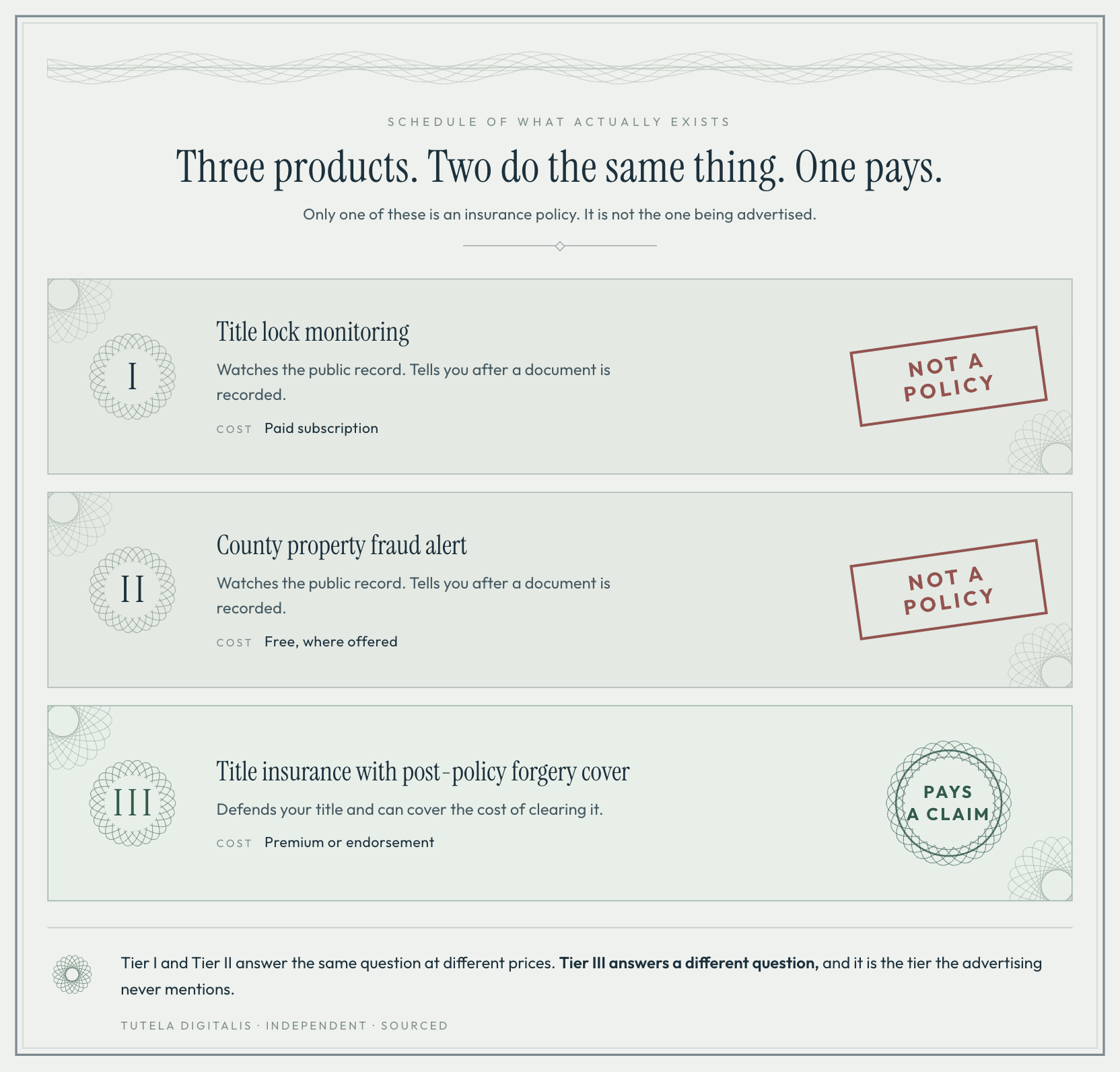
Tiers one and two do the same job
This is not our characterisation. Three independent sources describe the monitoring product in nearly identical terms, and they come from three different directions.
The FTC, in a consumer alert published in August 2024, wrote that “title lock insurance” is not title insurance and that “it’s not insurance at all,” describing it instead as a service that claims to monitor your deed. The alert is blunt about the timing: “You’d only find out AFTER your title got transferred to someone else without your authorization. So much for the lock.”
The San Francisco and San Diego city attorneys, in their April 2023 announcement, said the service “merely notifies homeowners after a fraudulent deed has been recorded.” San Francisco City Attorney David Chiu put the second half of it plainly, saying the advertising deceives homeowners into buying “a service that many local governments provide for free.”
And then the third direction, which is the one that surprised us. The American Land Title Association is the title insurance industry’s own trade body. Writing in June 2026 about its new forgery endorsements, ALTA described them as
“a practical alternative to unregulated products that merely monitor public records and issue notifications.”AMERICAN LAND TITLE ASSOCIATION, 23 JUNE 2026
If you want the notification, your county may well already provide it. Many county recorder and clerk offices run a free property fraud alert that emails you when something is recorded against your name. The FTC confirms the pattern, noting that “some areas even have a free notification program,” which is also the honest caveat: this is county by county, not national. The way to find yours is to search your own county recorder or clerk of court site rather than assuming coverage.
The FBI reached the same recommendation from the enforcement side. Its June 2026 public service announcement advises property owners to enrol in notification services from their county recorder to receive alerts when documents are recorded using their name.
The tier that pays, and the catch inside it
Title insurance is the only one of the three that can write a cheque. Most homeowners bought a policy at closing and have not thought about it since, and most assume it covers this. Here is where that assumption breaks.
“The coverage is prospective, meaning it applies to forgery events that occur after the title policy is issued. Existing policy coverages already protect against title defects, including forgery, that occurred before the homeowner acquired the property.”AMERICAN LAND TITLE ASSOCIATION, 23 JUNE 2026
Read that twice, because it is the whole point. The protection most homeowners assume they are carrying covers forgery from before they bought the property. Deed fraud happens after. Those are two different risks, and the standard policy was built for the first one.
Whether you are covered depends on which policy you hold. ALTA notes that its Homeowner’s Policy has provided broad post policy forgery protection for more than two decades, but adds that “that policy is not available in every state and may not be suitable for every residential transaction.” For everyone else, ALTA published two endorsements in August 2025 to widen access:
The scale of a claim is worth knowing before deciding any of this is theoretical. Dan Buchanan, chair of ALTA’s Forms Committee and senior vice president and chief title counsel for First American Title Insurance Co., noted an average title insurance fraud and forgery claim exceeding $143,000. That is the number a notification does not cover and an insurance policy might.
The property criminals target is the one the new cover excludes
This is the finding that came out of reading two 2026 documents against each other, and we have not seen it stated anywhere else.
The FBI’s June 2026 alert is titled “Protect Your Property from Illegal Sales Through Parcel Owner Impersonation,” and it is specifically about vacant land parcels. The method it describes runs in three phases. Criminals create fake driving licences or passports, Outlook email addresses and Voice over Internet Protocol phone numbers, using owner details gathered from county or state public websites, data brokers, stolen account information or phishing. They then approach real estate agents and title companies posing as the owner and draft a genuine sales contract, sometimes presenting a fictitious deed. The proceeds are directed to a co-conspirator attorney in a different state.
It works because nobody lives there. An empty lot generates no post, no neighbours and no monthly reason for the real owner to look.
Now put ALTA’s eligibility rule beside it. The endorsements, ALTA writes, “are available only for improved one-to-four-family residential properties owned by natural persons or qualifying estate-planning entities.” Improved means built on.
One honest caveat, because it cuts against the neatness of that observation: eligibility for unimproved land is reported to vary between states and underwriters, so this is a rule about the standard endorsements rather than a flat national bar on ever insuring vacant land. If you own land you do not live on, that is a question to put to a title insurer directly rather than to assume in either direction.
The FBI’s own advice on this is refreshingly analogue, and it is worth being precise about who it is aimed at: it is guidance to a buyer, not to the owner being impersonated. “When purchasing,” the PSA says, send a certified letter to the address of record on the land tax record to verify the legitimacy of the seller. If you own land you do not live on, the protection that is yours to arrange is the county notification service and the policy question above.
The version that reaches people who do live there
There is a second variant, and it is largely missing from the coverage of this topic even though it is the one that touches occupied homes.
It does not involve forging anything. The owner signs a real deed, willingly, because they were deceived about what the document was. The Pennsylvania Attorney General’s office has described the pattern: a refinance that is not a refinance, or a rescue from overdue property taxes that quietly transfers ownership. The signature is genuine. The understanding was not.
That is a meaningful difference, because monitoring does not help you here either. An alert would fire correctly, on a document you did in fact sign. This is the version where the defence is not a subscription or an endorsement, it is refusing to sign property paperwork that has not been read by somebody working for you.
The Pennsylvania Attorney General’s office has also given the fairest one line summary of the risk overall: while these scams are not common, they can be devastating to the victims. Both halves of that sentence are doing work.
One jurisdictional point, and its limits
The San Francisco and San Diego city attorneys made a strong legal claim in 2023: that “a fraudulent deed has no legal effect in California and therefore cannot result in loss of a home or its equity.”
That is a statement about California recording law, made by California city attorneys, and it should not be stretched into a national rule. Property law is state law. What is void on filing in one state may take a court action to unwind in another, and the cost and time of that unwinding is exactly what a title insurance claim would cover.
What to do, and both parts are free
If, after all that, you still want to pay for monitoring, that is a legitimate choice and it is a legal product. Just buy it knowing precisely what it is: a notification, priced, doing what your county may do for nothing, and not the thing that pays.
The advertising sells the top rung of the ladder hardest. The bottom rung is free and does the same job. And the rung that actually catches you is the one that never appears in the advert at all.