Whatnot is a genuine live-shopping marketplace, not a fake storefront. The risk sits with what happens during a live auction. Whatnot itself reported in July 2026 that shill bidding on the platform was down nearly 80% over six months, which is also an admission that it occurs at a scale worth reporting, and the figure comes with no baseline totals and no definition of what the 80% counts. In March 2026 an attorney filed 15 arbitration complaints alleging the platform operates as an illegal casino, which Whatnot rejects. None of that tells you whether the bid that just jumped past you was real, and nothing on your screen will.
Shill bidding has a plain definition, and the useful one is Whatnot's own: a seller, or someone connected to them, placing bids without genuine intent to buy, which drives up the price paid by legitimate customers. It is not a con that takes your money and vanishes. You get the card. You simply pay more for it than the room would have made you pay.
That is why the usual advice fails here. There is no misspelled domain to notice, no urgent text to ignore, no request to move money somewhere strange. The manipulation happens inside a normal transaction, in public, at speed. So the only honest way to write this is to go through one auction and mark, at each moment, the difference between what the screen shows and what it holds back.
Forty-seven seconds
One item, one stream. The times are the auction clock. On the left is what any bidder can see. On the right is what none of them can.
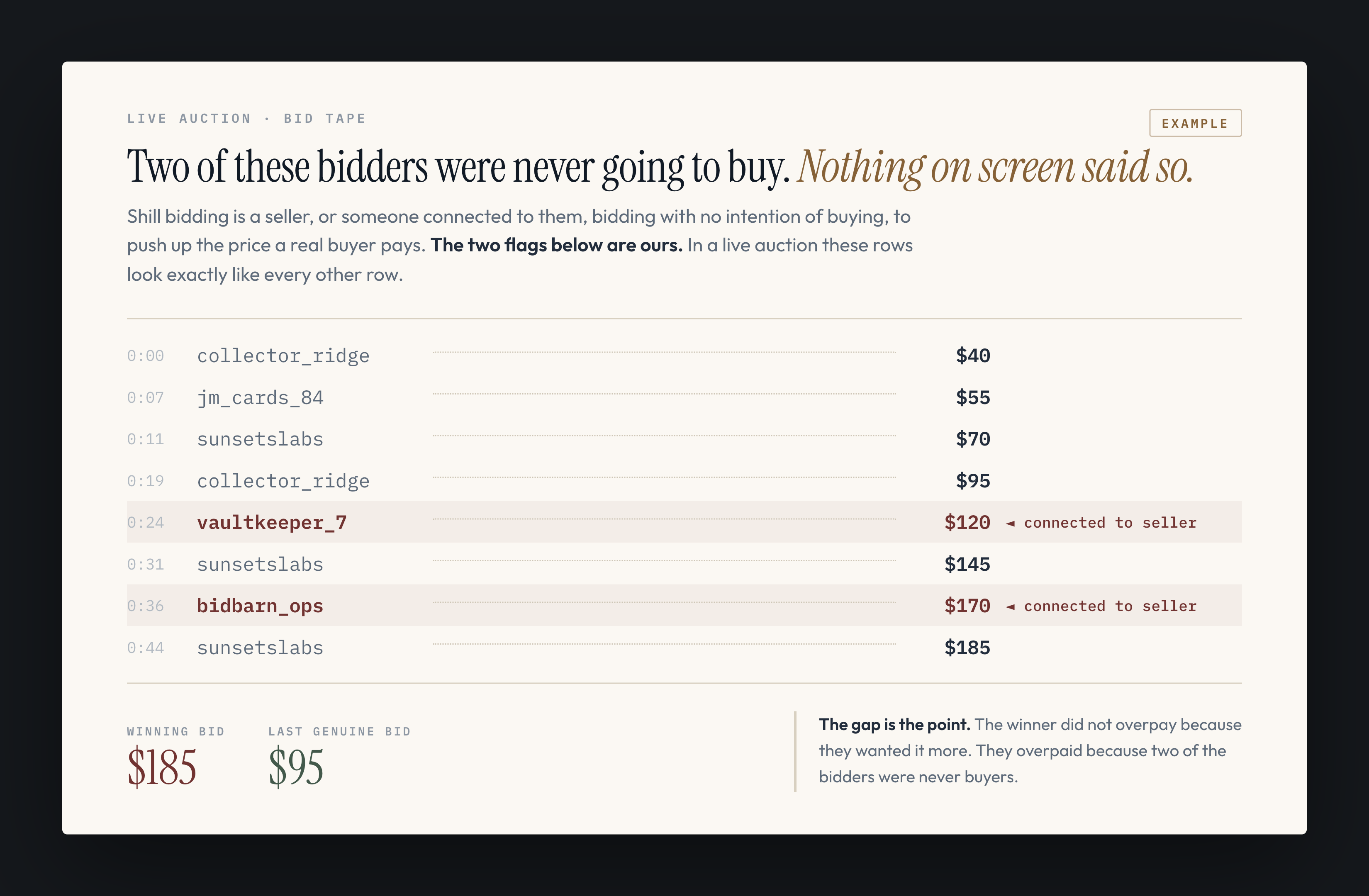
The gap between $185 and $95 is not a fee, a markup or bad luck. It is the price of two bidders who were never going to pay. And the buyer has no way to compute it, because the auction only ever shows the number that was reached, never the number that would have been reached honestly.
What the platform has said, and what it has not
On 28 July 2026, updated on 11 August, Whatnot published an account of its enforcement work. It reported that shill bidding activity was down nearly 80% over six months, that user reports of suspected shill bidding fell 45%, and that it had increased fivefold the number of signals it uses to identify suspicious activity. It said confirmed violations can lead to warnings, restrictions, suspensions or permanent bans.
Read that as a buyer and one question follows immediately. Eighty percent of what? The post does not say whether the figure counts bids, auctions, accounts, sellers or an internal measure, and it publishes no baseline totals for accounts, auctions or transactions affected. It gives no numbers for how many accounts received a warning, a suspension or a ban. The detection methods are withheld on the stated grounds that disclosure could help users evade them, which is a defensible position for a platform and an unhelpful one for a customer.
There is a second reading, and it is the more useful one. A company does not publish a shill-bidding reduction unless shill bidding was happening at a scale worth reducing. The number is evidence of the problem as much as of the response.
Value Added Resource — Whatnot says shill bidding activity down nearly 80% ↑The arbitration complaints
In March 2026, attorney Paul Lesko filed 15 arbitration complaints against Whatnot on behalf of users and said he intended to file 15 more. He described them as focusing on Whatnot allegedly running an illegal casino without the safeguards that regulated casinos are required to have to protect consumers.
Two of the allegations bear directly on the auction itself. The complaints allege that some sellers holding Premier Shop status engaged in shill bidding, and that sellers assembling repackaged products used inside knowledge of card locations, leaking the positions of valuable cards to favoured buyers by private message before broadcasts. The filing also alleges the platform historically failed to permanently ban violators.
Whatnot rejects the characterisation. Its response was that gambling is not allowed on Whatnot and that it strictly enforces this policy, and it describes card breaks as a long-standing format in collecting. These complaints are untested allegations, arbitration is a private process, and no finding has been made against the company. We are reporting what has been alleged and what has been answered, not settling it.
But note where the first allegation lands. Premier Shop status is a trust signal. It is the platform telling you a seller is established. If the badge and the behaviour can occupy the same account, then the one shortcut a buyer has for judging a stranger at speed is the shortcut in dispute.
Sports Illustrated — Whatnot faces legal challenges over breaking practices ↑Why “just watch out for it” is not advice
The clearest statement of the problem comes from Whatnot's own explanation of why live auctions are hard to police: sellers, moderators and frequent buyers interact closely, which makes it difficult for other participants to identify connected bidders. That is the platform saying, in its own words, that you cannot reliably tell.
So any guidance that depends on you spotting a fake bidder is worthless. You are being asked to identify, in seconds, a relationship between two accounts that is invisible by design and that the company itself needs machine signals to detect. Advice built on that premise is not caution. It is a transfer of responsibility onto the one participant with the least information.
What actually protects you
Everything below works whether or not a shill is present, which is the only sensible test for advice in a room you cannot see into.
None of this requires you to distrust the platform, and none of it depends on catching anyone. It is the same discipline that protects a buyer on any marketplace where you cannot verify the person on the other side, which is also the argument in our guide to Facebook Marketplace scams. The mechanism differs. The exposure does not.
If you have already lost money
Use the platform's dispute process first and keep every screenshot, then go to your payment provider, which is where the leverage actually is. A card chargeback is decided outside the marketplace by someone with no interest in the outcome of the stream. Report the seller regardless of whether you are reimbursed, so the account is on record. In the US you can also file at ReportFraud.ftc.gov.
The honest summary is short. Whatnot is legitimate. Live auctions are a format in which price manipulation is easy to perform and, by the platform's own account, difficult for participants to detect. Those two facts sit together comfortably, and holding both is the whole skill. Decide your number before the room can influence it, and the room cannot cost you anything beyond it.
Lost money in a live auction? Tell us what happened.
We read every case ourselves and tell you honestly what your options are, including when the answer is that there are none. Free, confidential, and we never charge to look.
Questions people ask
Is Whatnot legit?
Yes, in the sense that matters least. Whatnot is a real, funded live-shopping company that ships real goods and processes real payments, and most streams end with a buyer getting what they paid for. The question worth asking is narrower: can you tell, while bidding, whether the price you are paying is real? On that, Whatnot's own July 2026 post says shill bidding activity is down nearly 80% over six months, which is also an acknowledgement that shill bidding happens on the platform at a scale worth reporting. Whatnot defines it as a seller, or someone connected to them, placing bids without genuine intent to buy, which drives up the price paid by legitimate customers.
What is shill bidding, and is it illegal?
Shill bidding is when a seller, or someone acting with them, bids on their own item with no intention of buying it, purely to push the price up for a real buyer. Whatnot's own definition is that it drives up the price paid by legitimate customers. It is a form of price manipulation and it is prohibited by the platform's rules; Whatnot says confirmed violations can lead to warnings, restrictions, suspensions or permanent bans. The practical problem is not whether it is against the rules. It is that a shill bid and a genuine bid look the same on your screen while you are deciding whether to go higher.
What did Whatnot say about shill bidding falling 80%?
In a post published on 28 July 2026 and updated on 11 August 2026, Whatnot reported that shill bidding activity was down nearly 80% over six months, alongside a 45% decline in user reports of suspected shill bidding and a fivefold increase in the number of signals it uses to identify suspicious activity. Coverage of the post noted what it does not contain: no baseline totals for accounts, auctions or transactions affected, and no definition of whether the 80% refers to bids, auctions, accounts, sellers or another internal measure. Whatnot also withheld the detection methods themselves, arguing that disclosure could help users evade them. A reduction figure without a denominator cannot be checked by anyone outside the company.
Is Whatnot being sued over card breaks and gambling?
Not a lawsuit, arbitration. In March 2026 attorney Paul Lesko filed 15 arbitration complaints against Whatnot on behalf of users, and said he planned to file 15 more. He described the cases as focusing on Whatnot allegedly running an illegal casino without the safeguards that regulated casinos are required to have to protect consumers. The complaints allege that some sellers with Premier Shop status engaged in shill bidding, and that sellers assembling repackaged products used inside knowledge of card locations and leaked valuable card positions to favoured buyers by private message before broadcasts. These are allegations that have not been tested, and arbitration is a private process. Whatnot rejected them, saying gambling is not allowed on Whatnot and that it strictly enforces this policy, and describing card breaks as a long-standing format in collecting.
How do I avoid being bid up in a live auction?
You cannot detect a shill bid, so do not build your plan around detecting one. Decide your maximum before the stream starts and write it down where you can see it. Bid that number and stop, regardless of how the room behaves. The tactic that costs people money is not falling for a fake, it is treating the last bid as information about what the item is worth. It is not. Price your own interest, not the room's. If a seller's stream regularly ends in dramatic last-second jumps from the same handles, that is a reason to buy elsewhere rather than a reason to bid harder.
Are Whatnot card breaks and repacks gambling?
That is precisely what is contested. In a break or a repack you pay a fixed amount for a randomised outcome, which is structurally similar to a wager, and the March 2026 arbitration complaints characterise the format as gambling mechanics rather than retail. Whatnot's position is that gambling is not allowed on the platform, that it strictly enforces this, and that breaks are a long-standing format in collecting. No regulator finding has resolved it. What is not contested is the consumer arithmetic: you are buying a chance, not an item, so the only safe way to price it is as money you are prepared to lose entirely.
I lost money on Whatnot. What can I do?
Start with the platform's own dispute route and keep everything: screenshots of the stream, the listing, the bid history, the handles involved and every message. If that fails, the route that actually moves money is your payment provider. A card payment carries a chargeback right, and that is usually stronger than a marketplace's internal process. Report the seller to Whatnot so the account is on record even if you are not reimbursed, and if you are in the US you can also file with the FTC at ReportFraud.ftc.gov. Be alert to anyone who contacts you afterwards offering to recover your money for a fee, which is a separate and very common second scam.