IRELAND · DOES IT TEXT YOU? · THE STAMP9 September 2026 · 7 min read
Revenue does not text you. So the question is never "is this Revenue text real". It is only "what do I do with a fake one".
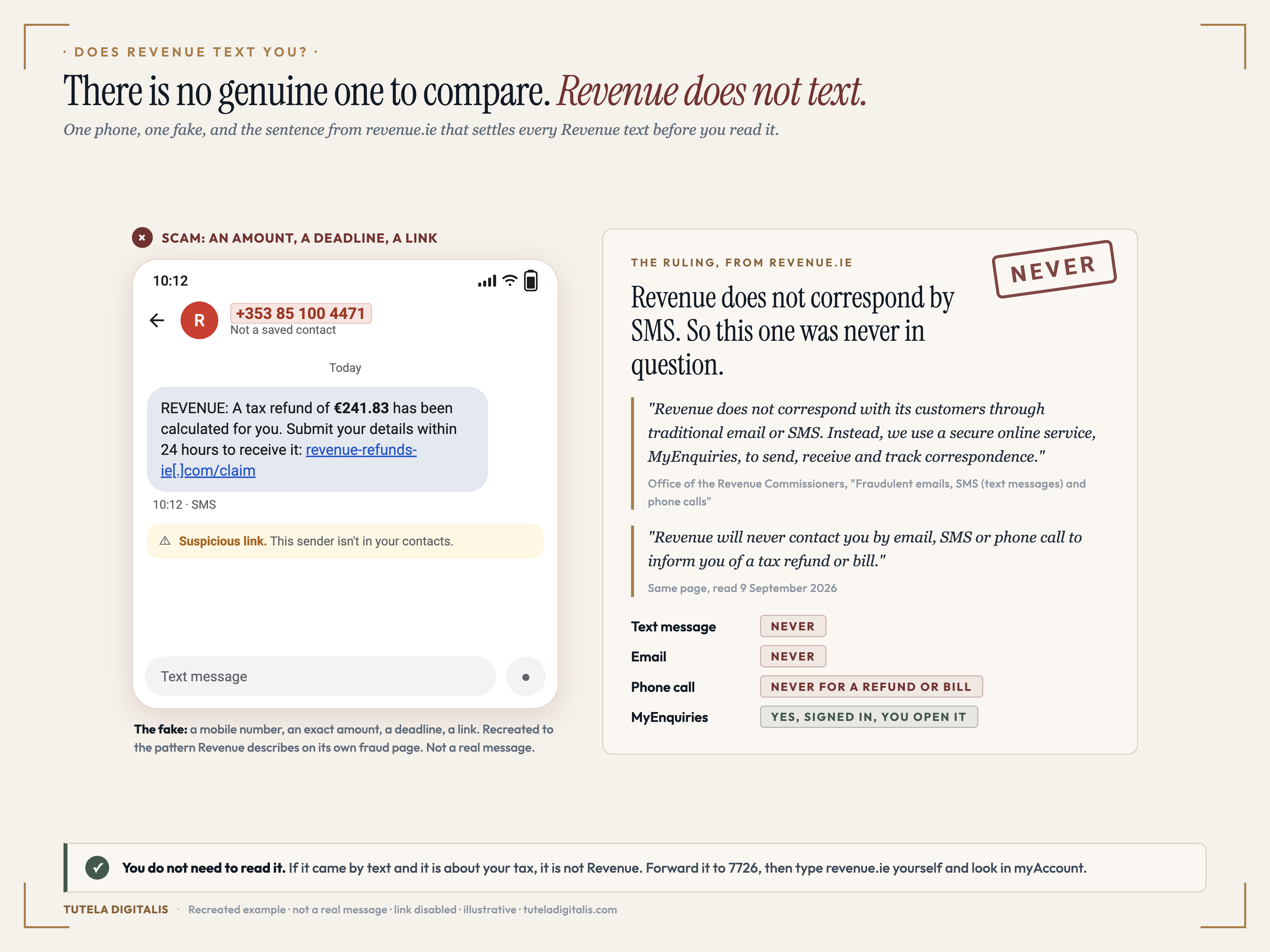
Some agencies make you study the message. Revenue made a cleaner choice: it does not correspond by SMS at all, and it says so on its own site. That turns every Revenue text into a scam by channel, before you read a word.
0
genuine Revenue text messages about your tax
MyEnquiries
the channel Revenue uses instead
7726
free forwarding number on Irish networks
€50
your maximum liability on an unauthorised payment
The short answer
No. Revenue does not send text messages to correspond with you, and it says so. Its own page states that it "does not correspond with its customers through traditional email or SMS" and uses MyEnquiries, inside myAccount and ROS, instead. It also states it "will never contact you by email, SMS or phone call to inform you of a tax refund or bill". A verification code you asked for while signing in is the only SMS you should ever see, and it carries no link and no amount. Every text about a refund, a bill, a penalty or a document is a scam by channel. Forward it to 7726 and check your account by typing revenue.ie yourself.
"Revenue does not correspond with its customers through traditional email or SMS. Instead, we use a secure online service, MyEnquiries, to send, receive and track correspondence."
Compare that with the UK, where HMRC runs a dozen genuine text campaigns and publishes the list, so a UK reader has to check the message against it. That page is here. Ireland's answer is shorter because Revenue drew the line at the channel rather than at the content. It is the best kind of rule for a reader in a hurry: no wording to study, no sender to decode, one fact to remember.
The stamp: three channels, three rulings, in Revenue's words
Does Revenue use this channel to tell you about your tax?revenue.ie · read 9 Sep 2026
SMS / text
NEVER
"Revenue does not correspond with its customers through traditional email or SMS." A text about a refund, a bill, a penalty or a document is a scam by channel.
Email
NEVER
Same sentence, same rule. Revenue uses MyEnquiries inside myAccount and ROS. An email telling you about your tax did not come from Revenue.
Phone call
NEVER, for refunds or bills
"Revenue will never contact you by email, SMS or phone call to inform you of a tax refund or bill." A caller announcing money owed or owing fails on that sentence alone.
MyEnquiries, myAccount, ROS
YES
The channel Revenue built for correspondence. You open it yourself, signed in. If a message is not there, it was not sent.
One exception, and it proves the rule: a one-time verification code you request while signing in arrives by SMS. It carries no link, no amount, and no news about your tax, and you know it is coming because you pressed the button.
What the fake looks like, and why the wording no longer matters
Revenue's fraud page describes the text it keeps seeing: a message with a link to a scam website, often with an exact amount of money, and a deadline. The page shows examples going back years; the most recent it displays is from March 2025. The amount is the persuasion. A round number reads like marketing; €241.83 reads like a calculation somebody did. It is the same move the fake bank alert uses when it names a merchant, and we take the psychology apart in why scammers sound official.
Recreated example, not a screenshot of a real message, following the pattern Revenue describes: an exact amount, a link, a deadline. There is no genuine counterpart to show, because there is no genuine Revenue text. The link is inert.
You do not need to read it. With a bank alert, the test is what the message asks. With Revenue, the test is the channel. If it came by text and it is about your tax, it is not from Revenue. Delete it, forward it to 7726 first if you want the number blocked, and check the truth by typing revenue.ie yourself.
From the field. The refund text works on people who have just filed, because a refund is exactly what they are waiting for, and the timing feels like confirmation rather than coincidence. That is not carelessness. It is a reasonable inference from a fact the scammer never had to know; enough people file in the same weeks that the message finds them. Which is why I like Revenue's rule so much. It does not ask you to out-think the timing. It gives you one sentence that is true in every week of the year.
If you entered card or bank details, the bank comes before everything else on this page. Call the number printed on your card, say what you typed, and ask them to block the card or watch the account. Unauthorised payments that follow are refundable under the EU Payment Services rules with your liability capped at €50; the Irish refund page has the articles to quote. A payment you make yourself on a fake site is the hard case, so the phone call is worth more than any report.
Where to send it
1.Forward the text to 7726. Free on Irish networks; it goes to your operator so the number can be blocked for everyone.
2.Report to An Garda Síochána at a Garda station, or on 999 or 112 if money is moving right now. The Ireland reporting guide covers the Garda National Economic Crime Bureau and what to bring.
3.Tell Revenue through MyEnquiries if you want it on their record. Revenue's page does not publish a separate address for reporting texts, and it does not need one: the channel itself is the filter.
4.If you clicked, change the passwords for myAccount, ROS and anything that shares them, from a device you trust, and turn on two-factor authentication.
5.Refuse the second offer. Anyone who contacts you afterwards offering to recover money for a fee is running the recovery scam.
Revenue gave Irish readers the rarest thing in fraud advice: a rule with no exceptions to memorise. It does not text you about your tax. Anything that does is somebody else.