Is this government text real? Four bodies told us, on their own pages, what they will never send.
A text says HMRC owes you a refund, or DVLA could not take your payment, or your Universal Credit needs confirming, or your GP has a message. The sender name looks right. This page puts what each body publishes about its own texts in one place, read on one day, with the dates, so you can check the message against the body instead of against your nerves.
A UK government text is real only if it tells you something and asks for nothing. HMRC says it will never ask for personal or financial information by text. DVLA says it will never ask for bank account details or payment confirmation, and that refunds are automatic, never via a link. Universal Credit says it will never text or email asking for personal information or bank details. The NHS sends from one sender ID, NHSNoReply, and blocked every look-alike in November 2024. If the text asks you to confirm, pay, claim or log in through its link, it fails all four tests at once. Forward it to 7726 and check the body through your own front door.
"Vehicle tax refunds are issued automatically – never via an email with a link!"
I sold for a living before I did this, and the government text is the easiest sale in the whole scam economy, because the seller never has to build trust. The trust is already there. Nobody wonders whether HMRC exists, whether DVLA has their registration, whether the NHS has their number. The message borrows all of that for free and spends it on one small ask: confirm, pay, claim, log in. The ask is the tell, and the four bodies below all say so in their own words.
What none of them publish is a US-style short code you can match. Nine US banks do, and even there the code turned out to belong to the messaging vendor rather than the bank. UK government bodies mostly describe the sender by name, or not at all, and an alphanumeric sender name is typed by whoever sends the message. So the register below is built on content, not on numbers: what each body says a genuine text can contain, and the one thing it says a genuine text never asks.
The four seals: what each body says about its own texts
Every line on every seal comes from the body's own page, read on 15 September 2026, and carries that page's own update date. Where a body publishes nothing about a sender name, the seal says so rather than inventing one.
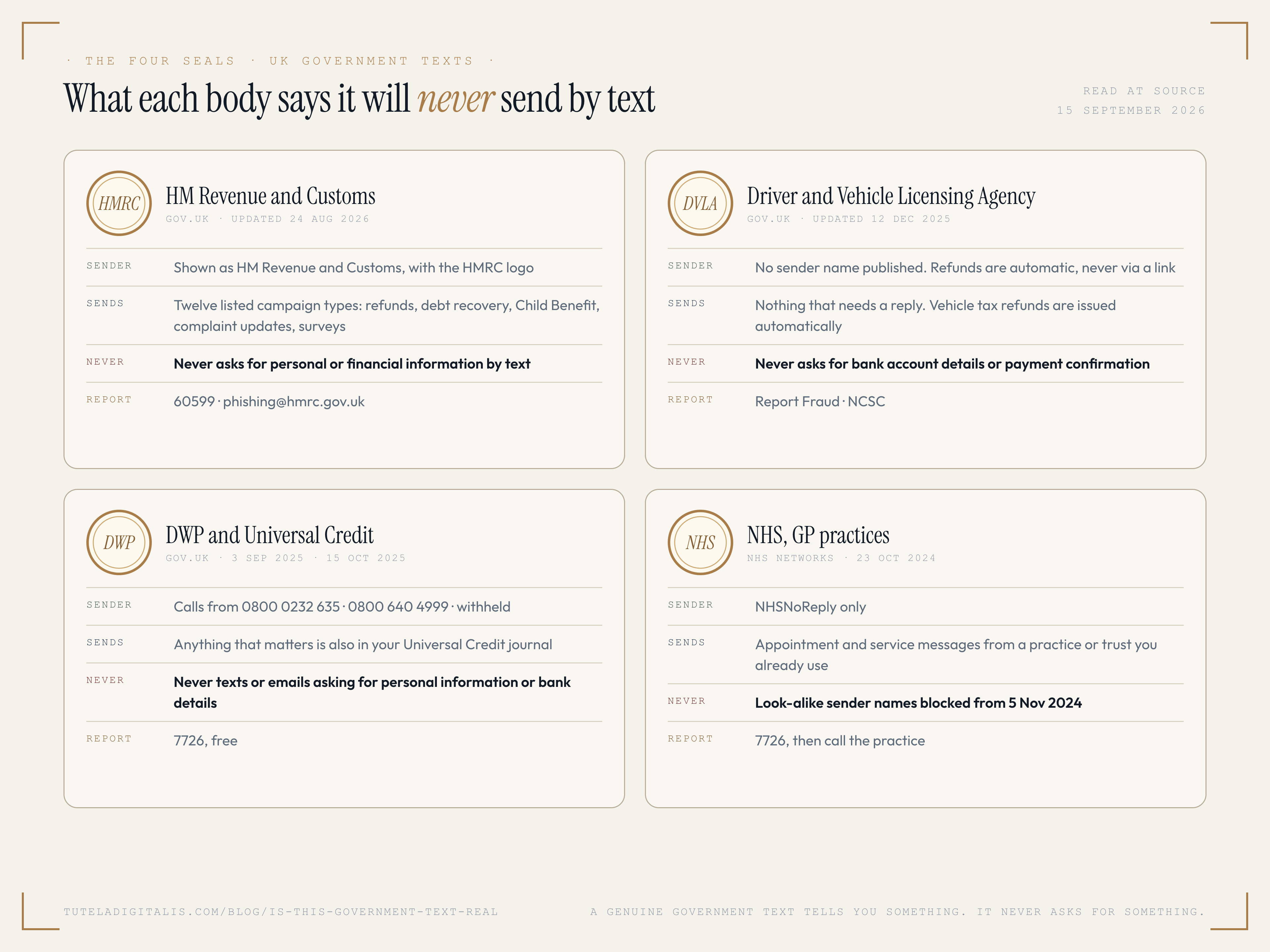
HMRC: the only one of the four that publishes a calendar
HMRC is the body that texts most, and the only one that lists what it is texting about. Its GOV.UK page on genuine text messages, updated 24 August 2026, describes the branded message, shown as HM Revenue and Customs with the HMRC logo on phones that support it, and states the rule that matters: HMRC will never ask for personal or financial information when it sends text messages. It adds a specific warning not to open links or reply to any text that offers a tax refund in exchange for personal or financial details. We keep the full campaign list, twelve types on the day we read it, on a page of its own. Suspicious texts go to 60599, and HMRC notes that network charges apply.
DVLA: the refund that arrives by itself
DVLA's guidance is the bluntest of the four. It says fraudsters often send emails or text messages asking people to confirm personal details such as bank or payment information, that DVLA will never ask you for your bank account details or ask you to confirm payment details, and that if you receive one of these emails or texts you should not click on any links. The line about refunds is the one to memorise: vehicle tax refunds are issued automatically, never via an email with a link. That sentence kills the two commonest DVLA fakes, the overpayment refund and the failed payment, in one move. DVLA points reports to the National Cyber Security Centre and to Report Fraud, the service that replaced Action Fraud on 4 December 2025; DVLA's page was updated on 12 December 2025 to point at it.
DWP and Universal Credit: check the journal, not the text
Universal Credit does contact claimants, and GOV.UK's guidance on managing a claim, updated 3 September 2025, says what that contact will never contain: we will never text or email you asking for your personal information or bank details. It lists the numbers genuine calls come from, 0800 0232 635 and 0800 640 4999, and warns that calls can also come from a withheld or unknown number, which is why the number alone cannot clear a call either. The page's own advice is the useful part: do not share information if you think a call, text message or email might not be from Universal Credit. It could be a scam. Anything real about your claim is also in your journal, and the journal cannot be spoofed by a text.
The scale is not small. A GOV.UK release on 15 October 2025 warned pensioners that Winter Fuel Payment scam referrals had risen 153% in the final week of September compared with the week before, restated that the DWP will never ask for bank details via text message, and asked people to forward suspicious texts to 7726.
NHS: one sender name, and every look-alike blocked
The NHS is the one body that solved the sender problem directly. Guidance published on NHS Networks on 23 October 2024 asked primary care organisations using SMS to use the NHSNoReply sender ID only, and said all other variations, such as nhs noreply, NHS NOREPLY and NHS-NoReply, would be blocked from 5 November 2024. The reason given is the one every other body should borrow: too many sender names made it hard for patients to tell a genuine message from a fake. So a GP text shown as NHSNoReply, about a practice or service you already use, fits. A text from a variant spelling, or from an ordinary mobile number, does not, and the check is a call to the practice on the number on your appointment letter.
Where a fake goes, in order
- 1.Forward the text to 7726. Ofcom's guidance, read 15 September 2026, says the service is free and alerts your mobile provider to investigate and potentially block the number. On an iPhone, hold the message, tap More, then the forward arrow, and send it to 7726. On Android, hold the message, tap Forward, and send it to 7726. The number spells SPAM on a keypad. Messages that arrived through WhatsApp, Telegram or Signal cannot usually be forwarded to 7726; report those inside the app.
- 2.Send a screenshot to report@phishing.gov.uk. The NCSC's page on scam texts says most providers are part of the free 7726 scheme, invites screenshots to that address, and reports 40.9K scams removed across 93.3k URLs as of July 2026 as part of the 7726 service.
- 3.HMRC fakes can also go to 60599, HMRC's own number, or to phishing@hmrc.gov.uk. Network charges apply to the text.
- 4.If money left your account, report it to Report Fraud, the City of London Police service that replaced Action Fraud on 4 December 2025, and call your bank on the number on your card first.
- 5.Then delete the text. Do not reply to it, even with STOP, because a reply confirms the number is live and moves it up the list.
Why TV Licensing is not on the register
TV Licensing texts are among the most-faked in the country, and we wanted a fifth seal. On the day this page was built its own guidance page could not be read at source: the site returned nothing to two different readers. The rule of this site is that a seal quotes the body's own words or does not exist, so there is no TV Licensing seal today. The general rule still applies to it: a text about a licence that wants a payment or a login through its link asks for something, and that is the tell.
The sender name is the easy part to fake and the hard part to check. The ask cannot be faked, because a genuine government text does not have one.
Does DVLA send text messages?
DVLA's own scam guidance, published on GOV.UK in April 2025 and updated in December 2025, describes emails and texts as the channel fraudsters use to ask people to confirm bank or payment details, and states that DVLA will never ask you for your bank account details or ask you to confirm payment details. It also says vehicle tax refunds are issued automatically, never via an email with a link. So a DVLA text that asks for anything, or offers a refund through a link, is a fake by definition, whatever the sender name says.
Does DWP text you about Universal Credit?
It can, and GOV.UK's Universal Credit guidance says what those texts will never contain: We will never text or email you asking for your personal information or bank details. The same page lists the numbers genuine calls come from, 0800 0232 635 and 0800 640 4999, and says calls can also arrive from a withheld number. The safe check is not the text. It is your Universal Credit journal, where anything real about your claim is also written.
Does the NHS send text messages, and from what sender?
Yes. NHS guidance published in October 2024 asks primary care organisations, which means GP practices, to use the NHSNoReply sender ID only, and says every other variation, such as nhs noreply, NHS NOREPLY and NHS-NoReply, was blocked from 5 November 2024. A text from a practice or trust you already use, shown as NHSNoReply, fits the pattern. A text from a near-miss of that name, or from a mobile number, does not.
What number do HMRC texts come from?
HMRC does not publish a short code the way US banks do. Its guidance, updated 24 August 2026, says genuine branded texts show HM Revenue and Customs as the sender and include the HMRC logo, on phones that support branded messages. The harder rule is about content: HMRC will never ask for personal or financial information when it sends text messages, and it advises you not to open links or reply to any text offering a tax refund in exchange for details. Suspicious texts go to 60599, with network charges, or to phishing@hmrc.gov.uk.
How do I report a scam government text in the UK?
Forward the text to 7726, which is free on every UK network and, as Ofcom explains, alerts your provider so it can investigate and block the number. The NCSC adds that you can send a screenshot to report@phishing.gov.uk, and its page reports 40.9K scams removed across 93.3k URLs as of July 2026 as part of the 7726 service. If you lost money, report it to Report Fraud, the service that replaced Action Fraud on 4 December 2025. HMRC fakes can also go straight to 60599.
I clicked a link in a fake GOV.UK text and typed my details. What now?
Treat it as a bank problem first. Call your bank on the number on your card, say exactly what you typed, and ask them to watch the account or reissue the card. Then change the password on any account that shares the one you entered, and switch on two-step verification for email and banking. Report the text to 7726 and the loss, if there is one, to Report Fraud. Expect a second contact from someone who says they can recover the money for a fee; that is the same scam coming back, and no genuine body asks a victim for money to return money.