DATING SCAMS · THE VERIFICATION TRAP
By Peter · 30 September 2026 · 7 min read
Dating verification ID scam: when “prove you’re safe” becomes a subscription.
A dating verification ID request can be a subscription scam when a match sends you to a “free” safety-check site that collects card details. The FBI documented this pattern in April 2024. Stop before entering payment information. Open your dating app independently to check its real verification process; if you already supplied your card, contact the issuer promptly.
Already entered your card? Go straight to the payment and cancellation steps. Otherwise, start with the request: who chose the verification site, and what are you being asked to hand over?
The documented scam starts with a reasonable wish: feeling safe
In its 26 April 2024 warning, the FBI described criminals approaching people through dating sites and moving the conversation to another messaging service. They then proposed a verification website, supposedly to establish that the person was not a predator or sex offender. Fake articles and familiar news logos helped make the check look credible.
The site requested personal information and card details for a supposedly free process. The victim could then be directed into a private dating subscription, with recurring charges appearing under an unfamiliar business name. A person expecting a safety check had instead supplied the information needed for billing.
That warning is evidence of a particular mechanism. It does not mean every website using the words “dating ID” is fraudulent, and it does not establish how often this happens today. You do not need a current loss estimate to recognize the dangerous handover: a stranger chooses the site, defines the test and makes your card the condition for continuing.
Scam anatomy: how concern becomes a payment instruction
Tutela Digitalis analysis: the persuasive move is to make refusal feel like evidence against you. You wanted to demonstrate that you were considerate. Now declining an unfamiliar checkout can feel like admitting you are unsafe. The request changes from “let us both be careful” to “prove yourself using the service I selected.”
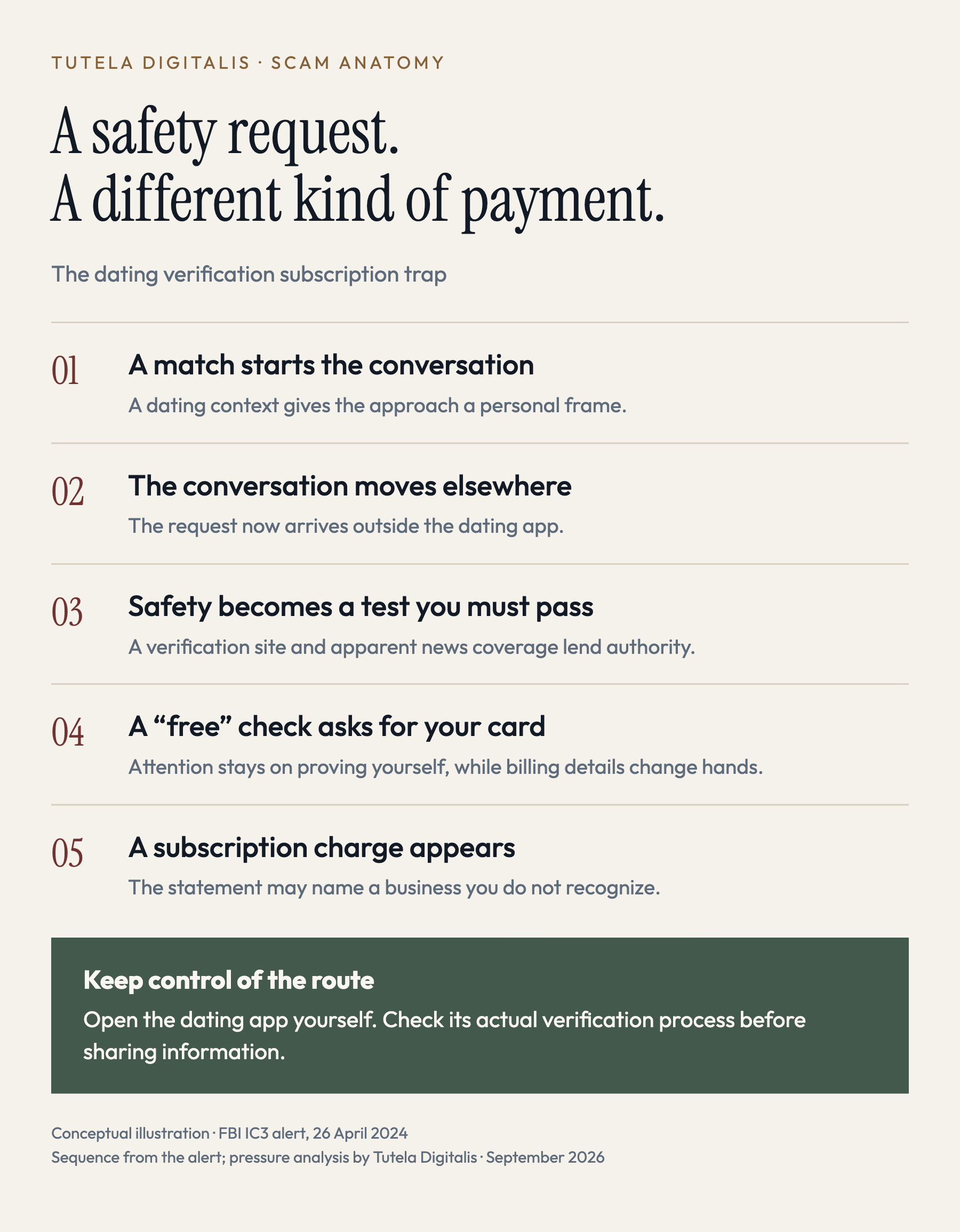
The news logo does another job: it lends the request an authority the person in the chat does not possess. But a logo reproduced on a page is not independent coverage. Open the named publication yourself if a claim matters. A screenshot of an article is still material supplied by the person asking you to comply.
Finally, “free” directs attention toward today’s price. The questions you actually need answered are who is receiving your details, what you are enrolling in, and whether a later charge is authorized. A small initial amount would not resolve those questions either.
Real app verification and a match’s link are different requests
Tinder’s Photo Verification uses a video selfie and a comparison with profile photos. Hinge’s Face Check uses a video selfie for liveness, photo comparison and duplicate-account checks, with a phased regional rollout. Bumble’s ID verification starts from your profile and uses a government ID and a live selfie. These are defined platform processes; they do not certify someone’s intentions.
| Question | A safer way to check |
|---|---|
| Who initiated it? | Open the dating app yourself and look for its verification settings. Do not begin from a match’s link. |
| What does it establish? | Read the platform’s explanation. Photo matching, age checks and a background check are different things. |
| Who gets your information? | Check the official help page and privacy explanation before uploading an ID. Never send an ID document directly to a match. |
| Why does it need a card? | Stop if a match says an unfamiliar card checkout is required to prove your safety. Check the supposed requirement with the app’s official support. |
A legitimate app may use an outside verification provider. The useful distinction is whether you reached that provider through the app’s own documented process. “Third party” alone is not a verdict, and a familiar brand name in a message is not authentication. For the wider limits of badges and screening, read our Tinder, Bumble and Hinge safety guide.
A response that preserves your boundary
You can say: “I’m happy to use the app’s verification. I won’t enter my card details on a link sent in chat.” This is a suggested response, not wording from a documented scam conversation. You can also stop responding altogether.
If the person keeps pressing, do not argue about whether you are trustworthy. Save the profile and relevant messages, then use the platform’s report and block tools. Refusing one website does not prevent either person from choosing ordinary precautions. Nobody has to continue a conversation or agree to meet.
If you entered your card, deal with billing and cancellation separately
Contact your card issuer or bank promptly through its official app or the number on your card. Explain what the page promised, which details you entered and whether a charge has appeared. The FTC recommends reporting deceptive or unauthorized card payments to the issuer immediately. Do not wait for the match to arrange a refund.
- Preserve the evidence you already have. Keep the profile, messages, receipts, offer terms and any cancellation confirmation. Record the merchant name on your statement, amount and date. You do not need to revisit a suspicious link just to build a perfect file.
- Ask how to secure the card and stop further charges. Tell the issuer if the site may have enrolled you in recurring billing. Follow its advice about blocking payments or replacing the card; do not assume replacing a card is itself confirmation that a subscription was cancelled.
- Identify and cancel any subscription through a verified route. Use independently checked merchant contact details or ask your issuer for help identifying the merchant. Keep the cancellation record. Do not supply more card details to a “refund” contact from the original chat.
- Dispute charges you did not authorize, or continued billing after cancellation. Describe accurately what you agreed to and what was concealed. Follow the issuer’s evidence requirements and deadlines. Monitor later statements; a pending investigation is not a refund guarantee.
The cancellation and dispute distinction follows the FTC’s subscription guidance. For more detail on a credit-card claim, see our credit-card refund guide. Procedures and legal protections depend on your country and payment method.
If you shared a password, identity document or only clicked
Password: change it through the real service, and change it anywhere you reused it. Enable two-factor authentication. The FTC’s account-security guidance also explains recovery when you can no longer sign in.
Identity information: tell the relevant document issuer if an ID image was exposed and ask which protective steps apply. In the US, IdentityTheft.gov provides an identity-theft recovery route. A card dispute does not resolve misuse of an identity document.
Only clicked: close the page and stop interacting. Clicking alone does not prove your account was taken over. The response changes if you also downloaded software, granted permissions, entered a password or supplied payment details. Describe those actions precisely when seeking help.
Report the profile to the dating service. US victims can also report the incident to FBI IC3 and the FTC; elsewhere, use your country’s fraud-reporting route. Be wary of anyone who later offers guaranteed recovery for an advance fee: that can become a second scam.
Questions readers ask
Is a dating verification ID always a scam?
No. Dating apps operate legitimate verification features, and some use outside providers. The danger described here is a match directing you to an unfamiliar site and requiring card details for a supposedly free safety check. Open your app independently and confirm its actual process through official support.
Does a verified badge mean someone passed a criminal background check?
Do not assume so. Photo or face verification checks described by Tinder and Hinge are not a certificate of good conduct. Read what the particular feature checks; a badge cannot establish honest intentions.
Why would a free dating verification ask for a credit card?
In the scheme documented by the FBI in April 2024, the verification request led to enrollment in a dating subscription and recurring charges. A card request does not become safe because the page says the check is free. Stop and verify the requirement independently.
Can I get the subscription charges back?
Contact the issuer promptly and explain whether the payment was unauthorized, the subscription was concealed, or billing continued after cancellation. Provide the available evidence and follow its dispute process. The result depends on the facts, payment method and applicable rules; a refund is not guaranteed.
Should I send my ID to the person I matched with?
No. Do not send a passport, driving licence or other ID image directly to a match. If you choose to complete a platform’s verification, start in the app yourself and check its official instructions and privacy information.
Unsure which part of an encounter needs reporting? Request a free case review with a short account of what happened. Do not send passwords, full card details or identity documents. If money or account access is at risk, contact your bank or the affected service first. We cannot guarantee recovery.
Sources and review notes
Primary sources checked on 30 September 2026. Platform features vary by region and can change. The FBI verification warning dates from April 2024; it establishes the scam pattern, not its current prevalence. The explanations of pressure and trust in this guide are Tutela Digitalis analysis.