SKILL GAMES · THE COURT RECORD
By Peter · 26 October 2026 · 12 min read
Is Solitaire Cash legit? It pays out. A federal court also found its maker filled cash contests with bots until late 2023.
Solitaire Cash and Bingo Cash are real apps from Papaya Gaming, and players do withdraw money from them. But on 31 July 2026 a New York federal court entered a $729 million judgment against Papaya. A jury found it liable for false advertising, and the judge wrote that Papaya used bots as players in its cash tournaments from 2019 through 2023 while telling players its games were fair contests between humans. A separate class settlement averages about $22 per participating player. Papaya has appealed.
"From 2019 through 2023, Papaya employed bots as players in its online cash tournaments to fill its rosters for the tournaments, which provided Papaya with both the 'liquidity' to run the tournaments and the ability to control the outcome of tournaments."
The usual way to answer the question people type, "is it legit?", is to test whether a withdrawal arrives. It does. That was never the real risk. The real risk is the one you cannot test from inside the app: whether the person you are paying to play against exists. On that question, two courts have now produced a public record.
The facts below come from court documents, Papaya's own terms and help center, the app store listing and the official helpline page, all read on 26 October 2026. Where a figure comes from the trial evidence, I say so. Where Papaya disputes something, I say that too.
Yes, it is a real app and it pays out. That was never the question.
Solitaire Cash is published by Papaya Gaming, a company based in Tel Aviv, Israel. On 26 October 2026 its US App Store listing showed about 590,000 ratings averaging 4.6, an 18+ age rating, second place in Apple's Casino chart, and, under the age rating, a "Contains" list naming gambling, loot boxes and advertising. Papaya also makes Bingo Cash, Bubble Cash and 21 Cash.
The money moves both ways. You pay entry fees for tournaments and win cash prizes, and Papaya's help article on withdrawals, written for players in what it calls Bonus Cash States (below), says they are processed within 14 days but usually arrive within 2 business days. The rules around that are worth reading before you deposit:
- There is a minimum and a fee. Papaya's terms refer to a minimum withdrawal amount and withdrawal fees, and let Papaya change the minimum, the methods and the fees without notice. The help article says a processing fee is deducted.
- One at a time, and possibly back to your card. The same help article says only one withdrawal can be in progress, and that withdrawals may be processed as refunds to the payment method you deposited with.
- You may need ID. The terms say a withdrawal can require your full name, address, phone number and a copy of a government-issued ID.
- Your state decides whether winnings are real money. In what Papaya calls Bonus Cash States (Arizona, Louisiana and Michigan for all its games, Montana for Solitaire Cash and Bingo Cash, Maine for card games), contests are "only for fun" and prizes are Bonus Cash "that cannot be redeemed for real money". Players there can withdraw deposits, not winnings. The terms also say Papaya no longer offers real-money Solitaire Cash or Bingo Cash in Michigan and Montana.
- Disputes go to arbitration. The terms open with a notice of a binding arbitration clause and a waiver of class action rights, and cap Papaya's total liability to a player at $100. New players can opt out of arbitration by writing to terms-inquiries@papayagaming.com within 30 days of first using the service, or of a materially changed clause.
So withdrawals arriving show this is not a fake app that keeps deposits. If an app ever asks you to pay more before you can take money out, that is the tell of a task scam's "lucky order", not of a game. Papaya is not that. Its problem, according to the court, was different.
What did the court find about bots in Papaya's games?
The case was brought by a competitor, Skillz, which runs its own cash tournament platform. Skillz sued in New York federal court on 4 March 2024 for false advertising. The trial began on 13 April 2026 and on 23 April the jury found Papaya liable under the federal Lanham Act and New York's consumer protection law, and awarded Skillz $420 million in damages. On 27 July, Judge Denise Cote denied Papaya's post-trial motions and awarded Skillz $719 million in disgorgement of Papaya's profits. The final judgment on 31 July came to $729,224,615.60 including attorneys' fees and costs.
The 27 July opinion sets out the evidence at trial, which the court had to view in the light most favourable to Skillz at that stage. According to that summary:
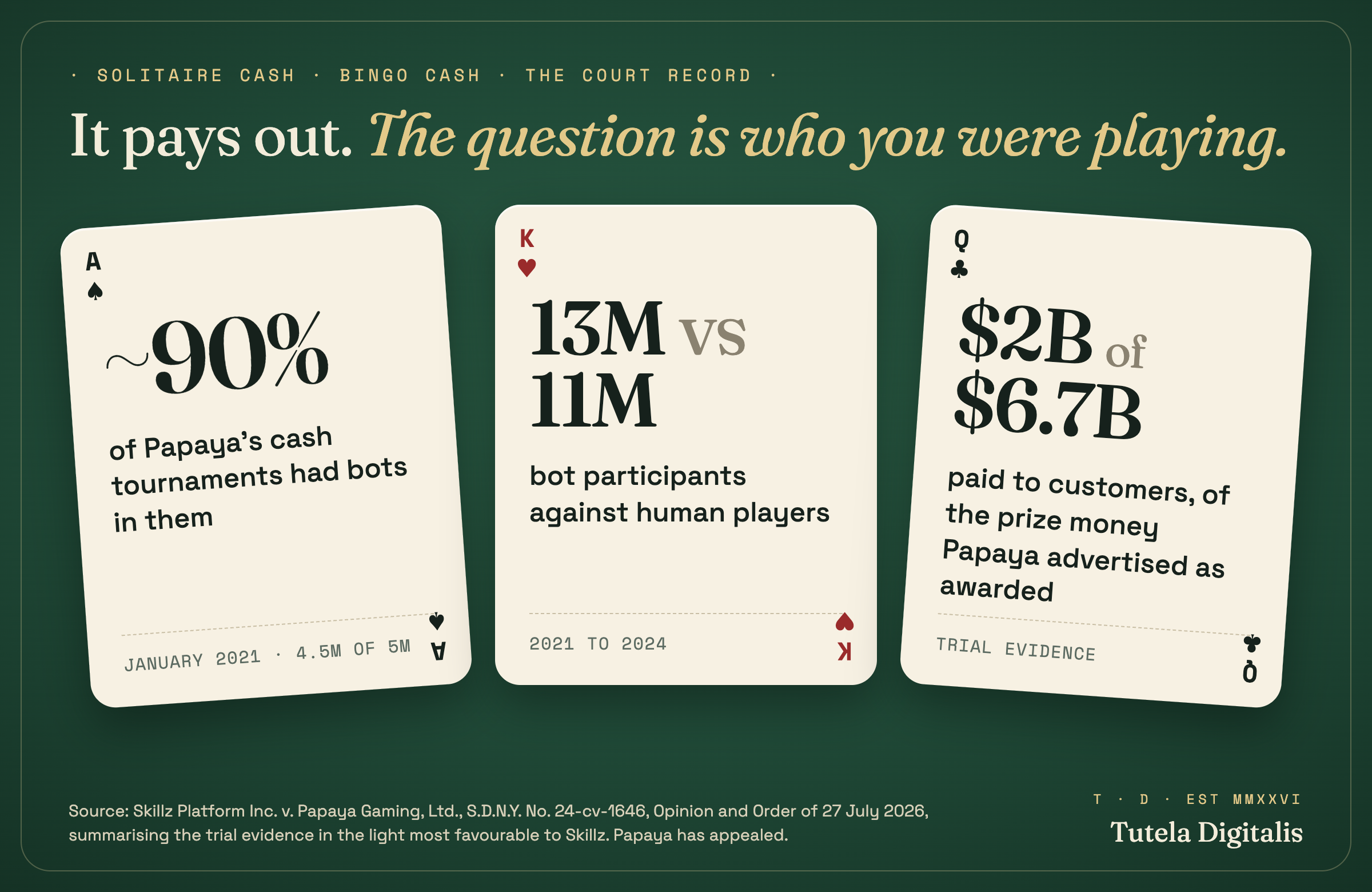
- In January 2021, Papaya used bots in about 90% of its cash tournaments, 4.5 million of 5 million. Just before it stopped, near the end of 2023, bots were still in roughly half.
- Between 2021 and 2024, bots accounted for over 13 million of the participants on Papaya's platform, compared with about 11 million human players.
- "Tailored bots" designed to give a particular player a win or a loss ran in over 630 million tournaments, about a quarter of the 2.6 billion Papaya hosted from 2021 to 2024. More than 6.1 million people played at least one tournament with bots designed to make them lose, and more than 7.3 million with bots designed to make them win.
- Because of the bots, Papaya paid customers roughly $2 billion of the $6.7 billion it advertised had been awarded in prizes.
- When players complained that they suspected bots, Papaya denied it. The opinion gives an example of a complainant's account being closed on a co-founder's instruction, and says Papaya removed posts complaining about suspected bots from its Facebook group.
Denying Papaya's post-trial motions, the judge wrote that there was "overwhelming evidence at trial that Papaya intentionally engaged in an advertising scheme to deceive consumers about the nature of its product". The opinion's procedural history also records that Papaya's executives invoked their Fifth Amendment right against self-incrimination at their depositions in March 2025, and sought to withdraw that invocation on the eve of trial. For its part, Papaya's counsel told the jury that "Papaya has taken responsibility for its actions" and "stopped using bots", and Papaya told the court it stopped using bots to create liquidity in cash tournaments in November 2023.
Two days later, in a second opinion, Judge Cote put it in her own words: from 2019 through 2023 Papaya used bots as players to fill its tournaments and control their outcomes, and "nonetheless falsely conveyed in its advertising that its games were fair and were games of skill in which human beings competed against each other". She also wrote that Papaya appears to have stopped using bots as players in late 2023. Skillz asked the court to make Papaya show every player a warning screen about the bots for six months. The judge refused, partly because there was no adequate showing of how many current players had been exposed to the false advertising.
The players' case: $15 million, 4.2 million class members, about $22 per player who took part
Players brought their own class action in Los Angeles, Barcelo v. Papaya Gaming (case 24STCV32626). It alleged that Papaya misled people into believing its games were skill-based when they were not, because of bots in contests. Papaya denies all the claims, and the court-approved notice stresses that the settlement is not an admission of wrongdoing.
The settlement covers people in the United States who had a Papaya account and made a deposit between 1 January 2019 and 5 September 2024. Papaya agreed to fund $15 million. On 25 March 2026, Judge Samantha Jessner granted final approval, and her ruling records the numbers:
| Class members | 4,237,084 |
|---|---|
| Claim forms filed | 67,183, of which 43,714 approved |
| Players due In-Game Cash automatically (active accounts, no claim needed) | 383,589 |
| Participating class members in total | 427,303 |
| Average payment per participating member | $22.23 |
| Amount to be distributed to players | $9,554,495.08, per the ruling. The fund also pays $5 million in attorneys' fees and costs, up to $389,886 for administration and $3,000 in service awards |
| Settlement as a share of Papaya's maximum exposure, as estimated by class counsel | about 0.24% |
The court accepted the amount as reasonable given the risks, including the likelihood that Papaya could force players into individual arbitration. Nine objectors argued it was too small and pointed to a claims rate of 1.06%. The settlement records that Papaya's terms of use state that after the initial free tutorial games players are matched only with human players, and that an independent third party periodically tests for bots. Papaya agreed to update its terms if those practices change.
The claim deadline was 30 January 2026, so there is nothing new to file. Settlement emails attract fakes, as they did around the AT&T data breach settlement. The official site is MobileGamingSettlement.com and the notice lists the administrator's line, 1-833-637-4073. Administration costs are paid out of the fund itself, so the administrator has no reason to ask you for money.
What happened next: an appeal and an insolvency filing
By 31 August 2026, Papaya had appealed to the Second Circuit (case 26-2434), so the judgment can still be changed on appeal.
Before that, on 2 August 2026, Chapter 15 petitions were filed in the US Bankruptcy Court in Delaware for Papaya Gaming Ltd. and its US subsidiary, Papaya Gaming Inc. (the subsidiary's case is 26-11218). Filed by the companies' foreign representative, they ask the court to recognise a restructuring proceeding in the Tel Aviv District Court under Israel's Insolvency and Financial Rehabilitation Law, brought to approve a debt arrangement addressing Papaya's liabilities. Chapter 15 is the part of US bankruptcy law that deals with cross-border cases; the US courts explain that it lets a foreign representative ask a US court to recognise a foreign insolvency proceeding.
Nothing in the public filings I read says what this means for player balances or for settlement payments still due, and I will not guess. What I would do with money sitting in any of these apps is simple: withdraw what you can, and do not leave a balance there that you could not afford to lose.
The promises, decoded: three lines from Papaya's own record
Each line below is Papaya's own wording as quoted in the 27 July 2026 opinion, from the trial evidence. For each one: the lever it pulls, why it works on careful people, and the move that breaks it. The analysis is ours; the words are theirs.
- Beat 1 · what you hear“Fair experience for everyone.”
The lever: A fairness promise you cannot check.
Why it works: The court records that Papaya assured players they would be matched with others within the same skill level to ensure a "fair experience for everyone". Fairness is the one thing a player inside the app has no way to test, so the promise does all the work. When you lose, you blame your play. When you win, you believe you earned it.
The counter-move: Treat "fair" and "skill-based" as marketing until something outside the app backs them. The court record is outside the app. So is a search of the developer's name with "lawsuit" before you deposit.
- Beat 2 · what you hear“No vested interest”
The lever: Neutral house.
Why it works: A game that says it does not care who wins sounds like a referee, not an opponent. According to the trial evidence the court summarised, some of Papaya's bots, described in the opinion as tailored bots, were built to give a chosen player a loss, and others to give a chosen player a win. A player on a losing streak could be handed a win to keep them entering paid tournaments.
The counter-move: Notice how you feel straight after a win that came out of nowhere. That is the moment the app most wants your next entry fee. Stop on a win, withdraw, and decide tomorrow.
- Beat 3 · what you hear“We do not use bots or computer players.”
The lever: Denial to the people who noticed.
Why it works: The court records that when players complained they suspected bots, Papaya told them it "want[s] to clarify that we do not use bots or computer players", and it describes a complainant's account being closed and complaint posts being removed from Papaya's Facebook group. A flat denial from the company can be enough to make a player doubt their own judgement.
The counter-move: A company's reply to a complaint is not evidence. Keep your own screenshots and dates, and if you have a dispute about money, put it in writing to the company and to your state attorney general.
The levers in depth: why smart people fall for scams · why scammers are so nice · the scammer's sales playbook
How to check any cash-prize game before you deposit
Papaya is one company, and other apps promise cash prizes for solitaire, bingo, pool and puzzle games too. These eight checks take about twenty minutes and work on any of them.
- Look up the developer, not the app. Find the developer name on the app store listing and search it with the words lawsuit and settlement. Court dockets on CourtListener are free to read.
- Read the withdrawal rules before the deposit screen. Check the minimum withdrawal, the fee, the processing time, what ID you may need, and whether people in your state can withdraw winnings at all or only deposits.
- Check your state. Papaya's terms list Bonus Cash States where prizes are Bonus Cash that cannot be redeemed for real money, and states where it no longer offers real-money play for Solitaire Cash and Bingo Cash.
- Test the cash-out early with a small win. Withdraw a small balance before you build a large one. Papaya's help article for Bonus Cash States says only one withdrawal can be in progress at a time and that withdrawals are processed within 14 days.
- Treat bonus money as a coupon. Bonus credit keeps you playing. Only money you can withdraw is money.
- Never pay to unlock a withdrawal. If any app or person asks for a deposit, a tax or a fee before you can withdraw, stop. That is how task scams keep the money, whatever the app looks like.
- Keep a record. Screenshot balances, entry fees and withdrawal requests with dates. If a withdrawal stalls, you will need them for the company, your bank and your state attorney general.
- Set a stop rule before you play. Decide in advance how much you will spend in a week and stop when you reach it, win or lose.
If an app is refusing to release money, put your complaint to the company in writing, keep copies, and if it goes nowhere, file with your state attorney general. If you paid by card for deposits you did not authorise, your card issuer is the faster route; see how to dispute a charge with your card issuer. If you have already sent money to an app that keeps asking for more before a withdrawal, read what a task scam looks like, because that is the same machine with a different skin. And for the wider picture of how gambling-style platforms resolve complaints, see our review of 254 casino-related complaints.
Whether an app pays out is the easy question, and the answer for Solitaire Cash is yes. The question worth twenty minutes before any deposit is who you are really playing against, and the place to find that answer is the court record, not the app store reviews.
Questions about Solitaire Cash and Bingo Cash
Is Solitaire Cash legit?
It is a real app, made by Papaya Gaming, and players do withdraw money from it. Its maker also faces several US court cases, and two matter most for players. In July 2026 a federal court in New York entered a $729 million judgment against Papaya after a jury found it liable for false advertising, and the judge wrote that Papaya used bots as players in its cash tournaments from 2019 through 2023. Papaya has appealed. Its current terms say players are matched only with humans after the free tutorial games.
Does Solitaire Cash actually pay real money?
Yes, in states where real-money play is offered. Papaya's terms refer to a minimum withdrawal amount and withdrawal fees, and its help article for Bonus Cash State players says withdrawals are processed within 14 days, usually arrive within 2 business days, and can only be requested one at a time. Its terms say a withdrawal may require ID such as a copy of a government-issued ID. In Bonus Cash States, prizes are Bonus Cash that cannot be redeemed for real money.
Did Solitaire Cash use bots?
The federal court did not single out individual games, but in Skillz v. Papaya, Judge Denise Cote wrote on 29 July 2026 that Papaya, which makes Solitaire Cash, employed bots as players in its online cash tournaments from 2019 through 2023, and that it appears to have stopped in late 2023. Papaya told the court it stopped in November 2023. The court's summary of the trial evidence says bots were in about 90% of Papaya's cash tournaments in January 2021. Papaya's terms now say players are matched only with humans after the tutorial games.
Is Bingo Cash legit?
Bingo Cash is another Papaya Gaming app, so the same record applies. The California class settlement covered deposits in any Papaya game, and its complaint names Bingo Cash alongside Solitaire Cash, Bubble Cash and 21 Cash. The federal case concerned Papaya's cash tournaments as a whole. Bingo Cash pays withdrawals under the same rules, except in Bonus Cash States. Papaya's terms say it no longer offers real-money Bingo Cash or Solitaire Cash to people in Michigan and Montana.
Can I still claim money from the Papaya Gaming settlement?
Not with a new claim. The claim deadline in Barcelo v. Papaya Gaming was 30 January 2026, and the court granted final approval on 25 March 2026. People who filed valid claims are to be paid by the method they chose, and players with active accounts are to receive In-Game Cash without a claim; the court has set a review of the final report for 2 April 2027. The official site is MobileGamingSettlement.com and the administrator's line is 1-833-637-4073. Administration costs come out of the settlement fund, so nobody should ask you for a fee.
Why can't I withdraw my winnings from Bingo Cash?
Usually because of where you are. Papaya's help center says that in Bonus Cash States players can withdraw only what they deposited, not winnings; for Bingo Cash it lists Arizona, Louisiana, Michigan and Montana. Elsewhere, check that you are above the minimum withdrawal, that you have no other withdrawal in progress, and that you have provided the ID the app requests. If money is withheld without a reason, complain in writing and keep copies.
Sources and review
Every source was read at origin on 26 October 2026, including the court opinions, orders and dockets, the settlement documents, Papaya's terms of use and help center, and the US App Store listing. Figures from the 27 July 2026 opinion describe the trial evidence viewed in the light most favourable to Skillz; Papaya has appealed. In Barcelo v. Papaya, Papaya denies all claims and the settlement is not an admission of wrongdoing. This is general information, not legal or financial advice.