SEXTORTION · THE FIRST HOUR, AND THE SECOND SCAM
By Peter · 9 November 2026 · 16 min read
Someone is threatening to share your photos. Do not pay them. And do not pay the “help” that finds you next.
Sextortion is two crimes stacked on top of each other. The first is the blackmailer, who runs a script on stranger after stranger and counts on your shame. The second is waiting in your search results, selling you silence at a higher price.
Sextortion is blackmail with an intimate image, real or claimed. Do not pay: paying marks you as someone who pays. Stop replying, screenshot everything, report the account, and remove the images free with Take It Down (under 18) or StopNCII (adults). Report it to police and tell someone you trust. Skip paid “sextortion help”: in October 2026 the FTC sued one firm, alleging it took at least $60 million from victims. Emails quoting an old password are bluffs.
“Victims of sextortion should never have to pay fees to receive assistance or to have their non-consensual images removed from online or in-app postings.”
Someone has your photos and wants money, or they will send them to everyone you know. Maybe it started as a flirty chat that turned in minutes. Maybe it is an email that says a hacker filmed you through your webcam. Either way, the message is built to do one thing: make you panic badly enough to pay before you think.
So think, for ten minutes. Here is what the blackmailers do not want you to know. Canada's Cybertip.ca says most of these money demands come from international organised criminal networks. They are not a heartbroken stranger who will go away if you say sorry. They run the same script on person after person, and the panic you feel right now is the part of the script that makes it pay. Shame is the second wound, and they count on it to keep you quiet.
This page gives you the first hour, step by step; the difference between a real threat and a bluff; the free help in the US, UK, Canada, Australia and Ireland; and the second scam, the paid “helplines” that the FTC says turned victims' fear into a business. If you are not okay right now, jump to the crisis lines.
The first hour: eight orders, in this order
Do these before you do anything else, and do not skip the third one. You will want to delete everything. Save it first.
- Stop replying. Do not argue, plead or bargain, and do not send anything else. Every reply tells them you are still on the hook. Australia's eSafety Commissioner puts it first: stop all contact.
- Do not pay, not even once. Paying does not buy the images back. It tells them you are a person who pays, and the next demand is bigger. eSafety says blackmailers usually give up when they realise you won't pay and move on to the next target.
- Screenshot everything before you block. Save the profile, the username or number, every threat, and any payment details they sent, such as a bank account, a gift card request or a crypto wallet address. Police and the platforms work from this.
- Block and report the account. Report the account with the app's own safety tools, then block it on every platform where it can reach you.
- Take the images down at the source, free. If you were under 18 in the image, use Take It Down from NCMEC. If you were 18 or older, use StopNCII.org. Both make a digital fingerprint of the image on your own device, so the image never leaves your phone, and participating platforms use the fingerprint to find copies on their public services and remove them.
- Tell one person you trust. A friend, a parent, a partner, a counsellor. The whole crime runs on you staying silent. Every agency we read says the same thing: you are the victim of a crime and it is not your fault.
- Report it to the police. In the US, tips.fbi.gov or 1-800-CALL-FBI. In the UK, 101, or 999 in an emergency. In Canada, Australia and Ireland, your local police, with the specialist channels in the table on this page.
- Close any ad or caller that offers to make it stop for a fee. Real help is free. The FBI says victims should never have to pay to receive assistance or to have their images removed.
Two tools on that list deserve a sentence more, because people do not believe they work without sending the image to a stranger. Take It Down, run by the National Center for Missing & Exploited Children, is free and anonymous for images taken when you were under 18: it creates a “hash”, a digital fingerprint, on your device, and only the fingerprint goes to participating platforms. StopNCII.org does the same for adults, and is operated by the UK's Revenge Porn Helpline. Neither one ever sees the picture.
In the US there is now a legal deadline as well. The FTC says that under the Take It Down Act, platforms must remove a reported intimate image within 48 hours at no cost, and a platform that does not comply can be reported at TakeItDown.ftc.gov.
Bluff email or real threat? Two different crimes wear the same word
The bluff email. It says a hacker put malware on an adult website, took over your webcam, recorded you and copied your contacts, and that the video goes to everyone unless you pay in Bitcoin. It often shows a password you really used once.
In July 2018, KrebsOnSecurity described the twist that added a real password, and Canada's anti-fraud centre was still warning about new versions in 2024. The UK's National Cyber Security Centre is blunt about it: the sender does not know if you have a webcam, what you visited or how you talk to people. They are guessing, and gambling that enough people pay.
The password proves one thing: it leaked in an old data breach. It does not prove a camera. Do not reply: the NCSC's advice is not to engage with the sender at all. Change that password anywhere you still use it, check your address at haveibeenpwned.com as the NCSC suggests, and report the email: in the UK forward it to report@phishing.gov.uk, in the US file it at ic3.gov.
In Canada, the Canadian Anti-Fraud Centre warned in October 2024 about a newer version that adds your full name, your phone number, your home address and a screenshot from a search engine. That is data anyone can buy or look up, not a camera either.
The real threat. This one starts with a person. The UK's Revenge Porn Helpline says the blackmailer often poses as a stereotypically attractive man or woman, gains your trust and quickly persuades you to send an image, or records you without your knowledge. Then come the threats, the demand for money, and screenshots of your friends list to prove they can reach the people you care about.
The Helpline adds the detail that explains everything: the amount is set to be just enough to make you pay, it will not be enough, and they will come back for more. According to Cybertip.ca's 2024 figures, boys are typically extorted for money and girls for more images. The National Center for Missing & Exploited Children says teenage boys have been the most common targets in recent cases.
It can also be built from nothing. Ireland's Hotline.ie treats a digitally altered image of you, shared without consent, as intimate image abuse, so a fake is still a crime and can still be removed.
Cases you may have heard of, and what each one teaches
Sextortion is not new, and it is not rare. Some of these names will be familiar. Each one shows a different part of how it works, and why the advice above is the advice.
If any of this is too close to home tonight, the free lines are a little further down this page, open now, and staffed by people who are not selling anything.
The second scam: the “sextortion help” the FTC says took $60 million
Now the part that almost nobody warns you about. You are panicking, you search for help, and the results can include ads for paid “sextortion helplines” and “digital forensics” firms that promise to track the blackmailer down and make it stop. On 13 October 2026 the Federal Trade Commission announced that a federal court had granted its request to temporarily halt one of them.
The FTC's complaint, filed in the US District Court for the Northern District of Ohio, is against Digital Forensics Corporation, its owner and several affiliated companies. The FTC's consumer alert says the company operates BlackmailHelpline.com, DigitalForensics.com, CyberBlackmail911.com and SecurityBreach911.com. According to the FTC's press release, the complaint alleges:
“Digital Forensics preys on consumers already in crisis, exploiting victims of sextortion by using fear to pressure them into paying thousands of dollars for services that are never provided.”
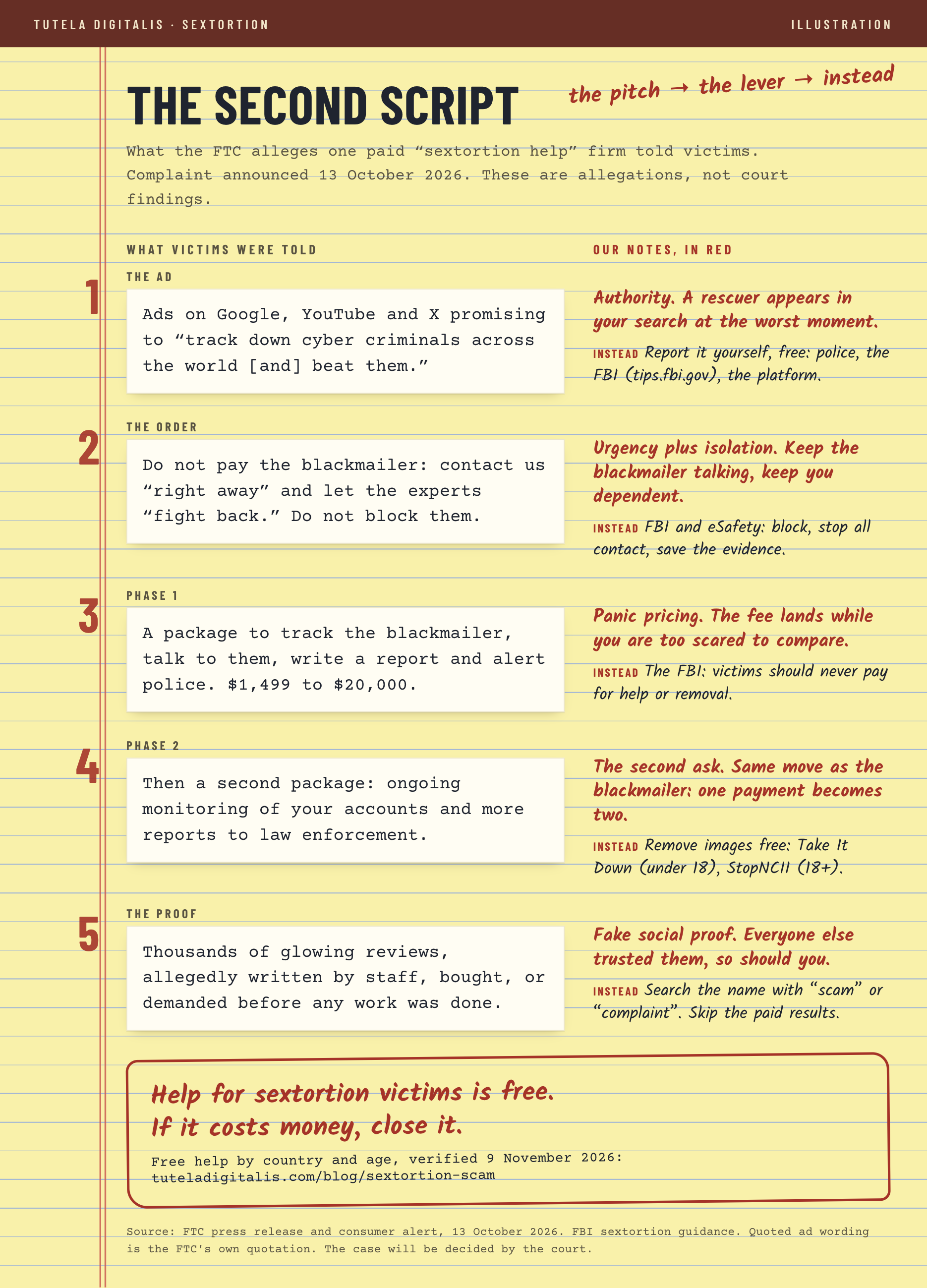
How to spot a paid fixer before it costs you. It appears as an ad at the top of your search. It promises to “track down”, “identify” or “stop” the blackmailer. It tells you not to block, or to keep talking. It pushes you onto a phone call and names a price while you are still panicking. Its reviews all sound alike. The FTC's advice is to search any company's name with words like “scam”, “review” or “complaint”, and to skip the paid results. The simpler rule is the FBI's: help for sextortion victims should not cost money.
Free help, by country and age
This is every free channel we could verify at its own website on 9 November 2026. For other kinds of fraud, our guide to reporting a scam covers each country. Removal tools are listed by your age in the image, not your age today. When in doubt, call the talk line in the last column: they will point you to the right place.
| Country | Image taken under 18 | Image taken at 18 or older | Report the crime | Talk to someone now |
|---|---|---|---|---|
| United States | Take It Down (takeitdown.ncmec.org). NCMEC CyberTipline, 1-800-843-5678. | StopNCII.org. If a platform has not removed your image 48 hours after your request, report it at TakeItDown.ftc.gov. | tips.fbi.gov or 1-800-CALL-FBI. Bluff emails: ic3.gov. | 988, call or text. |
| United Kingdom | Report Remove, run by Childline and the Internet Watch Foundation. Childline, 0800 1111 (under 19). | Revenge Porn Helpline, 0345 6000 459 (Monday to Friday, 10:00 to 16:00). StopNCII.org. | Police on 101, or 999 in an emergency. Forward bluff emails to report@phishing.gov.uk. | Samaritans, 116 123. |
| Canada | Cybertip.ca. NeedHelpNow.ca helps youth get images removed and accounts taken down. | StopNCII.org. | Local police. Extortion emails: the Canadian Anti-Fraud Centre. | 9-8-8, call or text. Kids Help Phone: text CONNECT to 686868. |
| Australia | eSafety Commissioner (report image-based abuse). The ACCCE takes reports of online child exploitation. | eSafety Commissioner. StopNCII.org. | Local police, through eSafety's police and legal help page. | Kids Helpline, 1800 55 1800 (25 or younger). Lifeline, 13 11 14. |
| Ireland | Hotline.ie. | Hotline.ie (report line +353 86 8116273) can request removal and, in some cases and if you want, liaise with Gardaí. StopNCII.org. | An Garda Síochána. Garda Confidential Line, 1800 666 111. Immediate danger: your local Garda station. | Samaritans, 116 123. |
Each of these is run by a government agency, a police force or a non-profit, and each of them says some version of the same sentence. eSafety puts it as: it is not your fault, it can happen to anyone and you are not alone. The UK's Revenge Porn Helpline notes that threatening to share an intimate image without consent is against the law in the UK.
Report it to police on 101 even if the blackmailer is overseas: the Helpline says police may be able to do less, but the report adds to national intelligence on these crimes. For under-18s in the UK, the IWF's Report Remove tool, built with Childline, lets young people confidentially report images of themselves so they can be removed. In Canada, Cybertip.ca and NeedHelpNow.ca do the same work for youth, and in Australia the ACCCE takes reports of online child exploitation.
If it is your child: your first move is help, not punishment
The FBI's advice to parents is to keep the door open, so children know that whatever happened, the first thing you will do is help. These criminals rely on fear of exactly the conversation you are about to have. Your child may have broken a family rule. They are still the victim of a crime, and the crime is the threat, not the photo.
Sextortion often begins with someone pretending to be a young person they are not, the same opening move we take apart in our guide to dating app safety and in why scammers manufacture urgency.
The blackmailer sells silence. The fake helper sells the same silence at a higher price. Do not buy it from either of them: save the evidence, take the images down for free, report it, and tell one person tonight.
Questions about sextortion threats, emails and paid help
What should I do if someone is threatening to share my photos?
Stop replying and do not pay. Screenshot the profile, the threats and any payment details, then block and report the account on the platform. Use the free removal tools: Take It Down if you were under 18 in the image, StopNCII.org if you were 18 or older. Both fingerprint the image on your own device, so you never send it to anyone. Tell one person you trust, and report it to the police: in the US at tips.fbi.gov or 1-800-CALL-FBI, in the UK on 101. Ignore anyone who offers to make it stop for a fee.
Should I pay a sextortion scammer?
No. Paying does not get the images back and does not end the threat. It proves you pay, so the usual result is a second demand. Australia's eSafety Commissioner says blackmailers usually give up when they realise you won't pay and move on to the next target, and its first instruction is to stop all contact and not send money or more images. If you have already paid, stop now. You have not lost the right to report it, and police still want to hear from you.
Is a sextortion email that shows my password real?
Almost always not. The classic email says a hacker recorded you through your webcam on an adult site and demands Bitcoin. The UK's National Cyber Security Centre says the sender is guessing: they do not know if you have a webcam or what you visited. A real old password in the email proves only that it leaked in a past data breach, which KrebsOnSecurity documented in the 2018 wave of these emails. Do not reply, change that password anywhere you still use it, and report the email (in the UK to report@phishing.gov.uk, in the US at ic3.gov).
Are paid sextortion help services legit?
Be very careful. In October 2026 the FTC sued Digital Forensics Corporation, which runs sites including BlackmailHelpline.com, alleging it took at least $60 million from sextortion victims, charged between $1,499 and $20,000, often did not do the work it promised, told victims not to block the blackmailer, and generated fake reviews. These are allegations and the court will decide them. The FBI's own advice is that victims should never have to pay for help or to have images removed. Real help is free.
Will they actually post my photos?
Nobody can promise either way, and anyone who promises you an outcome for money is selling something. What the agencies say is that the threat is the product: eSafety says blackmailers usually move on when they realise you won't pay. If they do post an image, it can be removed. Report it to the platform, use Take It Down or StopNCII, and in the US a platform must remove a reported intimate image within 48 hours under the Take It Down Act. Report a platform that does not at TakeItDown.ftc.gov.
Is sextortion a crime even if I sent the photo myself?
Yes. Sending an image to someone you trusted is not a crime against them. Threatening to share it to get money or more images is. The UK's Revenge Porn Helpline says it is against the law in the UK to threaten to share an intimate image without consent, and the FBI says young people being exploited are victims of a crime and should report it. Ireland made sharing intimate images without consent an offence under the Harassment, Harmful Communications and Related Offences Act 2020. You will be treated as the victim.
Sources and review
Every source was read at origin on 9 November 2026. Everything said here about Digital Forensics Corporation is an allegation in a complaint brought by the FTC, and the court has not ruled on it. Statistics are attributed to the agency that published them, for the year it covers. Tutela Digitalis has no relationship with any company named here, and we do not charge anyone for help with sextortion.