MEDICARE · OPEN ENROLLMENT 2026
By Peter · 19 October 2026 · 11 min read
Medicare scam calls: one question sorts every call. Did you ask for it?
15 OCT54 DAYS OF OPEN ENROLLMENT7 DEC
Medicare does not cold call. Medicare.gov says it will never call you to sell you anything, and federal rules bar Medicare Advantage and drug plans and their agents from cold calls, robocalls, texts and voicemails you did not ask for. So an unexpected call about "extra benefits", a "new card" or "updating your plan" that asks for your Medicare number is a scam or a rule breaker. Hang up and call 1-800-MEDICARE yourself.
"Medicare knows your Medicare number. They're not going to be calling you, texting you, or emailing you, saying that they need to confirm your Medicare number."
The phone rings in the middle of the morning. A friendly voice, a first name, "Medicare", a recorded line. They want to make sure you are getting everything you are entitled to this year. It does not sound like a scam. It sounds like paperwork, and paperwork is something people over 65 are used to cooperating with.
Between 15 October and 7 December, Medicare's Open Enrollment period, those calls come more often. The FTC says scammers get more active every year around it. One retired Medicare beneficiary told News 5 Cleveland she gets Medicare calls several times a day although she is on the Do Not Call registry. Most guides answer this with a list of red flags. There is a shorter test, written into Medicare's own guidance and federal rules: who started the call?
What do Medicare scam calls actually say?
Here are openings recorded or reported in 2026, word for word. Notice that none of them starts with a request for your number. That comes later.
"Hi, this is Casey. I'm a Medicare advisor calling on a recorded line. How are you today?"
"This is Shelly in the Medicare enrollment center, on a recorded line, and I see here in the past you inquired about your Medicare supplement coverage. Can you hear me OK?"
"Hello. Good morning. Lynn here from Medicare Services. I'm reaching out because we're helping folks maximize their benefits this enrollment season. Things like dental coverage, vision, even grocery [...] confirm you have Part A and Part B?"
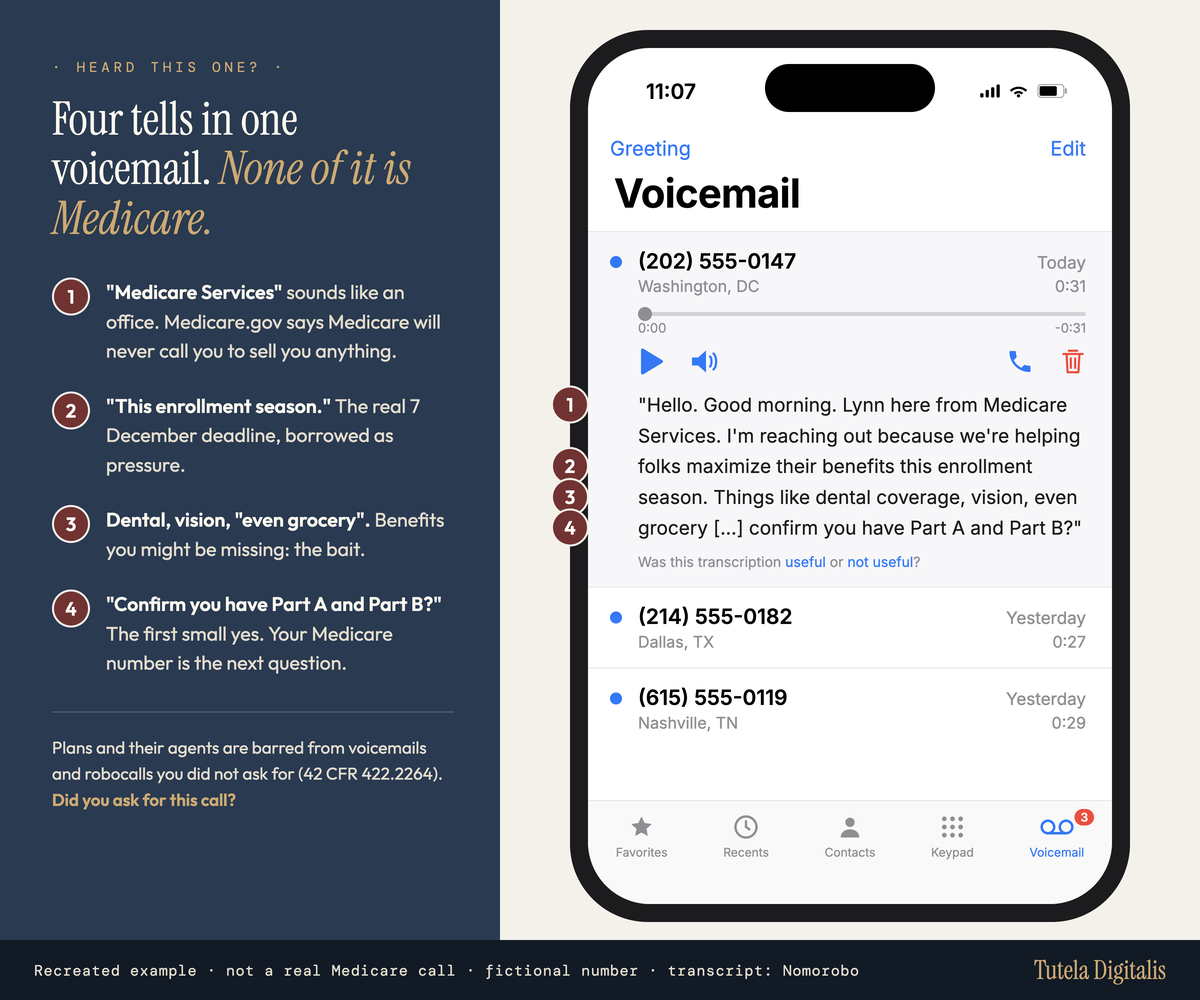
Texts follow the same script. In reports collected by the Better Business Bureau and published on 8 October 2026, one person described a text "saying that my health benefits were about to expire and I needed to call the number to renew", after which the "representative" demanded payment. Another described a caller who asked whether they had received "a new updated Medicare card in the mail", then asked them to read out details from the old one, including the date in the lower right corner, and finally the card number.
Who is actually allowed to call you about Medicare?
Very few people, and Medicare's own guidance says so. Federal regulations, current as of October 2026, cover the companies that sell Medicare Advantage and drug plans. Read together, they turn a confusing season into a short table.
| Who is calling | Can they call you without being asked? | What the source says |
|---|---|---|
| Medicare itself (1-800-MEDICARE) | Only in limited situations, never to sell | Medicare.gov: Medicare "will never call you to sell you anything" and will only call and ask for personal information in limited situations, like returning your call after you joined a plan, reported fraud or left a message. |
| A Medicare Advantage or drug plan you are not in, or an agent or broker selling one | No: no cold calls, robocalls, texts or voicemails | 42 CFR 422.2264 and 423.2264 bar unsolicited telephone solicitation, including calls based on referrals. A call is not unsolicited if you gave consent or contacted them first. |
| Your current plan | Yes, about your plan | The same rules let a plan call its current members about plan business, and it must tell them in writing at least once a year how to opt out of those calls. |
| Anyone who asks for your Medicare number, Social Security number or bank details on a call you did not start | Treat it as a scam | Medicare.gov: do not share your Medicare Number with anyone who contacts you by phone, email or in person "unless you contacted them first and gave them permission to contact you". |
Put simply: if you did not start the conversation, the person selling you a Medicare plan on the phone is either breaking the rules or not selling a real plan at all. You do not need to work out which. The FCC passes on the same instruction from Medicare.gov: never join a Medicare health or drug plan over the phone unless you called. The CMS rules quoted here govern Medicare Advantage and Part D plans; whatever the caller is selling, that advice holds.
Why are you getting so many Medicare calls?
Three things stack up in the autumn. First, the calendar. Open Enrollment runs from 15 October to 7 December, and Medicare.gov says that is when you can join, drop or switch Medicare Advantage and drug plans, with changes starting on 1 January. A real deadline is the best cover a fake one can have.
Second, consent. The same federal rule that bans cold calls says a call is not unsolicited if you gave consent or contacted the plan first, and gives the example of calling someone who returned a business reply card asking to be contacted. A reply card, a web form that asked for your phone number, or a call you made to a number in an advert can be where a stream of follow-up calls begins.
Third, search. The FTC warned on 28 September 2026 that during Open Enrollment, scammers and dishonest businesses pay to appear at the top of search results, use web addresses that look like Medicare.gov, and copy official-looking logos. If you use the link or phone number in such an ad, the FTC says, you might pay for "a scammy plan that's not health insurance" or expose yourself to medical identity theft. Type Medicare.gov yourself, scroll past results marked "Ad" or "Sponsored", and check for the .gov ending.
The volume is measurable. In the FCC's breakdown of robocall complaints for September 2026, insurance and healthcare calls made up 12%, one of its three largest categories, in the month before Open Enrollment opened.
The call, decoded: five beats from hello to your Medicare number
Every beat below is a line from a recorded call or a published victim report. For each one: the persuasion lever it pulls, why it works on careful people, and the move that breaks it. The analysis is ours; the words are theirs.
- Beat 1 · what you hear“Hi, this is Casey. I'm a Medicare advisor calling on a recorded line. How are you today?”
The lever: Borrowed authority.
Why it works: "Medicare advisor" sounds like a job inside Medicare, and "recorded line" is the language of regulated call centres. Both suggest rules are being followed before any rule has been mentioned. The transcript is one the FCC publishes, from audio recorded by Nomorobo.
The counter-move: Ask yourself one question, not the caller: did I ask for this call? Medicare.gov says Medicare will never call you to sell you anything. If you did not ask, hang up.
- Beat 2 · what you hear“I see here in the past you inquired about your Medicare supplement coverage. Can you hear me OK?”
The lever: A manufactured history, then an easy yes.
Why it works: Claiming you once asked about coverage plants the idea that this call is a follow-up you started, which is exactly the situation in which a call is allowed. "Can you hear me OK?" is the first small yes, and small yeses keep people on the line.
The counter-move: If you do not remember asking, treat the claim as part of the script. Even if you did fill in a form once, you can end the call and contact Medicare or a plan yourself.
- Beat 3 · what you hear“We're helping folks maximize their benefits this enrollment season. Things like dental coverage, vision, even grocery…”
The lever: Gain bait with a deadline.
Why it works: The pitch is framed as money you are leaving on the table, and "this enrollment season" adds a clock. Open Enrollment really does end on 7 December, so the deadline borrows a true date to make the hurry feel reasonable.
The counter-move: Plan changes do not need a stranger. Compare plans yourself at Medicare.gov or with your State Health Insurance Assistance Program (SHIP) before 7 December.
- Beat 4 · what you hear“They asked if I got a new updated Medicare card in the mail.”
The lever: A problem you did not know you had.
Why it works: A "new updated" card, in a BBB Scam Tracker report, or an "upgraded", "plastic" or "gold" card, which AARP's Fraud Watch Network told News 5 Cleveland it has heard recently, sounds like an administrative change you might have missed. The worry that you missed something makes it easy to cooperate.
The counter-move: The FTC says real Medicare cards are free and mailed to you automatically. If yours is lost, you can print an official copy from your own Medicare.gov account.
- Beat 5 · what you hear“Confirm you have Part A and Part B?”
The lever: The ladder to the number.
Why it works: Each question is small: which parts you have, your name, your address, then the date on the corner of your card. A BBB Scam Tracker report describes the same climb: a question about a new card, then name and mailing address, then the date on the old card, then a request to read out the card number. By then it feels like the next small step.
The counter-move: The number is the payload. "Medicare knows your Medicare number," as AARP's Amy Nofziger put it. Nobody who already serves you needs you to read it out on a call they started.
The levers in depth: why scammers sound official · why scammers create urgency · the scammer's sales playbook
What happens to the number afterwards explains why they work so hard for it. HHS-OIG describes a scheme in which callers claiming to work for Medicare offer free equipment or services, collect the Medicare number, and then bill Medicare every month for supplies, such as urinary catheters, that may never arrive. The FCC, citing the FTC, warns of medical identity theft, where someone uses your details to get care, drugs or devices, or to submit claims, all in your name. And the BBB reports callers who push you to switch to a supposedly cheaper plan that keeps all the same services.
What should you do at the stage you reached?
Start from what you actually shared. Answering the phone costs nothing. Each detail after that changes who you should call.
You only got the call, text or voicemail
You confirmed your name, address or which parts you have
You were enrolled in, or switched to, a plan you did not choose
Where do you report a Medicare scam call?
Report to Medicare first, then to the agencies that track the callers:
- Medicare: 1-800-MEDICARE (1-800-633-4227), or report Medicare fraud online through Medicare.gov.
- HHS-OIG: 1-800-HHS-TIPS (1-800-447-8477) for suspected Medicare fraud, as its alert asks.
- FTC: ReportFraud.ftc.gov, which the FTC asks for after you tell Medicare.
- FCC: a consumer complaint about the robocall, linked from the FCC's Medicare scams page.
- Free help: your local Senior Medicare Patrol (877-808-2468, per HHS-OIG) and the AARP Fraud Watch Network Helpline (877-908-3360, per News 5).
Not sure whether a call or message was real? The Scam Checker walks through the warning signs; it cannot look up a caller. The same pattern of an official voice and a request to confirm details runs through fake jury duty warrant calls and the government texts that are not what they claim. And if you are wondering how they got your number in the first place, see what a scammer can do with your phone number.
The script is built so that every question feels harmless on its own. Do not grade the questions. Ask who started the call, and if it was not you, hang up and dial Medicare yourself.
Questions about Medicare scam calls
Does Medicare call you?
Rarely, and never to sell you anything. Medicare.gov says Medicare will never call you to sell you anything, and that Medicare, or someone representing it, will only call and ask for personal information in limited situations, such as returning your call after you joined a plan, reported fraud or left a message. If an unexpected caller asks for your Medicare number, hang up and call 1-800-MEDICARE (1-800-633-4227) yourself.
Why am I getting so many calls about Medicare?
Partly the season and partly consent. The FTC says scammers get more active every year around Open Enrollment, which runs from 15 October to 7 December. Separately, federal rules ban Medicare Advantage and drug plans and their agents from cold calling, but a call is not unsolicited if you gave consent or contacted them first, for example by returning a reply card. Forms and ad phone numbers can be where the calls start. Scammers ignore the rules entirely.
How do I stop Medicare scam calls?
You cannot stop scammers from dialling, but you can stop them getting anything. Do not answer unknown numbers, and hang up on any caller who asks for your Medicare number, Social Security number or bank details. The FCC suggests asking your phone company about call blocking and labelling tools and checking your phone's built-in blocking. Report the calls to 1-800-MEDICARE, the FTC and the FCC so patterns can be traced.
I gave my Medicare number to a caller. What should I do?
Call 1-800-MEDICARE and say you shared your number with an unsolicited caller. Then watch your Medicare Summary Notices, or your Medicare.gov account, for services or equipment you never received. HHS-OIG says to refuse deliveries of medical equipment your doctor did not order. Report it to the HHS-OIG hotline at 1-800-HHS-TIPS. If you also shared your Social Security number or bank details, contact your bank and the FTC.
Is there a new gold or plastic Medicare card?
Treat any call offering one as a scam. The FTC says real Medicare cards are free and mailed to you automatically, and that true Medicare representatives will not call, text or email you out of the blue to ask for your numbers or a payment. AARP's Fraud Watch Network has warned about callers offering upgraded, plastic and gold cards. If you need a replacement, print or order one through your Medicare.gov account or 1-800-MEDICARE.
Can a Medicare plan or agent call me without permission?
Not to sell you a plan. Federal rules at 42 CFR 422.2264 and 423.2264 bar Medicare Advantage and Part D plans, and their agents and brokers, from cold calls, robocalls, text messages and voicemail messages you did not ask for. Your current plan may call you about plan business and must tell you yearly how to opt out. Whoever calls, Medicare.gov says not to join a plan over the phone unless you called and asked for help.
Sources and review
Every source was read at origin on 19 October 2026, including the federal regulations as published on eCFR (current to 15 October 2026). Call and text wording is quoted from the publications named. This guide covers US Medicare and is general information, not legal or insurance advice; Medicare, your plan and your State Health Insurance Assistance Program decide individual coverage questions.