Yes, Vinted is legitimate. It was founded in Lithuania in 2008, it is one of the largest secondhand marketplaces in Europe, and it launched in the United States in January 2026. The useful question is not whether the company is real. In the US, sellers pay Vinted nothing at all, and the platform is funded by a mandatory Buyer Protection fee of about 5% plus $0.70 charged to the buyer at checkout. So the protection is something you bought. What you bought is a window of 2 calendar days, which opens when the parcel is marked delivered rather than when you open it, and which closes on its own if you say nothing. After that, in Vinted’s own words, it “can no longer offer a refund, compensation, or a return”.
Search that question and you will mostly find people arguing. A Reddit thread from years ago, a Trustpilot page, an app store review list, and a few articles written for resellers about whether the fees are worth it. Almost all of it is opinion about whether Vinted is any good.
None of that is the thing that decides whether you get your money back. That is decided by a handful of rules Vinted publishes openly, which take about ten minutes to read and which almost nobody reads until the parcel has already gone wrong. This is those rules, quoted, in the order they will happen to you.
Start with who pays, because it explains everything after it
One of the most common things people type into Google about this platform is not about safety at all. It is some version of how does Vinted make money, or how is Vinted free, or how is the shipping so cheap. That instinct is correct and it is worth following, because the answer sets up every rule further down this page.
In the United States, a Vinted seller pays no listing fee, no commission and no final value fee. Sell a jacket for $50 and $50 is what reaches your wallet. That is genuinely unusual, and it is the main reason sellers move to the platform from eBay, Depop, Poshmark and Mercari, all of which take a cut.
The money comes from the other side of the transaction. Every buyer pays a Buyer Protection fee at checkout, roughly 5% of the item price plus 70 cents, and it is not optional. Add shipping and paid listing boosts and you have the business.
One parcel, one clock, two people
Here is what almost no article about this platform does, and what makes the rules suddenly legible. Run a single order that goes wrong and watch it from both sides at once. The same hours, the same clock, and at every beat it means the opposite thing depending on which end of the parcel you are standing at.
Read the bottom row again, because it is the whole design in one line. The silence that ends the buyer’s protection is the same silence that pays the seller. Nobody has to do anything wrong for that to happen. There is no dispute, no decision and no villain. An order left alone resolves itself in exactly one direction, and it is not the buyer’s.
The clock, and who starts it
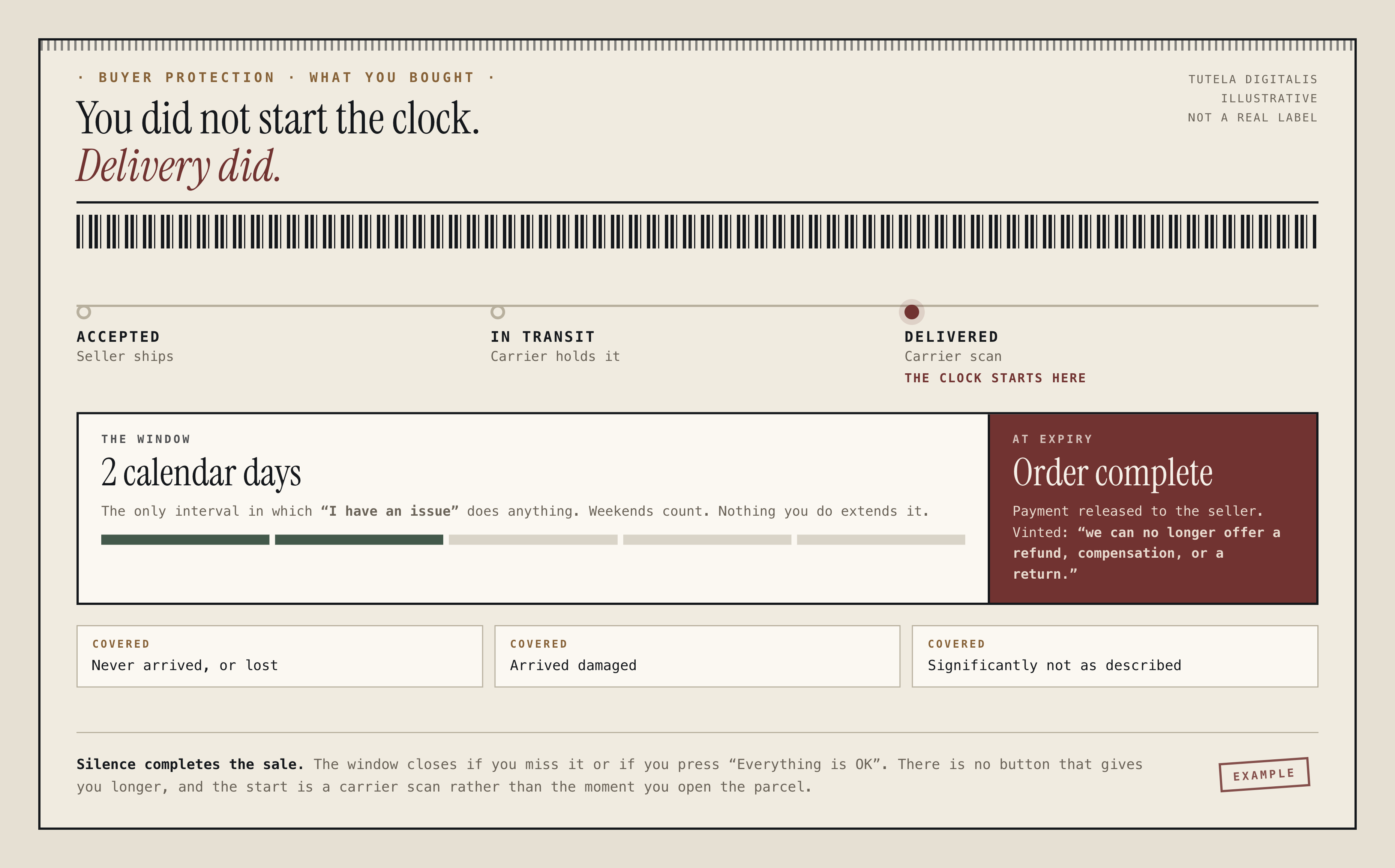
Vinted’s Refund Policy is the governing document and it is short. It says you can request a refund if an order was never shipped or is lost, arrived damaged, or is significantly not as described. Then it sets the window.
Two details in there are worth separating out, because they are the ones that catch people.
The first is calendar days. Not working days. A parcel scanned on a Friday afternoon can burn most of its window over a weekend while you are not thinking about it.
The second is that you do not start the clock. The Buyer Protection page words it as 2 days from the item being marked as delivered; the Refund Policy words it as Vinted notifying you that the order should have arrived or seems lost. Those two phrasings differ slightly, and both of them are anchored to delivery rather than to any action of yours. Opening the box does not start it. Being home does not start it. The only button that changes the window is Everything is OK, and that one ends it early, on the spot.
What proving a fake actually requires
The counterfeit route is the one worth reading before you buy anything branded, because the burden sits with you and it is specific. Vinted asks the buyer to send photographs of the whole item, the suspicious parts of it, the care label, all pages and sides, and the item’s serial number. It says it will respond in 48 hours and may suspend the order while it reviews what both sides have sent.
Then it states the standard it decides by, and the standard is the thing to notice.
Read plainly, an inconclusive case is not a draw. It resolves as authentic. That is a defensible rule for a platform to run, since the alternative is refunding on suspicion alone and no marketplace could survive that. But it is not neutral, and it means a buyer who cannot photograph a serial number well enough is in a worse position than one who can.
The fairness point belongs here too, because it is real and it is usually left out. When a counterfeit claim does succeed, Vinted refunds the price of the item, the initial shipping fee and the Buyer Protection fee itself, and says you will not have to return the item. When the system works, it works properly.
Vinted — Item seems to be counterfeit ↑The service that checks it first exists. It is not here yet.
Everything above describes authentication that happens after the item has already reached your door. Vinted also runs the other kind, where a designer item ships to a verification hub and experts check it before it continues to you, and a failed item goes back to the seller instead. It is called Item Verification, the fee is paid by the buyer, and eligible listings carry a diamond badge.
On the US site, that page opens with a note: the information “applies exclusively when the Item Verification service is introduced in your region. The launch date will be communicated”. Further down, it names where the service currently runs.
This is not a hidden fee or a broken promise. Vinted says it plainly on its own page and says the launch date will be announced. It is simply a structural difference that is easy to miss if you read a British or European guide to buying on Vinted and assume it describes your position. A buyer in Paris considering a designer bag has an option to pay someone to look at it first. A buyer in Chicago, today, does not. Their only authentication route is the one described in the section above, after the item is already in their hands, on a two day clock.
Vinted — Item Verification for designer items ↑The one move that removes all of it at once
Everything on this page assumes the transaction stays inside Vinted. There is a category of message whose entire purpose is to get it out, and it arrives politely, from either direction. Can we do this by bank transfer. Can you cancel the order and I will pay you directly. Can I collect it in person instead. Can you reserve it for me off the app.
Every one of those is the same move. Vinted’s protection is tied to Vinted’s payment system, so a payment made outside it is not covered by anything, there is no order to suspend and no window to report inside. You have not saved a fee. You have removed the product you were paying the fee for. We wrote about the same pattern on Facebook Marketplace, and on a version aimed at Vinted sellers in Portugal where the “payment” is actually a money request, a scam the Banco de Portugal has warned about by name.
The related trick to know is impersonation, because it does not need you to break any rule at all. Fake Vinted shipping labels, fake delivery notifications and fake login pages all exist, and they work by looking like the platform rather than by talking to you. A message about a parcel is one of the easiest things in the world to fake, which is the same mechanism behind the USPS delivery text. Open the app yourself rather than the link, every time.
If the window has already closed
Vinted is clear that once an order is complete, it is finished at their end. That is not the end of the transaction, though, because Vinted is not the only party to it.
If you paid by credit card, your issuer runs its own dispute process on its own timetable, and that process is not governed by a marketplace’s two day window. It has its own rules, its own deadlines and its own paperwork, and it is worth understanding before you need it. We have written the whole route out in how credit card chargebacks actually work, and the broader question of when a bank has to give money back in do banks refund scammed money.
Whatever route you take, keep the record. The listing description, the photographs, the messages and the dates are the entire case, and they are much easier to save now than to reconstruct later. And if anyone contacts you after a loss offering to get the money back for a fee, read recovery scams first. People who have just lost money are not a random target. They are the specific one.
So, is Vinted legit?
Yes, and that was never really the question. Vinted is a large, lawful, seventeen year old company that lets sellers keep every cent of the sale price, which is a genuinely good deal and not a trick.
What is worth knowing is narrower and more useful. You are the one funding the protection, it lasts two calendar days, delivery starts it rather than you, silence ends it, an inconclusive counterfeit case resolves as authentic, and the service that checks designer items before they ship runs in fourteen European markets that do not include this one.
None of that is hidden. All of it is on Vinted’s own help pages, in public, in plain English. It is simply written to be read before something goes wrong, and it is almost always read afterwards. Open the parcel on the day it arrives. That one habit is worth more than every review you could read about the company.